UEFA Champions League Final Preview: Paris Saint Germain vs Arsenal
On 30 May 2026, under the vast steel arcs of the Puskas Arena in Budapest, Paris Saint Germain and Arsenal walk out knowing there is nothing bigger left to chase: the UEFA Champions League trophy, the culmination of a campaign that has tested their nerve and identity. For Paris Saint Germain, it is the chance to turn an attacking surge into immortality after powering through the competition with goals and drama. For Arsenal, it is the opportunity to crown a relentlessly efficient run at the summit of Europe, arriving in the final as the competition’s most consistent side.
Season Context
Paris Saint Germain reach this final from a position of controlled strength in the UEFA Champions League table. Sitting on 14 points from 8 matches, they have combined firepower with vulnerability, scoring 21 goals but conceding 11. A record of 4 wins, 2 draws and 2 defeats underlines a side capable of explosive nights yet occasionally exposed at the back (goal difference +10).
Arsenal arrive as the benchmark team of this Champions League campaign. Top of the standings with 24 points from 8 games, they have been perfect in terms of results, winning all 8 while scoring 23 and conceding only 4 (goal difference +19). Their path has been built on balance: ruthless in attack and remarkably secure in defence, turning each step of the knockout journey into a statement of control.
Form & Momentum
Paris Saint Germain’s recent form string of DLDWL hints at a side mixing brilliance with inconsistency (2 wins, 2 defeats and 1 draw in that five-game sample). Over their 8 Champions League matches they average 2.6 goals scored per game and 1.4 conceded (21 for, 11 against), so they come into Budapest as an attacking force that can overwhelm opponents but also leave doors ajar at the back.
Arsenal’s form reads WWWWW, a flawless sequence that mirrors their perfect 8-from-8 record in this Champions League run (24 points from 8 games). With 23 goals scored and only 4 conceded, they average just under 3 points per match and 0.5 goals conceded per game, a combination that justifies describing them as both clinical in attack and extremely solid defensively (23 goals for, 4 against).
Head-to-Head Patterns
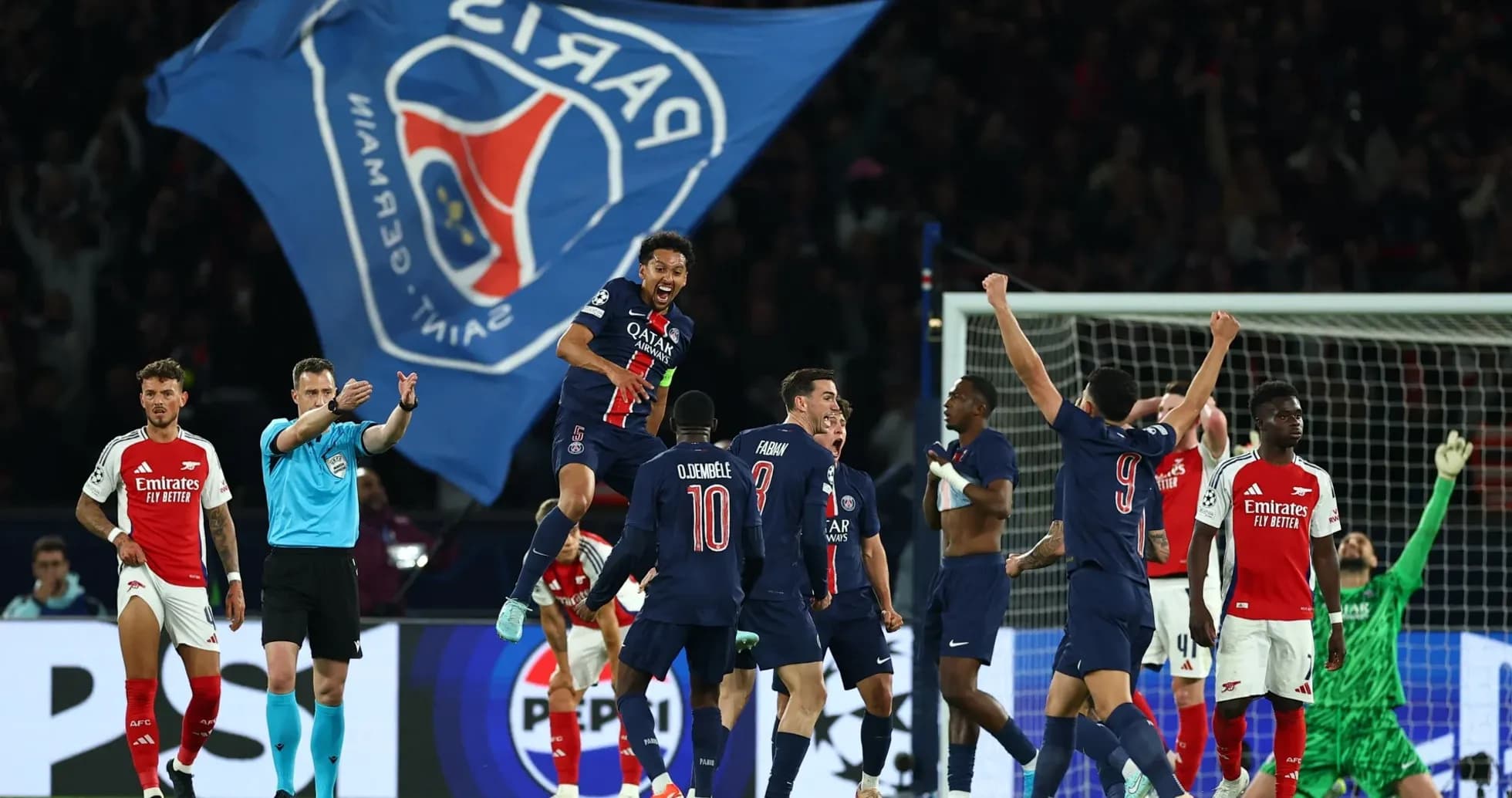
Recent meetings between these two clubs in the UEFA Champions League have swung like a pendulum. On 7 May 2025, Paris Saint Germain edged Arsenal 2-1 at Parc des Princes (UEFA Champions League, season 2024, May 2025), turning a tight semi-final into a night of Parisian celebration. Just days earlier, on 29 April 2025, Paris Saint Germain had also prevailed 1-0 at Emirates Stadium (UEFA Champions League, season 2024, April 2025), a disciplined away performance that silenced London. However, Arsenal had struck first in this modern chapter with a 2-0 home win at Emirates Stadium on 1 October 2024 (UEFA Champions League, season 2024, October 2024), a reminder that the English side can impose themselves when their structure clicks.
Tactical Preview
Paris Saint Germain are expected to lean again on their 4-3-3 structure, a system they have used 16 times in this Champions League campaign. That shape has underpinned an expansive attacking profile, with 44 goals in 16 matches across the broader sample (average 2.8 per game) and only 1 failure to score, even if they have conceded 22 in that span (average 1.4). In midfield, Vitinha is a central metronome from his listed midfielder role, with 1,553 completed passes at 93% accuracy and 23 key passes, plus 6 goals and 1 assist, making him a two-way threat (16 appearances). Out wide and up front, K. Kvaratskhelia’s 10 goals and 6 assists in 15 appearances, backed by 30 shots and 51 dribble attempts, give Paris Saint Germain a primary creative and scoring reference, while O. Dembélé (7 goals, 2 assists) and D. Doué (5 goals, 4 assists, 28 key passes) add unpredictable one‑v‑one danger. A. Hakimi, listed as a defender, contributes width and delivery from deep with 6 assists and 23 key passes, pushing Paris Saint Germain’s full-backs high in possession.
Defensively, Paris Saint Germain must manage discipline and transitions. I. Zabarnyi, a defender with 1 red card in 6 appearances, and L. Hernández, also with 1 red card in 10 appearances, highlight a back line that can be aggressive to a fault. With 11 goals conceded in 8 Champions League matches from the standings sample, they face the challenge of containing an Arsenal side that rarely wastes chances.
Arsenal’s tactical identity has been more flexible but equally clear. They have alternated between 4-3-3 (9 times) and 4-2-3-1 (5 times), systems that both support their blend of control and vertical threat. Across their wider Champions League statistics, they have 29 goals in 14 matches (average 2.1) and only 6 conceded (average 0.4), numbers that confirm their status as a compact, well-drilled unit. The defensive platform is anchored by players like Martín Zubimendi, listed as a midfielder but also appearing as a defensive presence with 14 tackles, 5 blocks, 10 interceptions and 4 yellow cards in 12 appearances, embodying Arsenal’s willingness to disrupt opposition rhythm in the middle third.
In attack, Arsenal spread responsibility. Gabriel Martinelli, listed as a midfielder, brings 6 goals and 2 assists in 13 appearances, supported by 17 successful dribbles and 16 key passes, giving Arsenal a direct runner who can exploit the spaces behind Paris Saint Germain’s advanced full-backs. With a defensive record of only 4 goals conceded in 8 matches in the standings sample and 9 clean sheets across the wider stats, Arsenal’s back line and midfield screen are set up to absorb pressure and spring forward, particularly from wide areas.
The tactical battle in Budapest should therefore pit Paris Saint Germain’s high-tempo, wing-driven 4-3-3 against Arsenal’s more balanced 4-3-3/4-2-3-1 hybrid. Paris Saint Germain will look to stretch the pitch, isolate their attackers and lean on the creativity of Vitinha and K. Kvaratskhelia, while Arsenal will aim to compress central spaces, trust their defensive structure (only 6 goals conceded in 14 broader matches) and punish any turnovers with runners like Gabriel Martinelli.
Statistical Snapshot
- Competition: UEFA Champions League, season 2025 — 30 May 2026.
- Venue: Puskas Arena, Budapest.
- Prediction: Win or draw — Double chance : draw or Arsenal.
- Win Probabilities: Home 10% / Draw 45% / Away 45%.
- Model: Paris Saint Germain 42.0% — Arsenal 58.2%.
Betting Verdict
The prediction model leans towards Arsenal avoiding defeat, with a double chance on draw or Arsenal supported by both form and defensive numbers (Arsenal WWWWW in standings form and only 4 goals conceded in 8 matches). Paris Saint Germain’s attacking power makes a home win plausible, a fact reflected in home odds hovering around 2.30–2.40 with several bookmakers, but Arsenal’s resilience and perfect points haul tilt the value towards the visitors at roughly 3.00–3.30. With recent head-to-heads showing both teams capable of winning tight Champions League ties, the safer analytical angle is to side with Arsenal on the double-chance market rather than committing to an outright away victory. In a final of fine margins, backing Arsenal’s consistency and defensive structure looks the most rational play.