Bayern München vs PSG: Tactical Analysis of 1–1 Champions League Draw
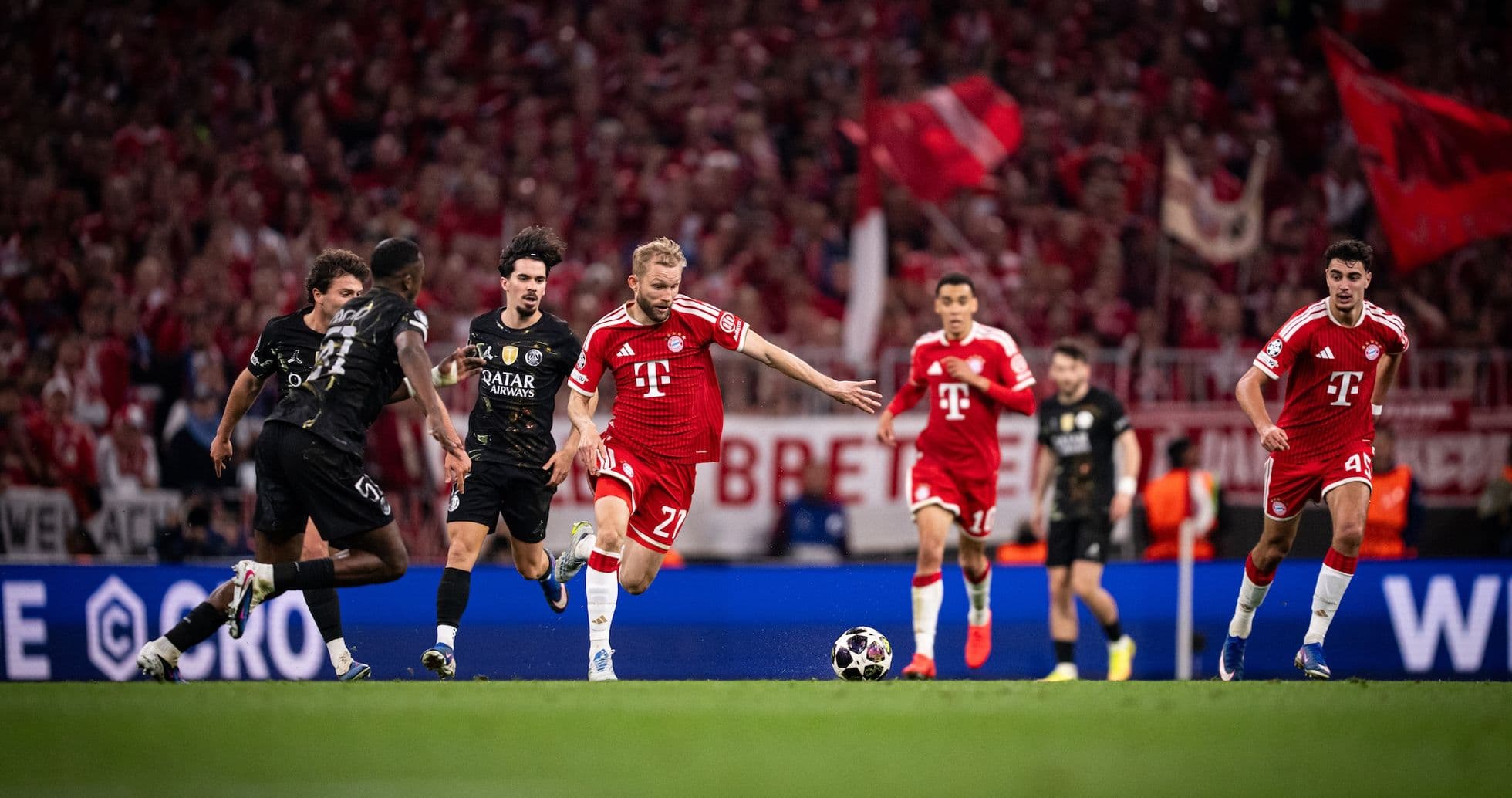
Bayern München and Paris Saint Germain produced a finely balanced 1–1 draw at Allianz Arena in this UEFA Champions League semi-final first leg, a contest defined by Bayern’s territorial dominance against PSG’s ruthless early transition. O. Dembele’s third-minute strike, assisted by K. Kvaratskhelia, gave PSG an ideal away platform, but H. Kane’s late equaliser, created by A. Davies on 90', restored parity and reflected the underlying expected goals: 1.4 for Bayern versus 1.03 for PSG. With 66% possession and a 570–301 passing advantage, Bayern controlled the ball, yet PSG’s compact 4-3-3 and counter-threat forced a tactical stalemate more than the scoreline alone suggests.
First Half
The scoring opened almost immediately: at 3', PSG exploited Bayern’s high line. K. Kvaratskhelia received on the left, attacked space and fed O. Dembele, whose finish capped a textbook transition. That early lead allowed PSG to retreat into a mid-to-low block and shape the game around counter-attacks.
Disciplinary control then became part of the tactical story. At 8', Nuno Mendes was booked for a foul, a direct consequence of PSG’s aggressive wide defending against Bayern’s right side. At 33', Jonathan Tah received a yellow card for argument, signalling Bayern’s rising frustration as PSG disrupted rhythm with compact central spacing and tactical fouls.
In first-half stoppage time, at 45+3', Khvicha Kvaratskhelia was cautioned for time wasting, underlining PSG’s intent to protect the 0–1 halftime scoreline (Bayern 0–1 PSG at 45'). After the break, the contest grew more heated. At 78', Luis Díaz was booked for argument, again tied to protests rather than a direct challenge. Later, at 86', Marquinhos received a yellow for a foul, reflecting the strain of repeated last-ditch interventions as Bayern increased pressure. Finally, at 90+7', Joshua Kimmich’s yellow for argument came deep into added time, emblematic of Bayern’s emotional edge as they chased a winner that never came.
Substitutions
Substitutions followed a clear pattern of tactical adjustment. At 65', B. Barcola (IN) came on for O. Dembele (OUT), with PSG swapping a direct one-versus-one winger for a fresher, vertical runner to maintain counter-threat. Bayern’s first change at 67' saw A. Davies (IN) come on for J. Stanisic (OUT), aggressively upgrading the left flank with pace and overlapping power. One minute later, at 68', Kim Min-Jae (IN) came on for J. Tah (OUT), a like-for-like central defensive change but also a reset after Tah’s earlier booking and visible agitation.
PSG doubled down on defensive reinforcement at 76': L. Hernandez (IN) came on for D. Doue (OUT), and L. Beraldo (IN) came on for F. Ruiz (OUT). Enrique Luis effectively shifted resources from attack and midfield creativity into back-line solidity, preparing to absorb a late Bayern surge. Bayern’s response was to add more attacking profiles: at 79', N. Jackson (IN) came on for J. Musiala (OUT), increasing penalty-box presence and depth runs; at 85', L. Karl (IN) came on for D. Upamecano (OUT), a bold move that tilted the structure further towards ball progression and late central pressure. PSG’s last change at 85' saw S. Mayulu (IN) come on for N. Mendes (OUT), maintaining defensive energy on the left after Mendes’ booking and heavy workload.
Tactical Overview
Bayern’s 4-2-3-1 under Vincent Kompany was built around high possession and territorial squeeze. With 66% of the ball and 570 passes at 87% accuracy (496 completed), they established long phases of circulation. The double pivot of Joshua Kimmich and A. Pavlovic anchored the structure: Kimmich stepping higher to connect with J. Musiala between the lines, Pavlovic providing the stabilising base to recycle and protect transitions.
The front four—M. Olise on the right, Musiala central, Luis Díaz left, and H. Kane as the nine—created layered occupation of the final third. Bayern’s 18 total shots (13 inside the box) show how often they managed to pin PSG deep. However, only 6 of those were on target, illustrating PSG’s effective last-line blocking (5 blocked shots) and compact penalty-area defence.
Tactically, Davies’ introduction for Stanisic was pivotal. Before 67', Bayern’s left side was more controlled than explosive. After Davies (shirt 19) entered, the left flank became a primary overload zone: Díaz drifting inside, Davies overlapping and Kane dropping to connect. The equaliser on 90' reflected this: Davies advanced high, delivered the decisive service, and Kane finished to bring Bayern level.
Defensively, Bayern’s high line and aggressive rest defence left space for PSG’s front three. Kvaratskhelia, starting from the left, repeatedly threatened in early transitions, as seen on the 3' goal. W. Zaire-Emery and Nuno Mendes had to manage Bayern’s right side under pressure, which contributed to Mendes’ early booking. Kim Min-Jae’s introduction added recovery pace and aerial presence, slightly reducing PSG’s ability to exploit the channels late on.
PSG’s 4-3-3 was structurally conservative after the early goal. With only 34% possession and 301 passes at 71% accuracy (213 completed), they accepted long spells without the ball. The midfield trio of F. Ruiz, Vitinha and J. Neves prioritised central compactness over pressing high, funnelling Bayern into wide areas where full-backs and wingers doubled up.
Despite less possession, PSG generated 15 shots, 8 from inside the box and 7 on target. This speaks to the clarity of their attacking plan: quick vertical releases to the front three, especially Kvaratskhelia and Dembele before his substitution. Later, Barcola and Mayulu provided fresh legs to sustain depth and pressing triggers on the flanks, while Hernandez and Beraldo added bodies to defend crosses and cutbacks.
In goal, M. Neuer made 6 saves for Bayern, compared to M. Safonov’s 5 for PSG. Neuer’s workload confirms PSG’s threat in isolated moments; his interventions helped keep Bayern within reach after the early setback. Safonov, facing 6 shots on target from a high-volume Bayern attack, matched Neuer in efficiency. The goals prevented metrics were symmetrical at 0.23 for both keepers, indicating that each slightly outperformed the xG of shots faced and that neither side was heavily bailed out by goalkeeping heroics alone.
Statistical Analysis
Statistically, Bayern’s xG of 1.4 against PSG’s 1.03 aligns closely with the 1–1 outcome. Bayern’s Overall Form in this match, viewed through possession control, passing accuracy and chance creation, was strong; yet their finishing under pressure limited the margin. Defensively, their index is more mixed: 11 fouls and multiple cards for argument point to moments of emotional leakage, while conceding 7 shots on target from only 34% possession highlights vulnerability in transition.
PSG’s Overall Form was defined by efficiency and discipline in a reactive game model. Offensively, turning 34% possession into 1.03 xG and an early away goal is a strong return. Defensively, their index shows resilience: 12 fouls, 3 yellows (Mendes for a foul, Kvaratskhelia for time wasting, Marquinhos for a foul), but crucially no red cards, and strong penalty-area protection limiting Bayern to one goal despite sustained pressure.
Across the tie, this first leg sets up a second match where Bayern’s structural dominance and depth on the flanks will again confront PSG’s compact block and transition sharpness. The data suggests a finely poised semi-final: Bayern marginally ahead on process, PSG having already proven they can punish any lapse in Bayern’s aggressive approach.