Arsenal Edges Atletico Madrid in UEFA Champions League Semi-Final
Arsenal edged a cagey UEFA Champions League semi-final first leg at Emirates Stadium, beating Atletico Madrid 1–0 in a match defined more by control and structure than volume of chances. Mikel Arteta’s 4-2-3-1 produced a narrow territorial advantage and a clear xG edge (1.58 to 0.53), while Diego Simeone’s 4-4-2 stayed compact but lacked sustained threat. Bukayo Saka’s 44' strike separated the sides, and with no scoring in the second half, the tie remains alive despite Arsenal’s statistical superiority in possession (54%) and shots (13–9). Both defences limited clear openings, forcing the game into a battle of pressing traps, rest defence, and set-piece control.
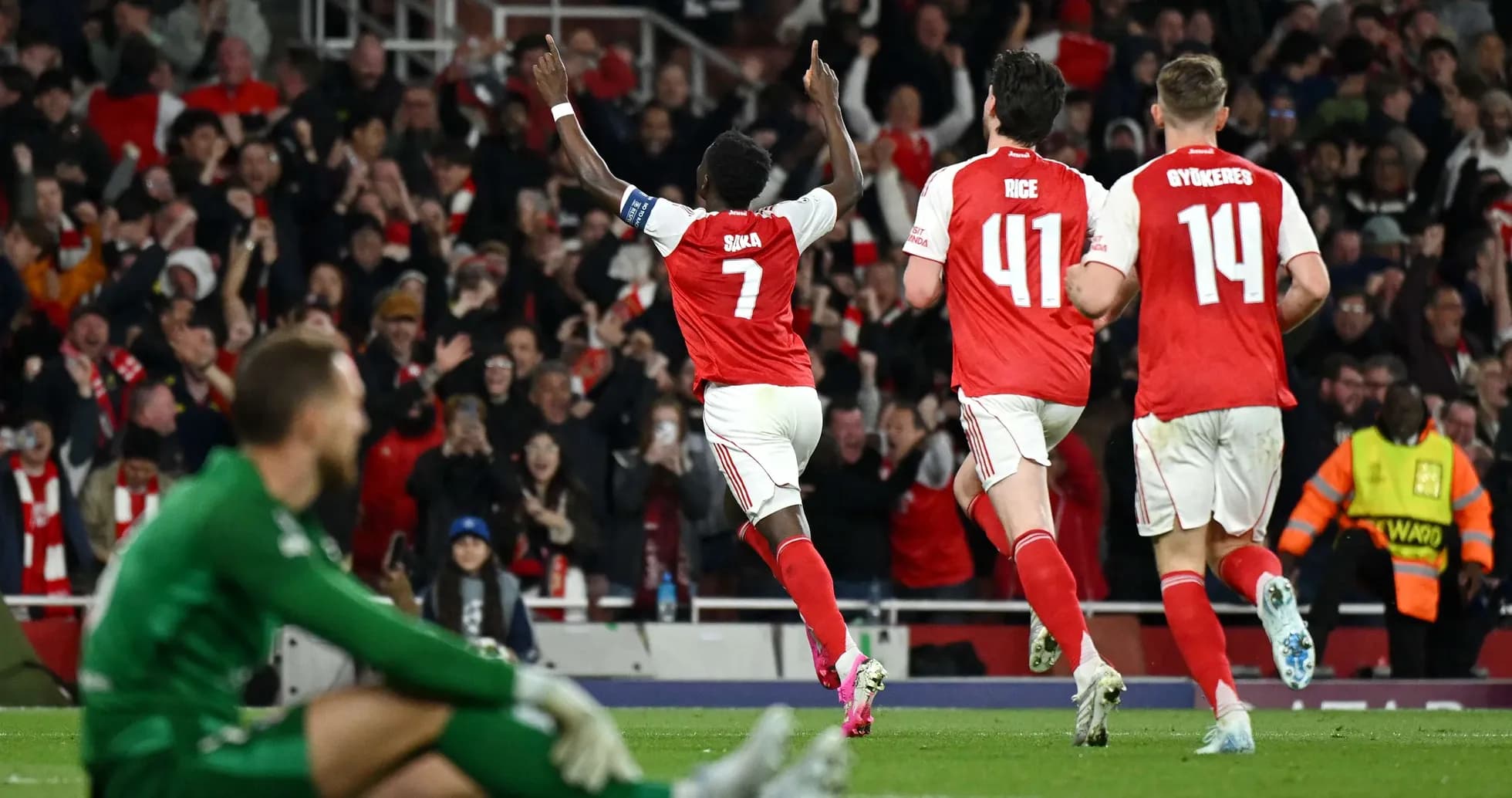
Arsenal’s only card arrived unusually before kick-off: Kepa Arrizabalaga was booked for time wasting at -5', a rare pre-match yellow that slightly constrained Arteta’s in-game goalkeeping options from the bench. The decisive moment came on 44', when B. Saka scored a normal goal for Arsenal, giving the hosts a 1–0 lead that reflected their incremental territorial pressure rather than any chaotic spell of chances. There is no VAR annotation, so the goal stood without delay.
Second Half
The second half was shaped heavily by substitution waves. At 57', Atletico made a triple change to re-energise their structure and add aerial and transitional threat: A. Sorloth (IN) came on for R. Le Normand (OUT), N. Molina (IN) came on for A. Lookman (OUT), and J. Cardoso (IN) came on for G. Simeone (OUT). This shifted Atletico away from a pure back-four balance towards a more aggressive, physically oriented approach, especially down the right.
Arsenal responded immediately at 58–59' to protect the lead and refresh pressing intensity. At 58', N. Madueke (IN) came on for B. Saka (OUT), and P. Hincapie (IN) came on for R. Calafiori (OUT), while at 59' M. Odegaard (IN) came on for E. Eze (OUT). These moves rebalanced the left side defensively and added control between the lines.
Atletico’s second wave at 66' further altered the attacking profile: A. Baena (IN) came on for A. Griezmann (OUT), and T. Almada (IN) came on for J. Alvarez (OUT), swapping one forward pair for a more creative, second-line threat. Arsenal’s final structural tweak came at 74', when M. Zubimendi (IN) came on for M. Lewis-Skelly (OUT), adding positional discipline in front of the back four. At 83', G. Martinelli (IN) came on for L. Trossard (OUT), giving Arsenal a direct outlet for late counters.
Atletico collected both in-game bookings. On 81', Marc Pubill received a yellow card for a foul, reflecting Atletico’s increased urgency and higher defensive line. On 90+5', Koke was booked for a foul, underlining the late-game tension as Atletico chased an equaliser. The halftime score was 1–0 to Arsenal, exactly as established by Saka’s 44' goal, and it remained unchanged to full time.
Tactical Overview
Tactically, Arsenal’s 4-2-3-1 was built on a stable double pivot of D. Rice and M. Lewis-Skelly, with the back four of B. White, W. Saliba, Gabriel, and R. Calafiori (later P. Hincapie) providing a high starting line and strong rest defence against Atletico’s counters. With 54% possession and 444 passes at 85% accuracy, Arsenal prioritised circulation and positional occupation over constant penetration. The shot profile (13 total, 6 inside the box, xG 1.58) indicates a moderate but controlled attacking output, consistent with a side that reached good zones but rarely overloaded Oblak’s goal.
In the final third, Saka and Trossard worked as narrow wingers, often stepping into half-spaces while E. Eze operated as the central creator behind V. Gyökeres. Saka’s goal just before the break was the clearest payoff of that structure: Arsenal had only 2 shots on goal, but one of them produced the decisive strike, reflecting a “quality over volume” dynamic rather than relentless bombardment.
Defensively, Arsenal’s back line was well protected. Atletico generated 9 shots, 7 of them inside the box, yet their xG remained at a modest 0.53, suggesting that many of those efforts were from pressured or poor angles rather than clear one-on-ones. Arsenal’s goalkeeper D. Raya was required for 2 saves, matching Atletico’s 2 shots on target and aligning with the low-xG profile. The “goals prevented” metric for Arsenal’s goalkeeping (0.02) suggests Raya performed roughly to expectation: he did what was required, without a need for spectacular interventions.
Atletico's Strategy
Atletico’s 4-4-2, with J. Oblak behind a line of M. Pubill, R. Le Normand, D. Hancko, and M. Ruggeri, aimed to compress central spaces and funnel Arsenal wide. In possession, Koke and M. Llorente were key to first-phase progression, while A. Lookman and G. Simeone provided width and work rate. The front pairing of A. Griezmann and J. Alvarez was designed to alternate dropping between lines and attacking depth.
However, Atletico’s 46% possession and 384 passes at 83% accuracy show they were more reactive than dominant. Their 2 shots on target and xG of 0.53 underline that, despite 7 box shots, they struggled to convert structural possession into truly dangerous opportunities. Oblak faced only 2 shots on goal and made 1 save; with “goals prevented” also at 0.02, he conceded in line with the quality of Saka’s chance and had limited scope to influence the scoreline further.
The substitution of R. Le Normand for A. Sorloth at 57' was especially telling tactically: Simeone effectively traded a centre-back for an additional forward, pushing Atletico into a more aggressive, risk-accepting shape. The introduction of N. Molina, J. Cardoso, A. Baena, and T. Almada layered more attacking profiles but also stretched Atletico’s defensive compactness. Arsenal’s response—Hincapie for Calafiori, Zubimendi for Lewis-Skelly—was clearly aimed at re-securing the left channel and screening central spaces against those new threats.
Statistical Summary
Statistically, Arsenal’s narrow win is strongly supported by the underlying numbers. They led on possession (54% to 46%), total shots (13 to 9), corners (5 to 2), and xG (1.58 to 0.53). Atletico committed more fouls (13 to 10) and received more yellow cards (2 to 1), consistent with a chasing side increasingly forced into tactical and late-game fouls. Both teams’ goalkeepers posted identical goals-prevented figures (0.02), suggesting neither side was bailed out by extraordinary shot-stopping; instead, the match was decided by Arsenal’s slightly sharper attacking execution and superior territorial control.
In disciplinary terms, the card ledger is clear: Kepa Arrizabalaga’s pre-match yellow for time wasting at -5', Marc Pubill’s yellow for a foul at 81', and Koke’s yellow for a foul at 90+5'. No reds, no VAR interventions recorded, and no penalties. The data paints a picture of a semi-final first leg where Arsenal’s structure and measured risk-taking produced a deserved but fragile 1–0 advantage, leaving Atletico needing more creativity and cutting edge in the return leg without the safety net of an away goal on the night.