Ivory Coast Secures 1-0 Victory Over Ecuador in Group E Clash
Ivory Coast 1-0 Ecuador at Lincoln Financial Field, a second straight group win for Emerse Fae’s side, moves them to 6 points in Group E and firmly into the Round of 32 picture, while Ecuador remain on 0 points and see their qualification hopes severely damaged after a second narrow defeat.
Match Report
The match opened in cagey fashion, with Ivory Coast content to let Ecuador have more of the ball and look for direct transitions through Elye Wahi and Nicolas Pépé. The first major incident arrived on 28', when Seko Fofana (Ivory Coast) was booked for roughing, a sign of the physical edge Ivory Coast were prepared to bring in midfield. Ten minutes later, on 38', Franck Kessié (Ivory Coast) collected a yellow card for tripping as he broke up an Ecuadorian counter, and just two minutes after that, on 40', Guéla Doué (Ivory Coast) was also shown a yellow card for tripping after being isolated one‑v‑one on the flank. Despite the sequence of cautions, Ecuador could not turn their territorial advantage into shots on target, and the first half ended goalless.
Both coaches moved early in the second half. On 56', Ecuador made the first change as Nilson Angulo replaced Alan Minda (Ecuador), adding fresh legs to the front line. Simultaneously, Ivory Coast reshaped their attack: Ange-Yoan Bonny replaced Elye Wahi (Ivory Coast) to provide a more physical reference point up front, while Amad Diallo replaced Bazoumana Touré (Ivory Coast) to inject creativity from the right side.
Ecuador continued to adjust on 62', with Ángelo Preciado replacing John Yeboah (Ecuador) to offer more thrust from wing-back, and Jackson Porozo replacing Alan Franco (Ecuador) to bolster the back line and defend Ivory Coast’s growing threat on the break. However, Porozo quickly found himself in the book on 73', receiving a yellow card for holding (Ecuador) after being beaten for pace and dragging back his man to stop a transition.
Ivory Coast then refreshed their right flank and midfield again on 77'. Christ Inao Oulaï replaced Nicolas Pépé (Ivory Coast), giving Fae more defensive security out wide, while Ibrahim Sangaré replaced Seko Fofana (Ivory Coast) to add fresh energy and ball-winning in the middle as Ecuador pushed higher. Ecuador’s response came at the same minute, 77', when Kevin Rodriguez replaced Enner Valencia (Ecuador), a like-for-like change up front aimed at adding movement in behind a tiring Ivorian defence.
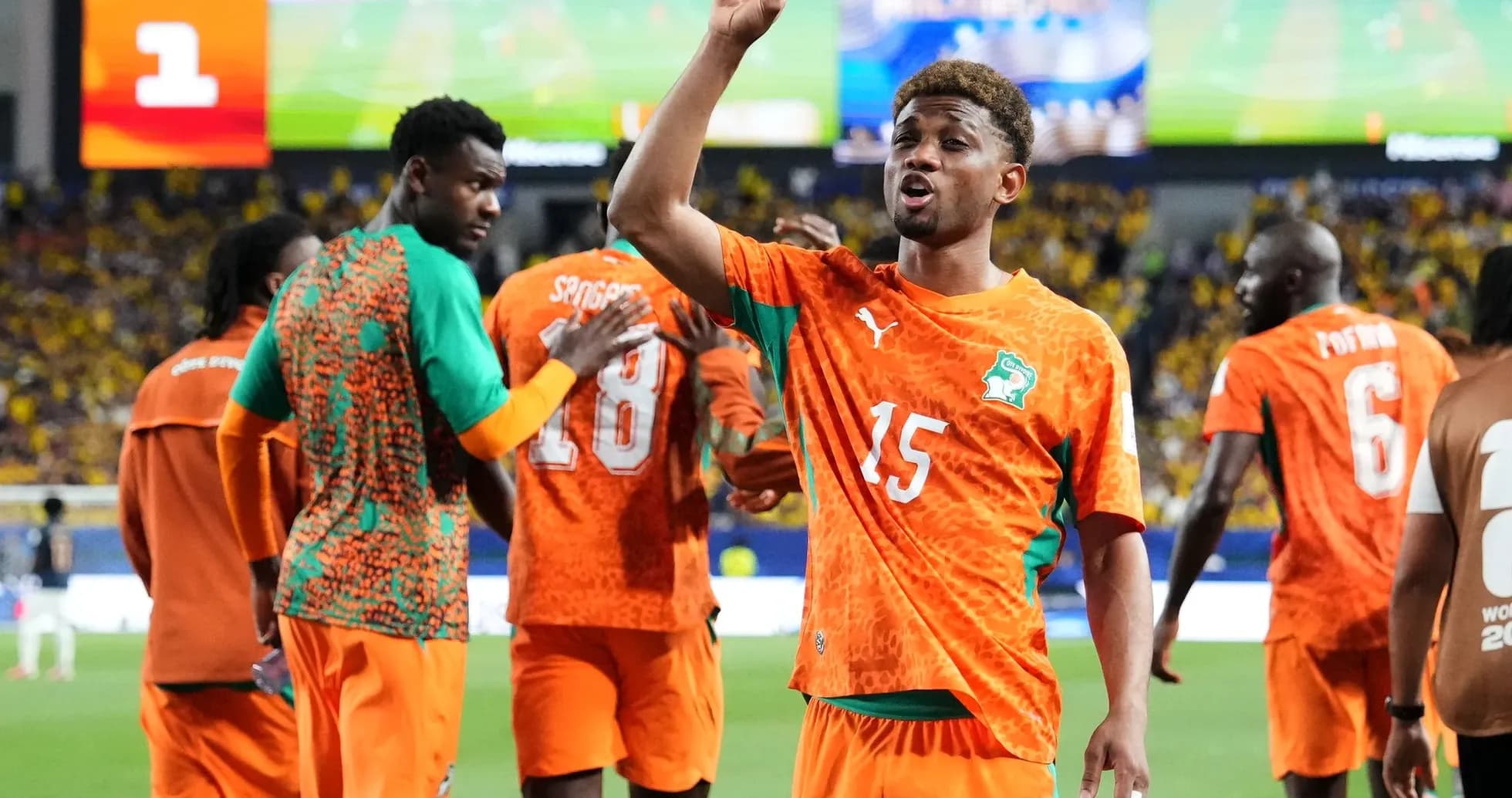
With the match drifting towards a stalemate, Ivory Coast made a final defensive tweak on 89', as Odilon Kossounou replaced Guéla Doué (Ivory Coast), switching to a more conservative back line to manage the closing stages. That platform proved decisive. On 90', Ivory Coast finally broke through: Ivory Coast goal — Amad Diallo (assisted by Wilfried Singo). Diallo timed his run into the box to meet Singo’s delivery and finished clinically from close range, giving Ivory Coast a 1-0 lead that reflected their superior chance quality despite having less of the ball. Ecuador had no time to respond, and the match finished 1-0 to Ivory Coast.
Fixture Statistics & Tactical Audit
- xG: Ivory Coast 0.73 vs 0.54 Ecuador
- Possession: Ivory Coast 45% vs 55% Ecuador
- Shots on Target: Ivory Coast 1 vs 0 Ecuador
- Goalkeeper Saves: Ivory Coast 0 vs 1 Ecuador
- Blocked Shots: Ivory Coast 3 vs 0 Ecuador
The numbers point to a tight contest in which Ivory Coast traded possession for shot quality. Ecuador’s greater share of the ball (55% possession) did not translate into a single effort on target, underlining how effectively Ivory Coast protected central areas and forced shots from distance. Ivory Coast’s lone shot on target produced the winning goal, aligning closely with their xG of 0.73 and suggesting a measured, low-volume attacking plan that prioritised high-quality situations. Ecuador’s 0.54 xG from six attempts reflects half-chances rather than clear openings, and with Yahia Fofana untested in goal, the 1-0 scoreline is broadly fair: Ivory Coast created the game’s clearest chance and converted it, while Ecuador’s sterile control never broke a compact Ivorian block.
Standings Update & Seasonal Impact
For Ivory Coast, this second consecutive 1-0 victory lifts them from 3 to 6 points, with their goals for tally moving from 1 to 2 and goals against remaining at 0, improving their goal difference from +1 to +2. Already occupying a Round of 32 qualifying position before kick-off, they now consolidate that status in Group E and can approach the final group match with a margin for error and a strong defensive platform. Ecuador, by contrast, stay on 0 points after back-to-back 0-1 defeats, with goals for stuck at 0 and goals against rising from 1 to 2, worsening their goal difference from -1 to -2. Sitting third in Group E, they now face an uphill battle to progress, likely needing a win and help elsewhere to escape the group.
Lineups & Personnel
Ivory Coast Starting XI
- GK: Yahia Fofana
- DF: Guéla Doué, Wilfried Singo, Emmanuel Agbadou, Ghislain Konan
- MF: Yan Diomande, Franck Kessié, Seko Fofana, Bazoumana Touré
- FW: Nicolas Pépé, Elye Wahi
Ecuador Starting XI
- GK: Hernán Galíndez
- DF: Alan Franco, Joel Ordóñez, Willian Pacho
- MF: John Yeboah, Moisés Caicedo, Pedro Vite, Piero Hincapié
- FW: Gonzalo Plata, Enner Valencia, Alan Minda
Post-Match Verdict
Ivory Coast delivered a controlled, pragmatic performance built on defensive solidity and selective attacking. Their back line and midfield screen limited Ecuador to 0 shots on target (from 6 total attempts), and although they conceded more possession (45% vs 55%), they were compact without the ball and aggressive in duels, reflected in their higher foul and card count (3 yellow cards). Offensively, they were clinical in terms of chance conversion (1 goal from 1 shot on target) and marginally ahead on xG (0.73 vs 0.54), with the decisive moment coming from a well-timed overlap and cut-back from Wilfried Singo finished by Amad Diallo. Ecuador’s display, by contrast, was characterized by sterile dominance: more passes and a better completion rate (87% vs Ivory Coast’s 83%) but no end product, with 0 shots on target and 0 blocked shots in their favour. Their inability to penetrate centrally or create high-quality chances meant that, despite territorial control, they rarely threatened the Ivorian goal. In a finely balanced group-stage contest, Ivory Coast’s defensive organisation and efficiency in the final third justified the narrow 1-0 margin.