Australia’s Tactical Masterclass Against Türkiye in World Cup
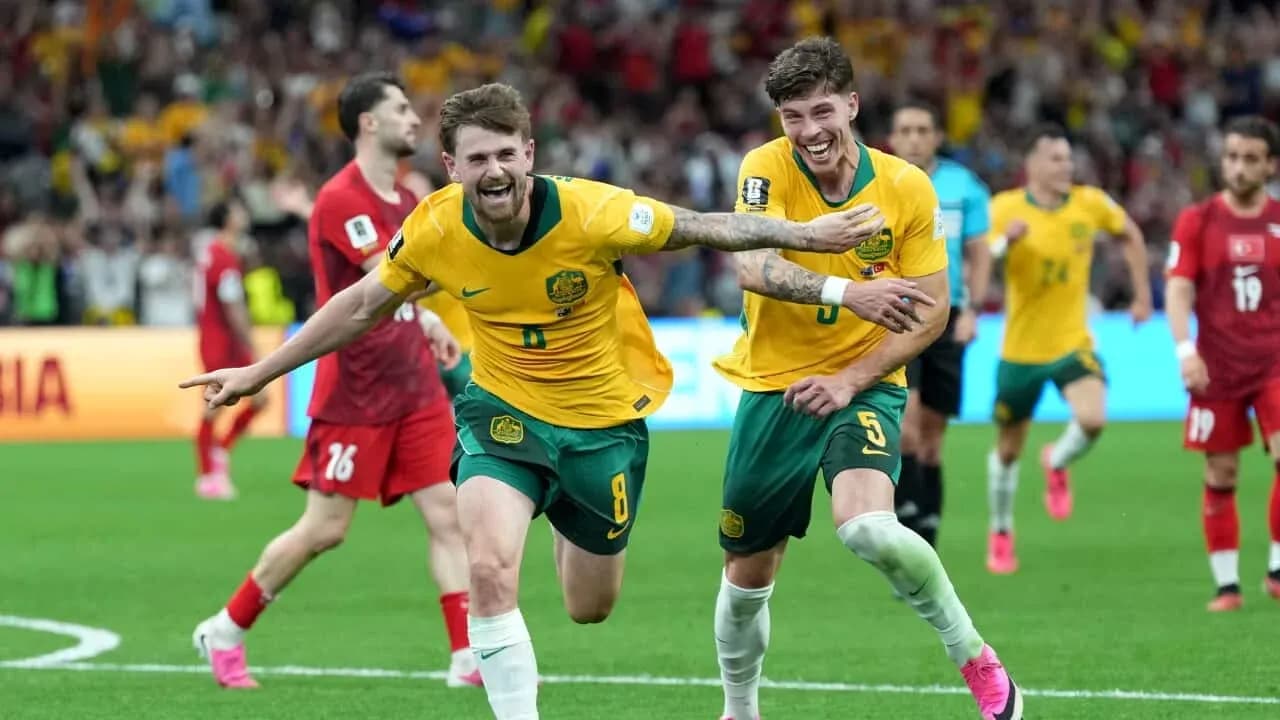
Australia’s 2-0 win over Türkiye at BC Place was a classic low-block, transition-driven World Cup group-stage performance, executed with remarkable defensive resilience and efficiency in both boxes. Despite having only 28% possession and facing 30 shots, Australia controlled the game’s key spaces and moments, turning a structurally reactive game plan into a tactically convincing result.
Australia lined up in a 5-4-1 under Tony Popovic, with a flat back five and a hard-working midfield band of four behind lone forward Mohamed Touré. The shape was clearly designed to compress the central corridor: Harry Souttar, Alessandro Circati and Cameron Burgess formed a narrow trio, with Jordan Bos and Jacob Italiano tucked in as conservative wing-backs rather than expansive outlets. In front of them, Connor Metcalfe and Aiden O’Neill screened aggressively, while Paul Okon-Engstler and Nestory Irankunda provided the dual function of touchline outlets and auxiliary full-backs.
Türkiye, in contrast, used a 4-2-3-1 that tilted into a high-possession 2-3-5 in attack. Vincenzo Montella’s side built patiently through Abdülkerim Bardakcı and Merih Demiral, with Ferdi Kadıoğlu and Zeki Çelik pushing high and wide. İsmail Yüksek and Hakan Çalhanoğlu formed the double pivot, while Arda Güler, Orkun Kökçü and Barış Alper Yılmaz rotated behind central forward Kerem Aktürkoğlu. The structure yielded territorial dominance and 72% of the ball, but ran repeatedly into Australia’s compact block.
First Half
The first decisive tactical pattern came on the opener at 27'. Australia had spent much of the early phase in a mid-to-low block, but the moment they recovered possession, their first thought was verticality. A quick transition through midfield found Okon-Engstler between Türkiye’s lines, and his ability to receive under pressure and turn was crucial. His forward pass released Nestory Irankunda into the half-space, exploiting the gap left by Türkiye’s advanced full-backs. Irankunda’s finish crowned a textbook counter-attacking move: regain, secure the first pass, then attack the exposed channel behind the Turkish back line.
From there, Australia doubled down on their defensive scheme. The back five rarely broke line; instead, the wide midfielders dropped to form a situational back six when the ball went to the flanks. This forced Türkiye into a high volume of shots from less-than-ideal positions: 30 total efforts, but with many either blocked (12) or taken from distance (16 outside the box). The visitors’ xG of 1.33 underlines that they created some decent looks, but Australia consistently got bodies between ball and goal, funnelling play away from the most dangerous central zones.
Goalkeeping Performance
In goal, Patrick Beach (Australia) was decisive. He faced 8 shots on target and made 8 saves, a perfect shot-stopping line that underpinned the clean sheet. Several of those saves came from Türkiye’s attempts to shoot through crowds after recycled possession around the box. Beach’s handling and positioning were secure, and his goals prevented figure of -0.95 suggests the model rated some of those chances as very saveable, but in tactical terms his reliability allowed Australia to sit deep without panic. At the other end, Uğurcan Çakır (Türkiye) had a quieter but less efficient evening: he faced 4 shots on target and made 2 saves, conceding twice in situations where his defence had been structurally stretched in transition.
Second Half
The second goal at 75' reflected Australia’s growing comfort exploiting Türkiye’s desperation. By then, Montella had already introduced Kenan Yıldız for Barış Alper Yılmaz at 46', pushing even more creative presence between the lines. Later changes — Yunus Akgün for Orkun Kökçü at 62', Salih Özcan for İsmail Yüksek at 81', Mert Müldür for Zeki Çelik also at 81', and Deniz Gül for Kerem Aktürkoğlu at 85' — tilted the side further towards attack, but also stripped away some of the original structure in rest defence.
Popovic’s substitutions were more conservative and game-state driven. Nishan Velupillay (IN) came on for Nestory Irankunda (OUT) at 61', maintaining pace on the break while freshening the defensive work on the flank. Tete Yengi (IN) replaced Mohamed Touré (OUT) at 74', adding a more physical reference point to hold long clearances. Jason Geria (IN) for Jacob Italiano (OUT) at 74' and Aziz Behich (IN) for Jordan Bos (OUT) at 84' both reinforced the defensive line with experienced, defensively-minded full-backs. Jackson Irvine (IN) for Paul Okon-Engstler (OUT) at 84' brought fresh legs and aerial presence into midfield for the closing phase.
Australia’s second goal arrived just as those adjustments were bedding in. With Türkiye committing numbers forward, space opened between their midfield and back line. Australia again broke quickly, and although the move is recorded without an assist, the key was Metcalfe’s late run from midfield. Arriving from deep, he exploited Türkiye’s poor tracking of second-line runners, finishing to make it 2-0 and effectively kill the contest.
Discipline and Statistics
Discipline played a minor but telling role. Türkiye received the only card of the match: at 86', Yunus Akgün (Türkiye) — Roughing. It encapsulated the visitors’ growing frustration at being unable to translate dominance of the ball into scoreboard pressure against a well-drilled block.
Statistically, the contrast in styles is stark. Türkiye completed 707 passes, 638 accurate (90%), using the ball with control but often in front of Australia’s block. Australia, by contrast, made 270 passes, 202 accurate (75%), prioritising direct progression over circulation. The xG split — 0.77 for Australia, 1.33 for Türkiye — suggests a game where the side with less possession maximised the value of their few attacks, while the dominant team struggled to turn volume into truly high-quality chances.
Overall, Australia’s defensive index in this match was outstanding: 12 blocks, deep compactness, and a flawless shot-stopping display from Patrick Beach (Australia) combined to neutralise a technically superior opponent. In tactical terms, this was a clinic in how a 5-4-1 low block, married to sharp transitional play and well-timed substitutions, can overturn possession and shot-count disparities at World Cup level.