Sweden Dominates Tunisia 5-1: Tactical Superiority Unveiled
Sweden’s 5-1 win over Tunisia at Estadio BBVA was built on a clear tactical superiority rather than territorial dominance. Despite having slightly less of the ball (49% to Tunisia’s 51%), Sweden’s 3-1-4-2 under Graham Potter consistently created higher-quality situations, reflected in a clear xG edge of 1.36 to 0.28 and a decisive 7-2 advantage in shots on goal. Tunisia’s 5-3-2, set up by Sabri Lamouchi, never converted their possession into penetration, ending with only six total shots and just two efforts from inside the box.
Structurally, Sweden’s back three of Gustaf Lagerbielke, Isak Hien and Victor Lindelöf gave them a stable platform to build. In front of them, Jesper Karlström as the single pivot in the “1” of the 3-1-4-2 was crucial: he allowed the outside centre-backs to spread and the wing-oriented midfielders to push high without losing central control. With nine of Sweden’s 13 shots coming from inside the box, the system repeatedly succeeded in flooding the penalty area with Viktor Gyökeres, Alexander Isak and late-arriving midfielders.
First Half
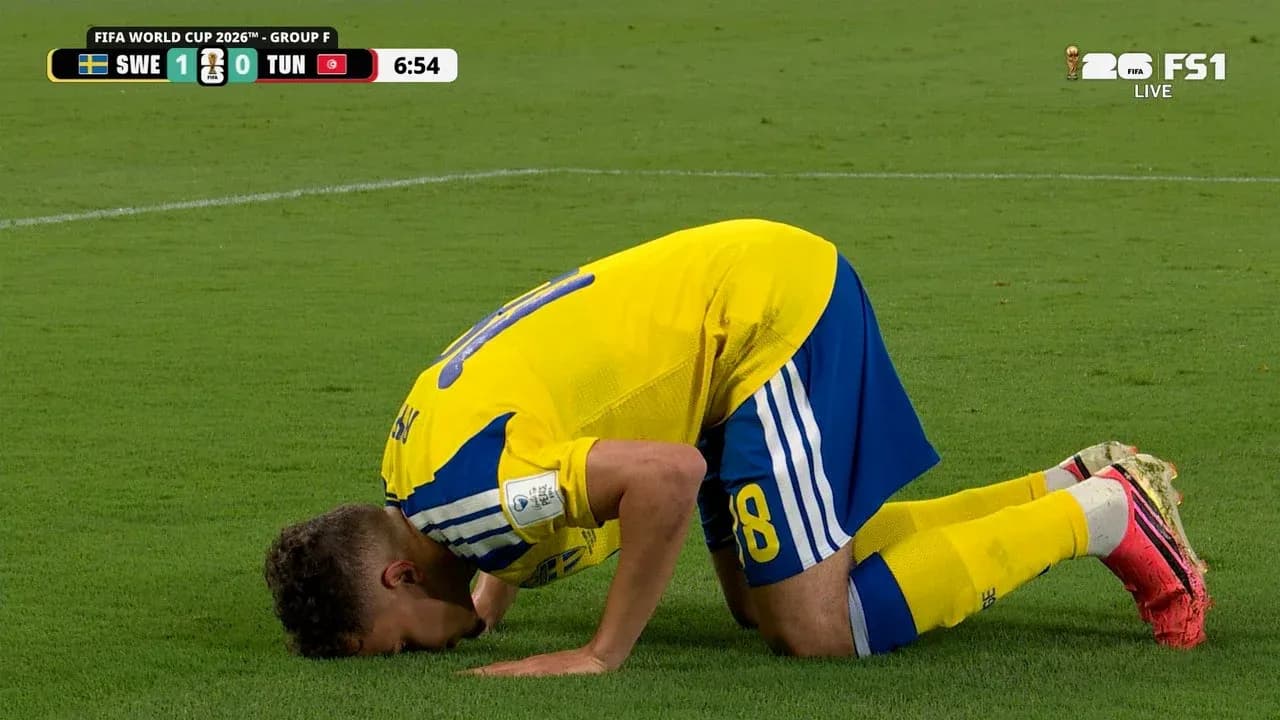
The first half showcased how Sweden manipulated Tunisia’s back five. Gabriel Gudmundsson and Alexander Bernhardsson operated high and wide from midfield, pinning Ali Abdi and Yan Valery, while Benjamin Nygren and Yasin Ayari attacked the half-spaces. The 7th-minute opener from Yasin Ayari came from precisely this structure: Sweden created a central overload, drew Tunisia’s midfield narrow, and Ayari arrived from midfield into a pocket between the lines to finish. Tunisia’s three-man midfield of Rani Khedira, Ellyes Skhiri and Hannibal Mejbri struggled to track these movements while also protecting the back line.
Sweden’s second goal on 30 minutes, finished by Alexander Isak and assisted by Viktor Gyökeres, underlined the complementary nature of the front two. Gyökeres frequently dropped or drifted wide to receive, dragging one of Tunisia’s centre-backs out of the line, while Isak attacked the vacated central channel. That pattern was visible again after the break when Gyökeres scored Sweden’s third at 59 minutes from an Isak assist, this time exploiting Tunisia’s increasingly stretched defensive shape as they tried to step higher.
Tunisia's Attacking Plan
Tunisia’s own attacking plan was far more limited. In theory, the 5-3-2 could have given them strong counter-attacking lanes via Elias Saad and Anis Ben Slimane, but they produced only two shots inside the box and six in total. Their lone goal, scored by Omar Rekik from a Hannibal Mejbri assist at 43 minutes, came more from a rare set or broken-play situation than from sustained positional threat. Sweden’s compact back three and Karlström’s screening meant Tunisia’s forwards were often isolated, forced into lower-quality efforts from outside the box (four of their six shots).
Second Half Adjustments
In the second half, Lamouchi attempted to inject energy and attacking variety with a wave of substitutions around the 72nd minute. Sebastian Tounekti (IN) came on for Elias Saad (OUT), Mohamed Belhadj Mahmoud (IN) for Yan Valery (OUT), and Elias Achouri (IN) for Ellyes Skhiri (OUT), signaling a shift towards more offensive profiles in wide and central areas. Later, Ismael Gharbi (IN) replaced Rani Khedira (OUT) on 83 minutes and Firas Chaouat (IN) came on for Anis Ben Slimane (OUT) on 84 minutes, pushing Tunisia into a more aggressive, forward-heavy configuration.
However, these changes opened even more space for Sweden to exploit. Potter’s response at 65 minutes — Elliot Stroud (IN) for Gabriel Gudmundsson (OUT) and Lucas Bergvall (IN) for Benjamin Nygren (OUT) — refreshed the energy in the wide and half-space channels without compromising the structure. At 84 minutes, a further adjustment saw Mattias Svanberg (IN) come on for Jesper Karlström (OUT), with Karlström’s exit immediately followed by Svanberg scoring Sweden’s fourth, assisted by Isak. That sequence highlighted Sweden’s depth: the replacement for the single pivot stepped higher and contributed directly in the final third against a tiring and increasingly disorganized Tunisian block.
The late-game management continued in that vein. Anthony Elanga (IN) replaced Alexander Isak (OUT) at 90 minutes, and Daniel Svensson (IN) came on for Alexander Bernhardsson (OUT) at 90+1, keeping Sweden’s front line fresh for transitions. Lucas Bergvall then capped his substitute impact by assisting Yasin Ayari’s second goal at 90+6, a move that again came from Sweden attacking space vacated by Tunisia’s over-committed shape.
Goalkeeping Performance
In goal, Kristoffer Nordfeldt (Sweden) was largely protected by the structure in front of him and was required to make only 1 save, consistent with Tunisia’s meagre 2 shots on target. On the other side, Abdelmouhib Chamakh (Tunisia) also registered 1 save despite facing 7 shots on goal; Sweden’s finishing efficiency and the quality of their chances meant that most of their on-target efforts beat him, aligning with Tunisia’s goals prevented figure of -2.99, which indicates that, statistically, they conceded significantly more than an average keeper would be expected to.
Discipline and control further underlined Sweden’s tactical superiority. They committed 10 fouls to Tunisia’s 8 but managed the game without a single booking, while Tunisia picked up the only card: at 54 minutes, Rani Khedira (Tunisia) received a yellow card for “Tripping”. That isolated disciplinary incident reflected Tunisia’s growing frustration as they chased the ball and arrived late into challenges, unable to disrupt Sweden’s rhythm without conceding fouls.
Statistical Overview
Statistically, Tunisia’s 51% possession and near-identical passing volume — 364 total passes to Sweden’s 353 — with the same 79% pass accuracy for both sides (Sweden: 353 passes, 280 accurate; Tunisia: 364 passes, 288 accurate) suggest a balanced contest on the ball. But the underlying metrics tell a different story: Sweden generated more than double the total shots (13 to 6), more than triple the shots on goal (7 to 2), and three times as many efforts from inside the box (9 to 2). Sweden also forced more blocked shots (3 to 1), a sign of sustained pressure in and around the Tunisian area.
The xG gap (1.36 for Sweden, 0.28 for Tunisia) and the identical negative goals prevented values for both sides (-2.99) frame this as a match where Sweden’s attacking patterns and individual quality massively outstripped the expected baseline, while Tunisia neither created nor denied enough. Potter’s 3-1-4-2 maximized Sweden’s strengths between the lines and in the box, whereas Lamouchi’s 5-3-2 never solved the problem of defending wide overloads and dynamic forwards. The 5-1 scoreline, with Sweden leading 2-1 at half-time and accelerating after the break, was the logical tactical outcome of those structural and executional differences.