Ivory Coast’s Tactical Mastery in 1-0 Win Against Ecuador
Ivory Coast’s 1-0 win over Ecuador at Lincoln Financial Field was a controlled, structurally coherent 4-4-2 performance that gradually tilted the game in their favour despite a slight possession deficit. With both sides mirroring shapes, the match became a test of spacing, pressing triggers and the timing of substitutions rather than pure ball dominance. Ivory Coast used their double pivot and full-backs to create superiorities in wide channels, while Ecuador tried to lean on central ball circulation and set-piece pressure, but lacked incision in the final third.
Ivory Coast’s Formation
Ivory Coast’s 4-4-2 was built on a clear spine. Yahia Fofana in goal sat behind a back four of Guéla Doué and Ghislain Konan as full-backs, with Wilfried Singo and Emmanuel Agbadou as the central pairing. In midfield, Bazoumana Touré and Yan Diomande occupied the flanks, with Franck Kessié and Seko Fofana as the central duo, supporting a front two of Nicolas Pépé and Elye Wahi. The structure prioritised vertical lanes: Singo and Agbadou held a relatively high line, compressing the pitch so Kessié and Seko Fofana could step into duels without leaving large gaps behind.
Ecuador’s Approach
Ecuador mirrored the 4-4-2 but with a more possession-oriented flavour. Hernán Galíndez started in goal, protected by a back four of Piero Hincapié, Willian Pacho, Joel Ordóñez and Alan Franco. The midfield line of Alan Minda, Pedro Vite, Moisés Caicedo and John Yeboah sat behind a forward pair of Enner Valencia and Gonzalo Plata. With 52% of the ball and 492 passes (419 accurate, 85%), Ecuador tried to progress methodically through Caicedo and Vite, using Minda and Yeboah to stretch Ivory Coast laterally.
Chance Creation
Despite having less possession (48%), Ivory Coast were the more purposeful side in terms of chance creation. Their 15 total shots to Ecuador’s 12, and a 4–1 advantage in shots on goal, reflected a clearer attacking plan. The Ivorian wide midfielders narrowed in possession, allowing Konan and Doué to advance and create 2v1s on the flanks. This helped Ivory Coast generate eight shots inside the box compared to Ecuador’s five, aligning with a higher xG of 1.52 versus Ecuador’s 1.01.
Defensive Strategies
Defensively, Ivory Coast’s approach was aggressive in midfield, and the disciplinary profile underlined that. Seko Fofana’s yellow card at 28' for “Roughing”, followed by Franck Kessié’s at 38' and Guéla Doué’s at 40' (both for “Tripping”), showed how often the Ivorian double pivot and right-back stepped into contact to break Ecuador’s rhythm. The risk was a potential overload of cautions on the right side, but it also repeatedly disrupted Caicedo’s attempts to dictate tempo.
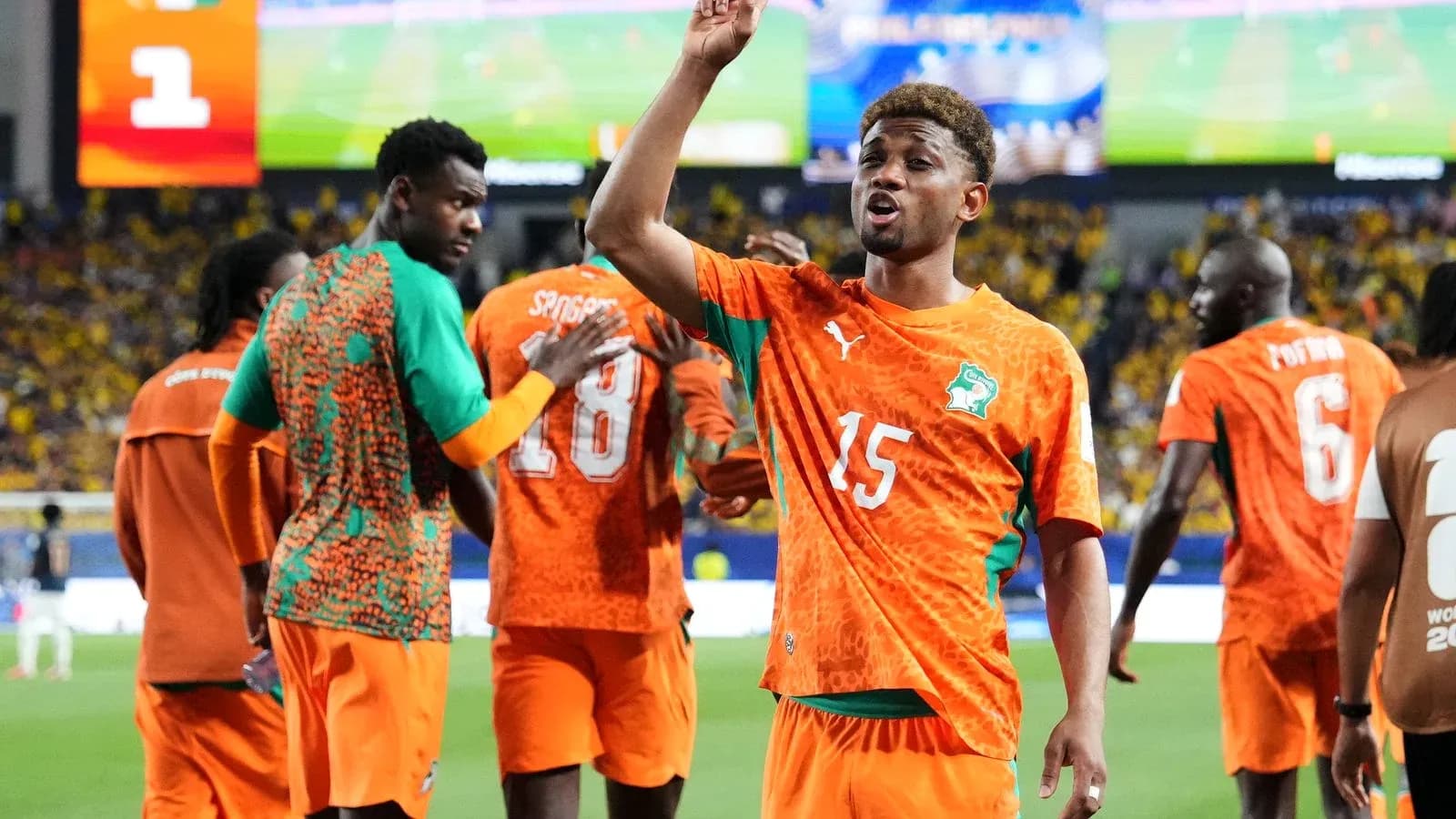
Ecuador’s back line coped reasonably well with direct pressure, restricting Ivory Coast to three blocked shots, matching their own blocked count. However, their main issue lay in the timing of pressure on the ball. Ivory Coast’s central midfielders often received between the lines with too much space, enabling switches of play and diagonal balls into the channels for Pépé and Wahi. The late winner, scored by substitute Amad Diallo from a Wilfried Singo assist at 90', was the logical endpoint of sustained territorial pressure rather than a random moment.
Substitution Patterns
The substitution pattern was decisive. At 56', Sebastian Beccacece tried to refresh Ecuador’s left flank and attack by bringing on Nilson Angulo (IN) for Alan Minda (OUT). Simultaneously, Emerse Fae injected pace and creativity: Ange-Yoan Bonny (IN) came on for Elye Wahi (OUT), and Amad Diallo (IN) replaced Bazoumana Touré (OUT). This shifted Ivory Coast’s front line from a more classic striker pair to a more fluid, wide-oriented attack, with Diallo drifting inside from the right and Bonny offering depth.
Ecuador’s double change at 62' — Ángelo Preciado (IN) for John Yeboah (OUT) and Jackson Porozo (IN) for Alan Franco (OUT) — rebalanced their right side but had mixed tactical consequences. Porozo’s introduction eventually led to their only booking at 73' for “Holding”, symptomatic of Ecuador’s growing difficulty in dealing with Ivorian runners between full-back and centre-back. At 77', Fae doubled down on midfield control, with Christ Inao Oulaï (IN) for Nicolas Pépé (OUT) and Ibrahim Sangaré (IN) for Seko Fofana (OUT). This gave Ivory Coast fresher legs and more defensive stability in the centre while keeping Diallo as the main creative outlet.
Ecuador’s response, Kevin Rodriguez (IN) for Enner Valencia (OUT) at 77', aimed to add mobility up front, but by then Ivory Coast had tightened their block. Odilon Kossounou (IN) for Guéla Doué (OUT) at 89' further solidified the Ivorian back line just before the decisive moment. The 90' goal, with Singo stepping forward from centre-back to provide the assist for Diallo, encapsulated Ivory Coast’s tactical evolution: a centre-back encouraged to carry the ball into midfield once Sangaré and Kessié had locked down central spaces.
Goalkeeping Performance
In goal, Yahia Fofana (Ivory Coast) had a relatively quiet but focused evening, facing just one shot on target and making one save. His calm distribution supported Ivory Coast’s 470 passes (397 accurate, 84%), ensuring they could recycle possession and keep Ecuador under pressure after turnovers. Hernán Galíndez (Ecuador) was busier, making three saves and repeatedly called into action as Ivory Coast’s attack sharpened in the second half. Both goalkeepers’ goals prevented figures (0.22 each) underline that neither side allowed a high volume of clear-cut chances, but Ivory Coast’s superior xG edge and shot profile ultimately told.
Match Statistics
Statistically, the match reads as a controlled, marginal superiority rather than domination. Ecuador’s 52% possession and slight edge in passing volume did not translate into attacking efficiency; their 12 shots yielded only one on target and an xG of 1.01. Ivory Coast, with 15 shots, four on goal and more efforts inside the box, better converted their structural advantages into genuine threat. The foul count (10 for Ivory Coast, 13 for Ecuador) and corner tally (3–5) confirm a competitive, territorially contested game, but the sharper tactical adjustments — especially the introduction and positioning of Amad Diallo and the late forward surges of Wilfried Singo — justified Ivory Coast’s narrow 1-0 win in this World Cup group-stage opener.