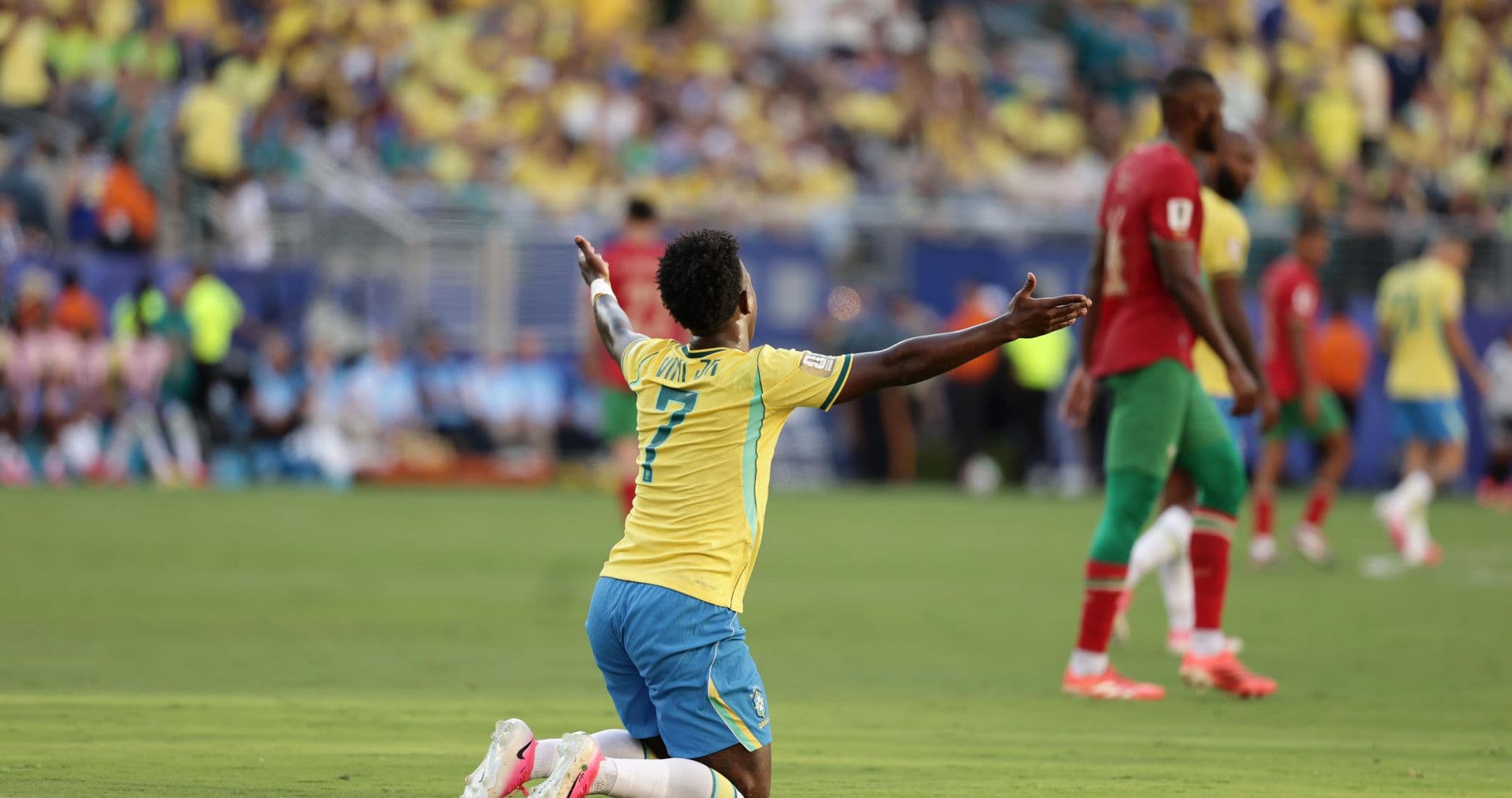
Brazil and Morocco: Tactical Insights from the World Cup Draw
The MetLife Stadium offered a neutral canvas, but Brazil and Morocco painted it with sharply defined identities. Following this result, the World Cup Group C table shows both sides with 1 point, one goal scored and one conceded overall, and a goal difference of 0. It is an opening draw that feels less like a stalemate and more like an opening chapter: two teams revealing their blueprints in a 1-1 that confirmed expectations as much as it raised new tactical questions.
I. The Big Picture – Two 4-2-3-1s, two different temperaments
Both coaches arrived committed to a 4-2-3-1, but the shapes behaved very differently.
Carlo Ancelotti’s Brazil was built around controlled aggression. At home in this tournament so far, they have played 1 match, scoring 1.0 goals on average at home and conceding 1.0 at home. The numbers are modest, but the structure is not. Alisson anchored a back four of Douglas Santos, Gabriel, Marquinhos and Ibanez, with Casemiro and Bruno Guimarães as the double pivot. Ahead of them, Lucas Paquetá, Raphinha and Vinícius Júnior floated behind the lone forward I. Thiago.
Morocco, under Mohamed Ouahbi, mirrored the system but with a different soul: compact, relational, and technically slick between the lines. Bono stood behind a back four of N. Mazraoui, C. Riad, I. Diop and A. Hakimi. The double pivot of N. El Aynaoui and A. Bouaddi sat beneath a creative band of B. El Khannouss, A. Ounahi and Brahim Díaz, supporting the central presence of I. Saibari.
Overall, both teams have identical statistical profiles in the competition so far: 1 match played in total, 0 wins, 1 draw, 0 losses, 1 goal for and 1 against. Yet the way they arrive at that symmetry could not be more stylistically distinct.
II. Tactical Voids and Discipline – Brazil’s edge of chaos
There were no listed injuries or suspensions, but the disciplinary record hints at where the tactical voids may emerge for Brazil. Heading into this game, Brazil’s yellow-card distribution was heavily concentrated: 2 yellow cards in the 31-45 minute window, accounting for 100.00% of their cautions. That spike is not random; it reflects a team that, when the first-half tempo accelerates, can be dragged into duels they do not fully control.
Ibanez and Casemiro embody that edge. Both played only 45 minutes, each collecting a yellow card. Casemiro’s role as enforcer is clear: 18 passes at 94% accuracy, 1 tackle, 1 block and 1 interception, plus 9 duels contested and 1 foul committed. He walks the line between protection and peril. Ibanez, too, was drawn into the chaos: 8 duels, 2 fouls committed, 1 interception, and that caution which now frames his tournament narrative.
Morocco, by contrast, emerge from this fixture with a clean disciplinary slate in the season statistics: no yellow or red cards recorded in any time range. It underlines the image of a side that defends more by structure than by last-ditch challenges. That calm may become a competitive advantage as the group tightens.
III. Key Matchups – Hunter vs Shield, and the Engine Room
Hunter vs Shield
In pure attacking terms, the headliners are already clear. For Brazil, Vinícius Júnior is not just a winger; he is their offensive compass. He has 1 goal in total this World Cup, from 1 shot on target, with 30 passes at 86% accuracy and 2 key passes. He engaged in 14 duels, drawing 2 fouls and committing 3, a sign of how central he is to the game’s friction points. Every Brazilian surge seems to bend toward him.
Morocco’s own cutting edge is I. Saibari. He has 1 goal in total, from 1 shot on target, with 24 passes at 91% accuracy. He won 3 of 7 duels, completed his only dribble attempt, and drew 1 foul while committing 2. His role is subtly different from Vinícius Júnior’s: more of a hybrid between target and connector, but just as decisive in the box.
Defensively, neither side has yet shown a dominant shield in the raw numbers: both have conceded 1.0 goals on average overall. But the Brazilian back line, with Marquinhos and Gabriel, is more about anticipation and control, while Morocco’s unit leans on the athleticism and one‑v‑one quality of Hakimi and Mazraoui. The duel between Vinícius Júnior and Hakimi on that flank is likely to define Brazil’s attacking ceiling in the games to come: a hunter of space versus one of the world’s most aggressive full-backs.
The Engine Room
If the goalscorers are the headline, the story is written in midfield. Bruno Guimarães and Casemiro form Brazil’s engine room. Bruno’s numbers in this World Cup are quietly authoritative: 38 passes with 89% accuracy, 1 key pass, 2 tackles, and 1 blocked shot. He is the metronome and the first line of counter-press. Casemiro, with his blend of 1 tackle, 1 block and 1 interception in just 45 minutes, is the destroyer.
They are mirrored by Morocco’s double pivot of N. El Aynaoui and A. Bouaddi, with Brahim Díaz drifting inside from the line of three. Brahim is already one of the tournament’s most influential creators: 1 assist, 19 passes at 100% accuracy, 2 key passes, 3 dribble attempts with 1 success, and 3 fouls drawn. He is the conduit between Morocco’s structured block and their sudden vertical bursts.
The “Engine Room” battle, then, is Bruno Guimarães’ capacity to control tempo against Brahim Díaz’s ability to break it. If Bruno can impose his passing rhythm, Brazil’s 4-2-3-1 becomes a platform for sustained pressure. If Brahim keeps finding pockets between the lines, Morocco’s transitions will continue to carve open even well‑set defences.
IV. Statistical Prognosis – Margins, xG logic, and future tilt
The raw numbers so far suggest two evenly matched sides: both with 1 draw in total, 1.0 goals scored on average overall and 1.0 conceded overall, no clean sheets, and no penalties taken or missed. In xG terms, this typically maps to balanced contests decided by moments rather than sustained dominance.
Yet beneath that symmetry, the trends diverge. Brazil’s card spike in the 31-45 minute band hints at emotional volatility just before half-time. Morocco’s spotless disciplinary record points to a team that trusts its structure and distances. Brazil’s offensive ceiling feels higher, driven by Vinícius Júnior’s individual gravity and the creative spine of Bruno Guimarães and Lucas Paquetá. Morocco’s threat is more distributed, with Brahim Díaz and I. Saibari already combining for 1 assist and 1 goal.
Following this result, the tactical preview for their remaining group games is clear: Brazil must refine control without blunting their edge, managing Casemiro’s and Ibanez’s aggression while feeding Vinícius Júnior in advanced zones. Morocco must double down on their collective discipline and sharpen the final-third efficiency around Saibari and Brahim.
On this evidence, xG‑style logic would lean toward Brazil creating the slightly better chances over the course of the group, but Morocco converting a higher proportion through precision and structure. The draw at MetLife Stadium feels like the right opening balance—yet also a warning to the rest of Group C: both Brazil and Morocco have only just started to reveal the full complexity of their tactical identities.