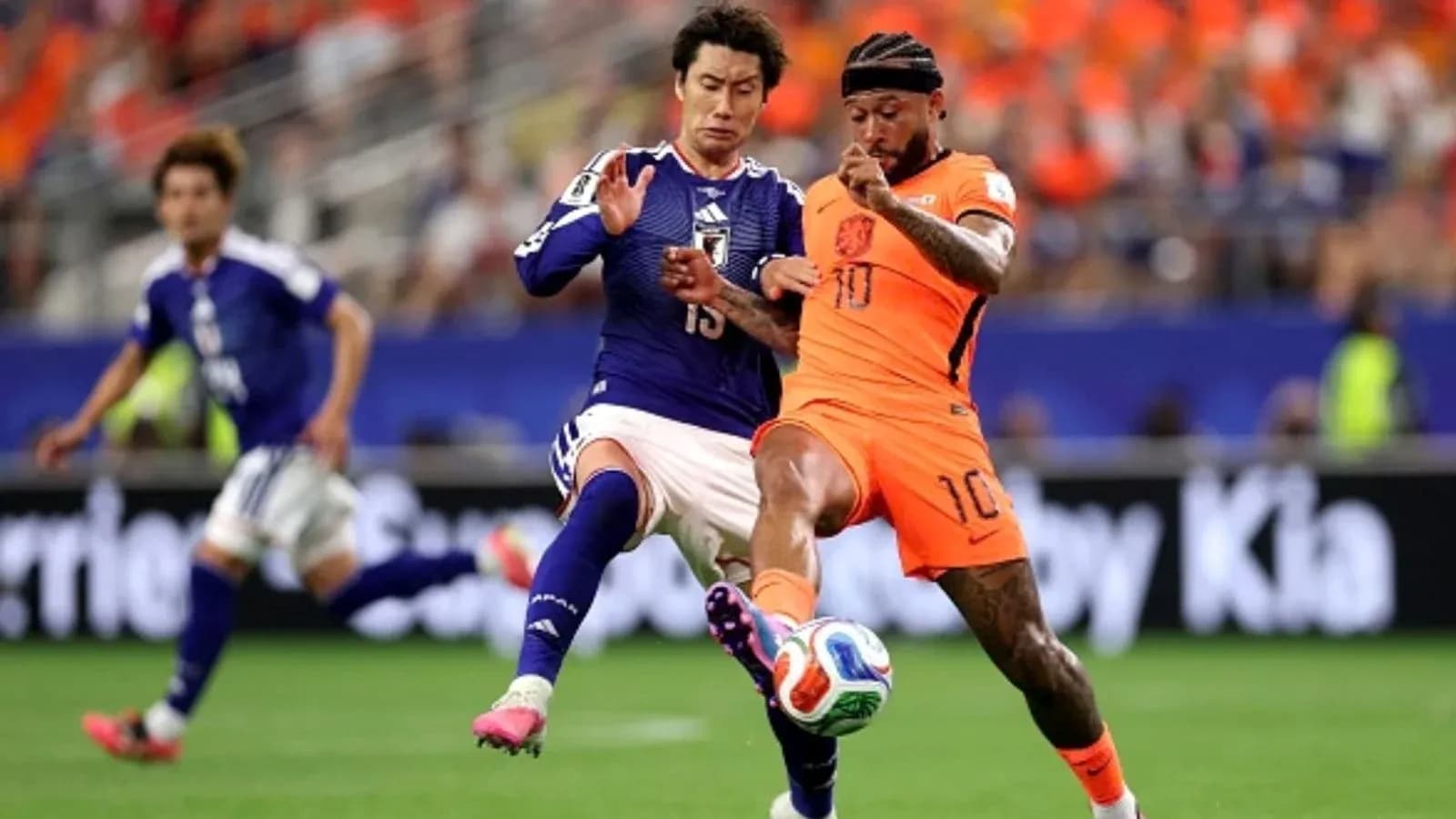
Netherlands vs Japan: Tactical Insights from a 2-2 World Cup Draw
Netherlands and Japan opened their World Cup Group Stage campaign at AT&T Stadium with a tactically rich 2-2 draw that showcased contrasting structures and a late Japanese response to Dutch territorial control. Ronald Koeman’s Netherlands imposed themselves with a 4-3-3 that produced 60% possession, 525 passes and a clear grip on territory, but Hajime Moriyasu’s 3-4-2-1 for Japan was built to absorb, counter and stay alive long enough to exploit late spaces. The data underlines a balanced shot profile (10-10 in Total Shots, 6-3 Shots on Goal to the Netherlands) and near-parity in xG (0.79 vs 0.54), reflecting a match where the Netherlands dictated the flow but never fully killed the contest.
Scoring Sequence
In terms of scoring sequence, the Netherlands twice moved in front only to be pegged back. The deadlock was broken on 51 minutes when Virgil van Dijk (Netherlands) scored a Normal Goal, assisted by Ryan Gravenberch, capitalizing on sustained Dutch pressure after the interval. Japan responded quickly: at 57', Keito Nakamura (Japan) equalized with a Normal Goal, assisted by Takefusa Kubo, punishing a rare lapse in Dutch control. The game’s disciplinary tone was set on 61' when Crysencio Summerville (Netherlands) received a Yellow Card — Foul, moments before becoming decisive in attack. On 64', Summerville (Netherlands) restored the lead with a Normal Goal, again assisted by Gravenberch, a sequence that highlighted the Dutch right side as a primary attacking lane.
Koeman then reshaped his side with a triple substitution on 70', while Moriyasu refreshed his attacking and wing-back lines between 66' and 75', gradually tilting the dynamic. The second Dutch booking came at 83': Memphis Depay (Netherlands) was shown a Yellow Card — Foul, reflecting increased Japanese pressure and more frequent transition defending. Japan’s persistence was rewarded on 89', when Daichi Kamada (Japan) struck a Normal Goal, assisted by Koki Ogawa, to make it 2-2. In added time at 90+1', Micky van de Ven (Netherlands) received a Yellow Card — Professional foul, a late intervention to break up a dangerous situation as Japan chased a dramatic turnaround. Final card tally: Netherlands 3, Japan 0, Total 3.
Team Structures
Structurally, the Netherlands’ 4-3-3 was built on a high technical base in midfield and aggressive full-back positioning. Frenkie de Jong, Ryan Gravenberch and Tijjani Reijnders formed a central trio that enabled controlled circulation and vertical access. The passing data is emphatic: 525 Total passes with 464 accurate at 88% shows a side comfortable progressing through the thirds rather than going direct. With 10 Shots inside the box out of 10 Total Shots, the Dutch attack was almost entirely focused on engineered penalty-area entries rather than speculative efforts from range, supported by 5 Corner Kicks that sustained pressure.
Gravenberch was pivotal as the advanced connector, directly assisting both Dutch goals and repeatedly finding half-spaces where he could slip runners in. On the right, Denzel Dumfries and Summerville stretched Japan’s back three, creating 1v1 and 2v1 situations against Hiroki Itō and the near-side midfielder. The fact that Summerville both scored and drew a Yellow Card for a Foul encapsulates his dual role as high-tempo dribbler and first presser when possession was lost.
Defensively, the Netherlands were relatively clean (7 Fouls) but relied heavily on their structure rather than last-ditch interventions. With only 1 Blocked Shot recorded and 1 Goalkeeper Save, the Dutch back line generally kept Japan at arm’s length, forcing them into less optimal shooting positions despite conceding 10 Total Shots. Bart Verbruggen (Netherlands) made 1 save, and with goals prevented at 0.62, the model suggests he slightly outperformed the quality of chances faced, even if his workload was modest in volume.
Japan’s 3-4-2-1 was designed to live without the ball: 40% Ball Possession, 342 Total passes with 287 accurate (84%) shows a side comfortable ceding territory but efficient when they did string moves together. The wing-backs and wide midfielders were key. Keito Nakamura and Ritsu Doan started as the wide midfielders in the line of four, with Kubo and Daizen Maeda operating higher as forwards around Ayase Ueda. Japan’s 6 Shots inside the box and 4 Shots outside the box indicate a more mixed shot profile than the Netherlands, balancing counters that reached the area with opportunistic efforts from distance.
Moriyasu’s substitutions were tactically coherent. Junya Ito’s introduction for Maeda at 66' added direct running in behind as Dutch legs tired. The triple change at 75'—Koki Ogawa for Kubo, Takehiro Tomiyasu for Doan, and Yukinari Sugawara for Tsuyoshi Watanabe—reshaped the back line and front structure, giving Japan fresher wide outlets and more presence in the box. Ogawa’s late assist for Kamada’s 89' equalizer was the clearest payoff of this adjustment, as Japan exploited slightly looser Dutch spacing between midfield and defence.
Zion Suzuki (Japan) was busier than his opposite number, making 4 Goalkeeper Saves. With goals prevented at 0.62, his performance aligned closely with the underlying chance quality, and his interventions were crucial in keeping Japan within one goal long enough to mount the late comeback. Japan’s discipline—0 Yellow Cards, 0 Reds despite 7 Fouls—helped them maintain aggression without undermining their compactness with suspensions or late sendings-off.
Statistical Overview
Statistically, the match reads as a controlled Dutch performance undermined by their inability to convert territorial and possession superiority into a decisive margin. The Netherlands’ 6 Shots on Goal from 10 Total Shots and xG of 0.79 suggest they generated reasonably efficient but not overwhelming chances; Japan’s 3 Shots on Goal from 10 Total Shots and xG of 0.54 confirm that their threat was more sporadic but ultimately just as decisive on the scoreboard. Both sides recorded only 1 Blocked Shot, underlining that most attempts reached the target or missed cleanly rather than being smothered by defensive lines.
From a broader lens, Netherlands’ high pass volume and accuracy, combined with three Yellow Cards, point to a possession-dominant side occasionally exposed in transition and forced into tactical fouls, especially late. Japan’s lower volume but efficient passing, plus a clean disciplinary record, reflects a compact, reactive game plan that was executed with clarity. The 2-2 draw, in the context of these numbers, feels like a meeting of a structured protagonist and a resilient counter-puncher, with neither able to fully bend the game’s probabilities to their will.