Germany Dominates Curaçao 7-1: Tactical Breakdown
Germany’s 7-1 demolition of Curaçao at NRG Stadium was a structural mismatch built on control between the lines and relentless occupation of the penalty area. Julian Nagelsmann’s 4-2-3-1 pinned Dick Advocaat’s 4-3-1-2 deep, with Germany turning 65% possession, 27 total shots and 22 efforts inside the box into a scoreline that actually exceeded their already hefty 3.91 xG. Curaçao’s 0.4 xG and eight total shots captured how sporadic their threat was despite a few bright moments in transition.
Germany’s positional play was clear from the opening minutes. The back four of Joshua Kimmich, Jonathan Tah, Nico Schlotterbeck and Nathaniel Brown spread very wide, with Aleksandar Pavlović and Felix Nmecha forming a double pivot that constantly received under minimal pressure. With Curaçao’s front two, Jürgen Locadia and Sontje Hansen, staying narrow, Germany could progress easily through Kimmich and Brown on the flanks, forcing the away side’s midfield three to shuttle laterally and opening pockets for Jamal Musiala and Florian Wirtz.
In the attacking band, Wirtz and Leroy Sané held high and relatively wide starting positions, while Musiala drifted freely in the half-spaces. This created a 2-3-5 shape in possession: full-backs advanced, the double pivot stayed as a rest-defense platform, and the front four plus Kai Havertz flooded the last line. The first goal at 6' encapsulated the pattern: Germany broke Curaçao’s compactness through central combination, and Nmecha arrived from deep to finish from a Wirtz pass — the classic late midfield run enabled by a pinned back line.
Curaçao’s 4-3-1-2 out of possession became a narrow 4-3-3 press only in short bursts. Livano Comenencia, Juninho Bacuna and Leandro Bacuna tried to step onto Germany’s pivots, but once that first line was bypassed, the back four were repeatedly left in wide 1v2s. Their equaliser on 21' through Comenencia came from one of the rare moments they could push higher: a transition where Germany’s full-backs were advanced and the double pivot briefly disconnected from the centre-backs.
However, Germany’s territorial dominance grew as the half progressed. Eight blocked shots and 22 efforts inside the box show how often they forced Curaçao into emergency defending. Schlotterbeck’s 38' goal, assisted by Brown, underlined the set-piece and second-phase threat: centre-backs were allowed to attack the box with little resistance once the initial line was broken. The 45+5' penalty converted by Havertz effectively killed the contest before half-time, with Germany already 3-1 up and Curaçao’s compact block stretched mentally and physically.
Manuel Neuer (Germany) had a largely supervisory role, facing only two shots on goal and making one save. Germany’s defensive structure — 18 fouls but no cards recorded — was based more on early counter-pressing than last-ditch interventions. When they lost the ball, the nearest three or four players immediately collapsed on the carrier, with Pavlović and Nmecha central in this behaviour. That limited Curaçao’s ability to exploit the space behind Germany’s advanced full-backs.
Eloy Room (Curaçao), by contrast, was under siege. Germany produced 12 shots on goal, and Room made four saves, but the negative goals prevented figure (-2.47) underlines that he conceded significantly more than the quality of chances would normally suggest. Part of this was the volume and clarity of Germany’s finishing positions: cut-backs to the penalty spot, free headers from deep crosses, and repeated 1v1 or 2v1 situations in the inner channels.
Nagelsmann’s in-game management accentuated Germany’s superiority rather than simply protecting the lead. At 64', Deniz Undav (IN) came on for Musiala (OUT), shifting Havertz’s reference points and adding a more penalty-box oriented second striker profile from the left half-space. On Curaçao’s side, Jeremy Antonisse (IN) replaced Hansen (OUT) at 46', and later Jearl Margaritha (IN) came on for Locadia (OUT) at 64', attempts by Advocaat to add fresh legs up front, but without altering the underlying structural issues in midfield.
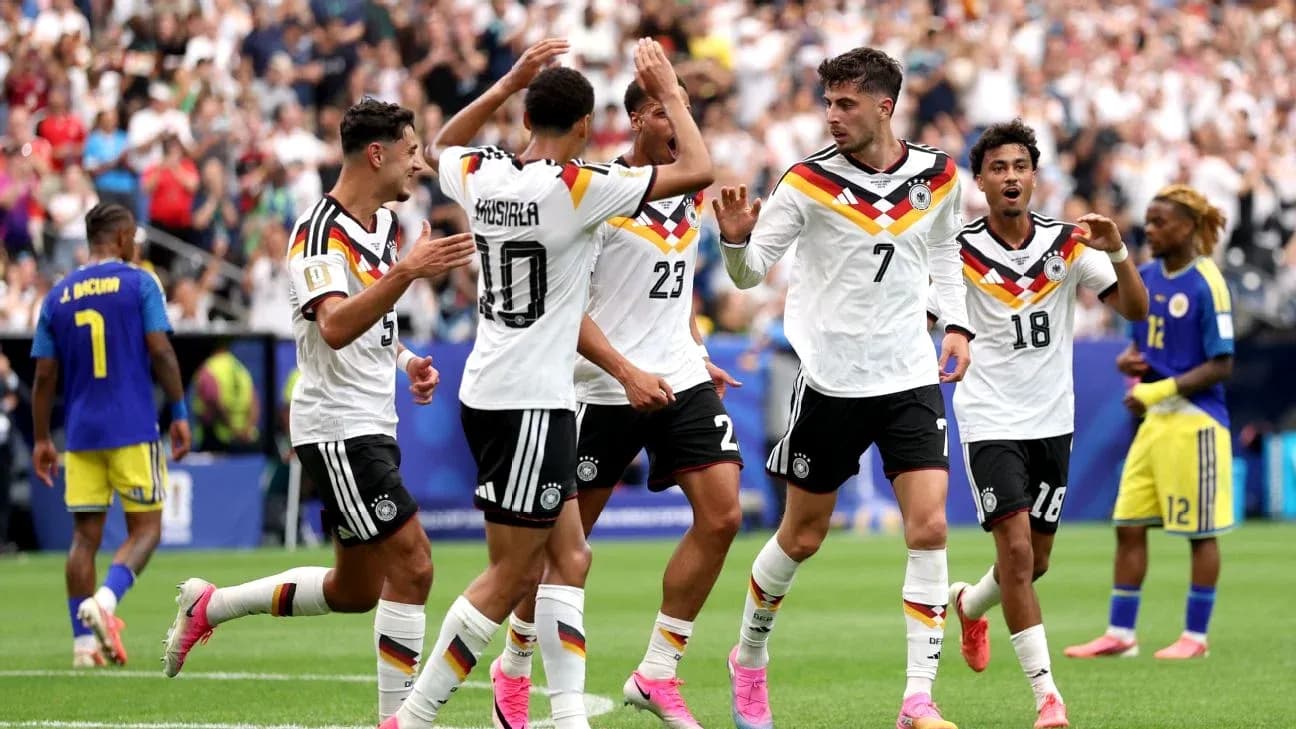
Germany’s fourth goal at 47', scored by Musiala from a Kimmich assist, was a direct consequence of their wing overloads: Kimmich advanced from right-back into the half-space, received under no pressure and threaded into Musiala attacking the inside-right channel. Brown’s 68' strike, assisted by Undav, again highlighted how Germany’s full-backs were effectively auxiliary attackers, arriving late and free at the far side as Curaçao collapsed towards the ball.
The wave of German substitutions at 73' — Antonio Rüdiger (IN) for Tah (OUT), David Raum (IN) for Brown (OUT), and Leon Goretzka (IN) for Nmecha (OUT) — did not reduce their control. Raum offered an even more aggressive left-footed crossing threat, while Goretzka’s box-arrival instincts maintained vertical pressure. Kimmich continued to be a key distributor until he was replaced by Waldemar Anton (IN) at 83' (Kimmich OUT), with Anton sliding into the back line to lock down transitions.
Undav’s 78' goal, again from a Kimmich assist, reflected Germany’s ability to attack the same zones with different profiles: this time a more classic No.9 movement across the front of the centre-backs. The final blow at 88' — Havertz finishing from an Undav assist — showed the reverse pattern, with Undav dropping and combining while Havertz attacked the depth. By then, Gervane Kastaneer (IN) had replaced Tahith Chong (OUT) for Curaçao at 83', shifting their front line, but the defensive block behind them remained overwhelmed.
Statistically, Germany’s 633 passes with 550 accurate (87%) contrasted with Curaçao’s 336 passes, 276 accurate (82%). The away side were tidy when they had the ball but simply had too little of it and too few players ahead of the play to sustain attacks. Germany’s 8-1 corner advantage and zero offsides further underlined how they controlled territory and timing, arriving in the final third in organised waves rather than rushed breaks.
From a tactical lens, this was a textbook example of a high-possession favourite translating structure into volume and, unusually, into an even more inflated scoreline than xG suggested. Germany’s rest-defense, their wide occupation and the flexible roles of Musiala, Wirtz and Havertz dismantled Curaçao’s narrow 4-3-1-2. For Advocaat, the data tells a clear story: without more lateral coverage in midfield and better protection for Room, Curaçao will struggle to contain elite opposition in this World Cup group.