
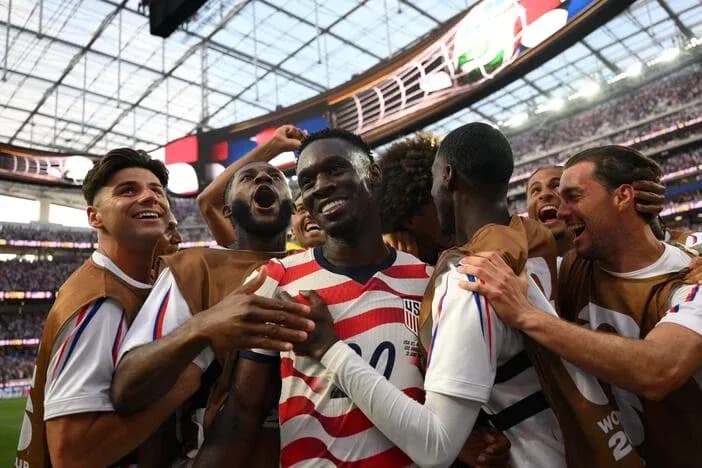
U.S. Men's Team Shines in World Cup Opener Against Paraguay
LOS ANGELES — For months, the noise around this World Cup has come from everywhere but the pitch: political flashpoints, eye-watering ticket prices, immigration snarls, transit headaches.
Then the whistle blew.
Now the tournament belongs to the football.
Across Mexico, Canada and the United States, the opening days have cracked the competition wide open. Upsets, statement wins, a few fairy tales already forming. And in Los Angeles, the U.S. men delivered a performance that will sit near the top of their World Cup history.
A U.S. opener with real weight
At Los Angeles Stadium on Friday night, the U.S. didn’t just beat Paraguay. They tore into them, 4-1, in a display of control and conviction rarely associated with this team on the sport’s biggest stage.
- Four goals — the most the U.S. men have ever scored in a World Cup match.
- A brace from Folarin Balogun — the first multi-goal game by an American at a World Cup since the inaugural tournament in 1930.
The numbers tell part of the story. The tone told the rest.
From the opening minutes, the U.S. pressed high, moved the ball crisply, and played with the kind of swagger usually seen in the shirts of traditional powers. Paraguay never really settled. When Balogun struck, twice, it felt less like a surprise and more like the inevitable conclusion of mounting pressure.
At the back, one returning figure quietly put together a historic night. Chris Richards, back in the XI after missing both pre-World Cup warm-ups with injury, completed all 83 of his passes. Every single one. No player has completed that many passes in a World Cup match since records began in 1966.
He didn’t just return. He dictated.
There was one cloud. Christian Pulisic, the star forward and heartbeat of so many U.S. attacks, came off at halftime with a calf issue. He walked gingerly to the team bus afterward, his status still unclear. The U.S. sparkled without him in the second half, but in a five-week tournament, losing your talisman for any stretch can alter everything.
For one night, though, this was as close to a complete World Cup performance as the U.S. men have produced. And still, it’s only one game.
Australia crash the party in Group D
If the Americans needed a reminder that group stages can turn quickly, they got it 24 hours later.
Turkey, stacked with top-tier European talent, walked into their opener against Australia as clear favorites. Names like Arda Güler of Real Madrid and Kenan Yildiz of Juventus headlined a side expected to challenge for top spot in Group D.
Australia didn’t flinch.
The underdogs struck, defended with discipline, and stunned Turkey 2-0. A result that flips the group on its head and injects real jeopardy into what looked like a straightforward path for the seeded sides.
That upset suddenly sharpens Friday’s USA–Australia clash into something bigger. If the U.S. win, they seize control of Group D and carve out a far smoother route into the knockout rounds. Drop points, and the group becomes a knife-edge.
The margin for error just shrank.
Scotland’s long-awaited return, and a jolt to royalty
Elsewhere, the World Cup delivered another jolt.
Scotland, playing in their first World Cup in 28 years, now sit atop Group C after beating Haiti. On its own, that’s a feel-good story. In context, it’s something more.
This is the group of Brazil and Morocco.
- Brazil: five-time champions, the sport’s enduring aristocracy.
- Morocco: a modern powerhouse, semifinalists at the last World Cup.
Those two met and drew 1-1, a heavyweight clash that many expected to shape the group’s hierarchy. Instead, it leaves Scotland looking down from first place — for now. One result won’t dislodge Brazil or Morocco from the list of favorites to advance, but it does change the math, and it gives Scotland something rare: early control in a group they were never supposed to lead.
A first point for Qatar, and a heavyweight stalemate
The weekend also delivered milestones for smaller stories.
Qatar, in just its second World Cup, claimed its first-ever point with a 1-1 draw against Switzerland on Saturday. The host nation in 2022, Qatar lost all three games in that tournament and left without a single point. This time, they walk away from their opener with something tangible.
On Sunday, Group F’s big hitters, the Netherlands and Japan, went punch for punch in a 2-2 draw. Neither side blinked. Neither side backed down. For a group expected to be tight at the top, that shared point keeps the door open for drama in the remaining fixtures.
Curaçao’s 17 minutes of belief
Then came one of those World Cup images that lingers, even in defeat.
Curaçao, the smallest country ever to play in a World Cup, made its debut against Germany. Population: 158,000. Opponent: a serial contender with a history of ruthless wins on this stage.
Germany scored early. Script intact.
Curaçao equalized. Script ripped up.
For 17 minutes, the scoreboard read 1-1. A tiny Caribbean nation stood level with a giant of the game, and belief surged. The moment didn’t last — Germany eventually rolled to a 7-1 win, a scoreline etched into their World Cup lore for other reasons — but those 17 minutes will live forever in Curaçao’s football history.
Sometimes, a debut is about more than the final score.
Politics in the background, Iran on the pitch
Away from the scorelines, geopolitics still shadows this World Cup.
On Monday, Iran face New Zealand at Los Angeles Stadium in a match that almost never happened. After the U.S. and Israel attacked Iran in February, questions swirled over whether Iran would even participate in the tournament.
The team had planned to base its training camp in Tucson, Arizona. Instead, citing hostilities and security concerns, Iran shifted its camp to Tijuana, Mexico. The U.S. government, for its part, is allowing the Iranian squad into the country only on the day before each of its three group matches.
So Iran will arrive, play, and leave — a team moving through the tournament on tight, politically drawn lines. On the field, though, the questions are simpler: can they handle New Zealand and settle quickly into a disrupted World Cup rhythm?
Mbappé, Messi and the next wave of stars
By Tuesday, the spotlight swings to two of the sport’s defining figures.
France, with Kylian Mbappé at the peak of his powers, open their World Cup campaign against Senegal in a high-stakes Group I meeting. France carry the burden of expectation every time they show up at this tournament; with Mbappé, they also carry the threat of a single player capable of bending games to his will.
On the same day, defending champions Argentina and Lionel Messi begin the hunt for back-to-back titles, starting against Algeria in Group J. Only two nations have ever managed to defend a World Cup crown: Italy in 1938, Brazil in 1962. That’s the company Argentina now chase.
Messi has nothing left to prove, yet here he is again, front and center in another World Cup, trying to push his country into a tiny, elite club in football history.
The politics, the logistics, the noise — all of it framed this World Cup before a ball was kicked. Now the football is answering back, one wild result at a time. And as the U.S. ride the high of a record-breaking opener into a pivotal clash with Australia, the question hangs over the next few weeks: is this the start of something truly new for American soccer, or just another bright flash in a tournament that rarely forgives complacency?




