
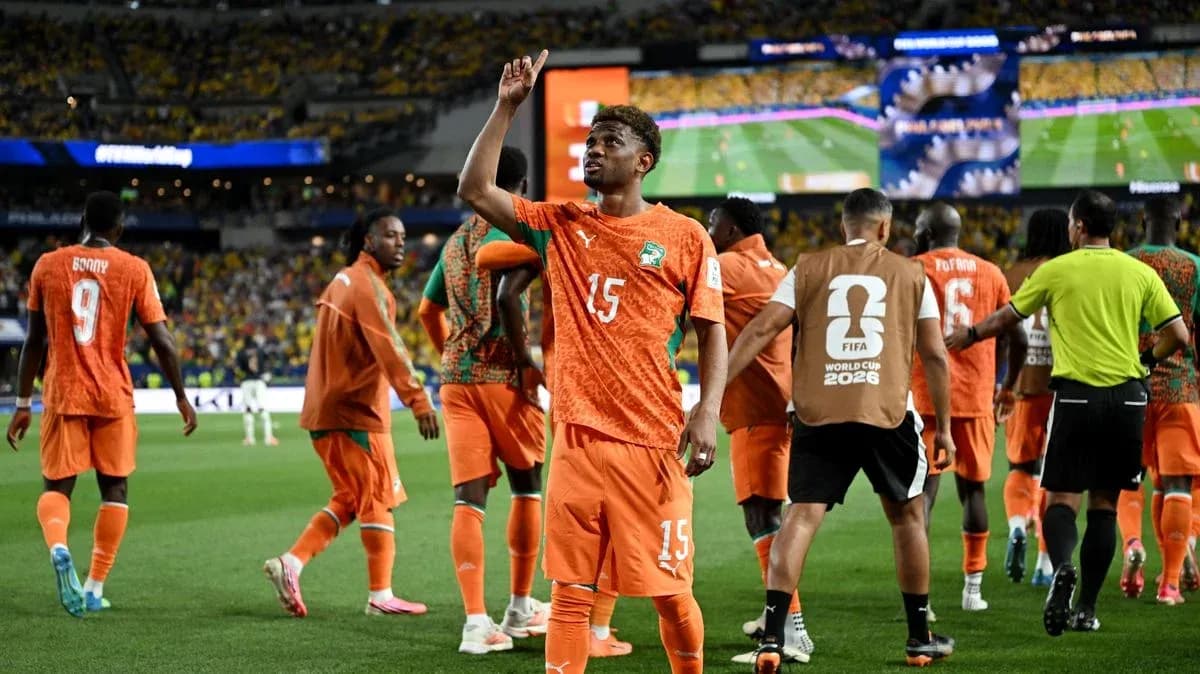
Amad Diallo: Proving His Worth to Manchester United
Amad Diallo walked off the pitch in Philadelphia last week thinking he had done his bit. A late winner against France in a World Cup warm-up, a sharp performance, the kind of display that usually earns you a starting shirt when the real tournament begins.
Then the teamsheet dropped for Ivory Coast’s opener against Ecuador. His name was not on it.
Emerse Fae turned instead to 19-year-old Yan Diomande on the right, the teenager United had tracked but who now seems destined for Liverpool from RB Leipzig. Bazoumana Toure, just 20, started on the left. Nicolas Pepe, the old hand at 31, took up the No. 10 role.
Amad was nowhere. Frozen out by his own national team’s depth.
Benched, then brilliant
For a country once accused of leaning too heavily on a couple of stars, Ivory Coast suddenly have attacking options everywhere. Fae used them. Diomande justified the call with an eye-catching World Cup debut, stretching Ecuador and showing exactly why Europe’s elite have circled his name.
Yet the game still needed a moment of calm, a finisher’s touch. That came when Amad finally stepped onto the pitch.
Brought on for Toure, he drifted infield rather than hugging the touchline, operating more as a second striker than a traditional winger. In just 34 minutes he changed the tone of the night, knitting moves together, finding pockets of space, and then, when it mattered, finishing with the cold precision that has always separated him from being just another wide forward.
The goal that sealed the win was classic Amad: a clever run from a central area, a first-time sweep from a low cross coming in from the right. No fuss, no extra touch, just a clean, decisive strike.
With minnows Curacao still to come, that goal has likely done more than win a group game. It has one foot of Ivory Coast in the World Cup knockouts for the first time in their history. It should also put Amad back where he belongs – in Fae’s starting XI.
Country form that Old Trafford can’t ignore
The contrast with his club season is stark. Two goals and four assists in 32 Premier League appearances for United is a thin return on paper, the kind of numbers that feed easy criticism.
Yet his form in orange tells a different story. Since the start of the Africa Cup of Nations in December, Amad has scored five times in nine games for Ivory Coast and added two assists. Those aren’t cameo contributions. That is a player carrying threat every time he pulls on his country’s shirt.
Crucially, his recent goals have come from central positions. Again against Ecuador, again against France, he attacked the box from the middle, timing his run and finishing first time from low deliveries off the right flank. The pattern is no accident. It is a blueprint.
For United, who used him almost exclusively on the right last season, that should ring a very loud bell.
More than a right winger
Amad’s reputation in England is still largely tied to that right-wing berth. That is where he spent almost all of last season for United, stretching play, linking with Bruno Fernandes, drifting inside onto his left foot.
But his loan spell at Sunderland told a different story. There, he thrived as a false nine, ghosting between the lines, popping up in scoring positions, finishing with the conviction of a natural forward. He became a regular source of goals in the Championship, not just a neat technician on the flank.
What Ivory Coast are seeing now is the fusion of those two versions: the winger’s touch, the forward’s instincts.
Diomande’s emergence on the right for his country only sharpens the point. If the teenager locks down that flank, Amad’s path back into the side is not to reclaim the touchline. It is to step into the spaces Pepe currently occupies, or to attack from the left in Toure’s spot.
Pepe is 31. Amad is 23, quicker, sharper, and increasingly comfortable operating in crowded central zones. Both of his latest goals underline that he can hurt teams when he starts inside, not just when he cuts in from wide.
A solution hiding in plain sight for United
All of this feeds into a question that has hovered around Old Trafford for months: where exactly should Amad fit in a United attack that already boasts flexibility?
Michael Carrick has options. Bryan Mbeumo and Matheus Cunha can both operate across the front three. There are plans to add another attacker, either a seasoned centre-forward or someone who can play off the left. The front line is built to rotate, to interchange, to keep defenders guessing.
Yet the real gap sits just behind them. United still lack a convincing understudy for Bruno Fernandes.
Fernandes has just delivered the season of his life, dictating games, creating relentlessly, dragging United through tight contests with his usual blend of craft and fury. But he turns 32 in September and has carried a heavy load since arriving in January 2020. At some point, the minutes will bite.
Cunha and Mason Mount can both step into the No. 10 role for certain games. They have the intelligence and the technical base to do it. Still, neither offers quite the same blend of penalty-box threat and between-the-lines movement that Amad is quietly showcasing for his country.
Carrick knows there is more to Amad than his league numbers suggest. He defended the Ivorian strongly towards the end of the season, urging observers to look beyond goals and assists and to focus on his contribution to United’s structure and pressing, his work in a winning side.
Now Ivory Coast are providing fresh evidence. A confident finisher, comfortable through the middle, capable of linking play and then arriving to finish moves – that is exactly the profile of a No. 10 who can spell Fernandes without blunting United’s edge.
The decision for Carrick is no longer whether Amad deserves minutes. It is whether he dares to redraw the map and trust the Ivorian not just as a winger, but as the man who can give his captain the rest he so clearly needs.




