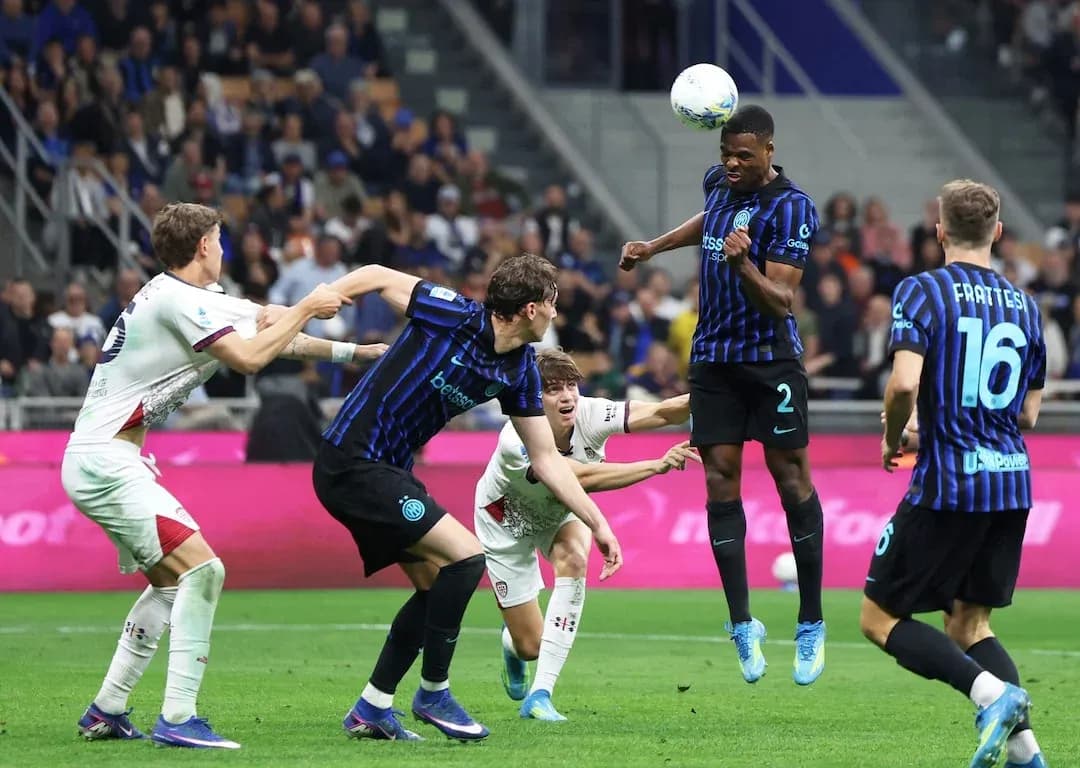
Cagliari vs Inter: Tactical Analysis of Serie A Clash
Under the Sardinian lights of the Unipol Domus, this was a meeting of two very different Serie A identities. Cagliari, back at home and still learning the pace of the new season, against an Inter side that already looks like a machine: efficient, ruthless, and structurally settled.
Heading into this game, the table told a clear story. Cagliari sat 12th with 3 points from 2 matches, their overall goal difference perfectly balanced at 0, coming from 1 goal scored and 1 conceded. The split was stark: at home they had played 1, lost 1, with 0 scored and 1 conceded; on their travels they had been far more effective, winning their only away outing 1-0. Inter arrived in Cagliari as early pacesetters, 2nd in the league with 6 points from 2 matches, their overall goal difference at +4, the product of 5 goals scored and just 1 conceded. At home they had already delivered a 4-1 statement win; away they had been more minimal, a 1-0 victory built on control rather than chaos.
I. The Big Picture: Structures and Seasonal DNA
The tactical shapes were instantly revealing. Fabio Pisacane stayed loyal to Cagliari’s 4-2-3-1, the same structure they have used in both league outings so far. E. Caprile anchored the side in goal, with a back four of J. Pedro, A. Deiola, J. Rodriguez, and A. Obert. In front of them, A. Romano and H. Winks formed a double pivot designed less to dominate the ball and more to compress space. Ahead, a band of three in M. Adopo, D. Maldini, and J. Fazzini worked to link with lone forward P. Mendy.
Cristian Chivu’s Inter, by contrast, were the embodiment of continuity. A 3-5-2 that has already been used in both league fixtures this season, built on the back three of B. Pavard, M. Akanji, and A. Bastoni ahead of J. Martinez in goal. The wing-backs F. Dimarco and Luis Henrique stretched the pitch, while the central trio of N. Barella, H. Calhanoglu, and P. Sucic controlled rhythm and territory. Up front, L. Martinez and F. Esposito offered complementary movement: one dropping, one stretching, constantly testing the Cagliari line.
The final 1-0 scoreline, mirroring Inter’s away pattern this season, felt like the logical extension of these identities. Inter now have, overall, 2 wins from 2, scoring 5 and conceding 1; away they remain perfect with 1 goal scored and 0 conceded in their single trip. Cagliari, by contrast, continue to live a split life: effective away, blunt at home, still without a goal in front of their own fans.
II. Tactical Voids: Absences and Discipline
Both coaches had to navigate important absences. For Cagliari, R. Idrissi and Y. Trepy were unavailable, both listed as missing through injury. While neither is a headline name, their absence thinned Pisacane’s options for late-game width and direct running, forcing him to lean heavily on the creativity of Maldini and the work rate of Fazzini.
Inter, too, were not at full strength. D. Spence (inactive) and M. Spinacce (injury) were ruled out, slightly narrowing Chivu’s defensive rotation and reducing his flexibility in the wide areas. Yet the depth on the bench remained imposing: J. Stones, P. Zielinski, H. Mkhitaryan, Carlos Augusto, and M. Thuram all available to alter the game’s tone if needed.
Disciplinary trends hinted at how the battle would be fought. Cagliari’s yellow card distribution this season has been heavily concentrated around the restart, with 50.00% of their cautions arriving between 46-60 minutes and 25.00% in each of 0-15 and 76-90. It speaks to a side that starts each half aggressively and then becomes stretched late on. Inter’s yellows are spread more evenly across the first 60 minutes, with 33.33% in each of 0-15, 31-45, and 46-60, suggesting a team that competes consistently in duels but rarely loses control.
Key individuals embody those trends. For Cagliari, J. Fazzini already carries 1 yellow card this season, his 3 fouls committed and 15 duels contested underlining his role as a combative, risk-taking midfielder. For Inter, H. Calhanoglu, M. Akanji, and L. Martinez each have 1 yellow card, but without red cards for either team, both sides have so far walked the disciplinary tightrope without falling.
III. Key Matchups: Hunter vs Shield, Engine Room vs Enforcer
The headline duel was always going to be Inter’s attacking structure against Cagliari’s defensive shell. Inter’s overall attacking numbers are imposing: 5 goals from 2 matches, with an average of 2.5 goals per game overall, 4.0 at home and 1.0 on their travels. Cagliari, by contrast, are cautious: just 1 goal in total, an overall average of 0.5, with 0.0 at home and 1.0 away.
The “Hunter vs Shield” dynamic crystallised around Inter’s forwards and creators against Cagliari’s back four and double pivot. L. Martinez, still searching for his first league goal this season despite 7 shots and 1 on target, used his movement to pull Deiola and Rodriguez into uncomfortable zones. F. Esposito, with 1 goal and 1 assist already in the campaign, attacked the channels, trying to isolate Obert and Pedro.
Behind them, Inter’s true cutting edge came from deep. H. Calhanoglu arrived as one of Serie A’s form players: 2 goals, an 8.0 rating, 125 passes at 91% accuracy, and 3 key passes. His capacity to dictate from zone 14, combined with 3 tackles, 1 blocked shot, and 3 interceptions, makes him both conductor and destroyer. Against a Cagliari side that has failed to score at home and averages 0.5 goals conceded overall (1.0 at home, 0.0 away), his ability to break lines with passes and shots was always likely to decide the tempo.
In the “Engine Room” matchup, Cagliari’s Winks and Romano faced a daunting task. They needed to screen passing lanes into Martinez and Esposito while tracking the late runs of Barella and Sucic. Inter’s midfield not only controls possession but also presses aggressively after loss, forcing Cagliari’s build-up through risky central channels where turnovers can be fatal.
IV. Statistical Prognosis and Tactical Verdict
Following this result, the trajectories of both squads feel reinforced rather than redefined. Cagliari remain a side more comfortable in compact away battles than in expansive home performances. Their overall numbers stay modest: 1 win, 1 loss, 1 goal scored, 1 conceded, with a clean sheet only on their travels and a continued failure to score at home. The 4-2-3-1 offers structure, but without greater penetration from Maldini and Fazzini and more presence from Mendy, the system risks becoming sterile in front of their own supporters.
Inter, meanwhile, continue to look like a team whose underlying metrics will keep them near the top. Overall, they have 2 wins from 2, 5 goals scored, 1 conceded, and a defensive record that includes an away clean sheet. There are no penalties taken or missed for either side so far this season, underlining that Inter’s advantage is not built on spot-kick variance but on open-play control.
From an xG and defensive solidity perspective, even without explicit xG figures, the patterns are clear. Inter create enough volume and quality of chances through Calhanoglu’s distribution, Esposito’s movement, and the width of Dimarco and Luis Henrique to justify their scoring rate. Defensively, with Akanji, Bastoni, and Pavard in front of a calm J. Martinez, they concede few high-quality opportunities, particularly away from home where they have yet to be breached.
For Cagliari, the path forward is equally clear and demanding. To turn the Unipol Domus into a fortress, Pisacane must coax more risk and verticality from his attacking quartet without sacrificing the compactness that has kept their overall goals against at just 1. The raw materials are there—a disciplined double pivot, a hardworking 10 in Fazzini, and the creativity of Maldini—but against elite visitors like Inter, the margins are razor-thin.
In narrative terms, this fixture felt less like a shock and more like a confirmation. Inter look every inch a Champions League-bound side, structurally coherent and statistically convincing. Cagliari, brave but blunt at home, will need to evolve quickly if they are to turn narrow, respectable defeats into points against Italy’s elite.