Napoli vs Como: Tactical Evolution and Early Season Struggles
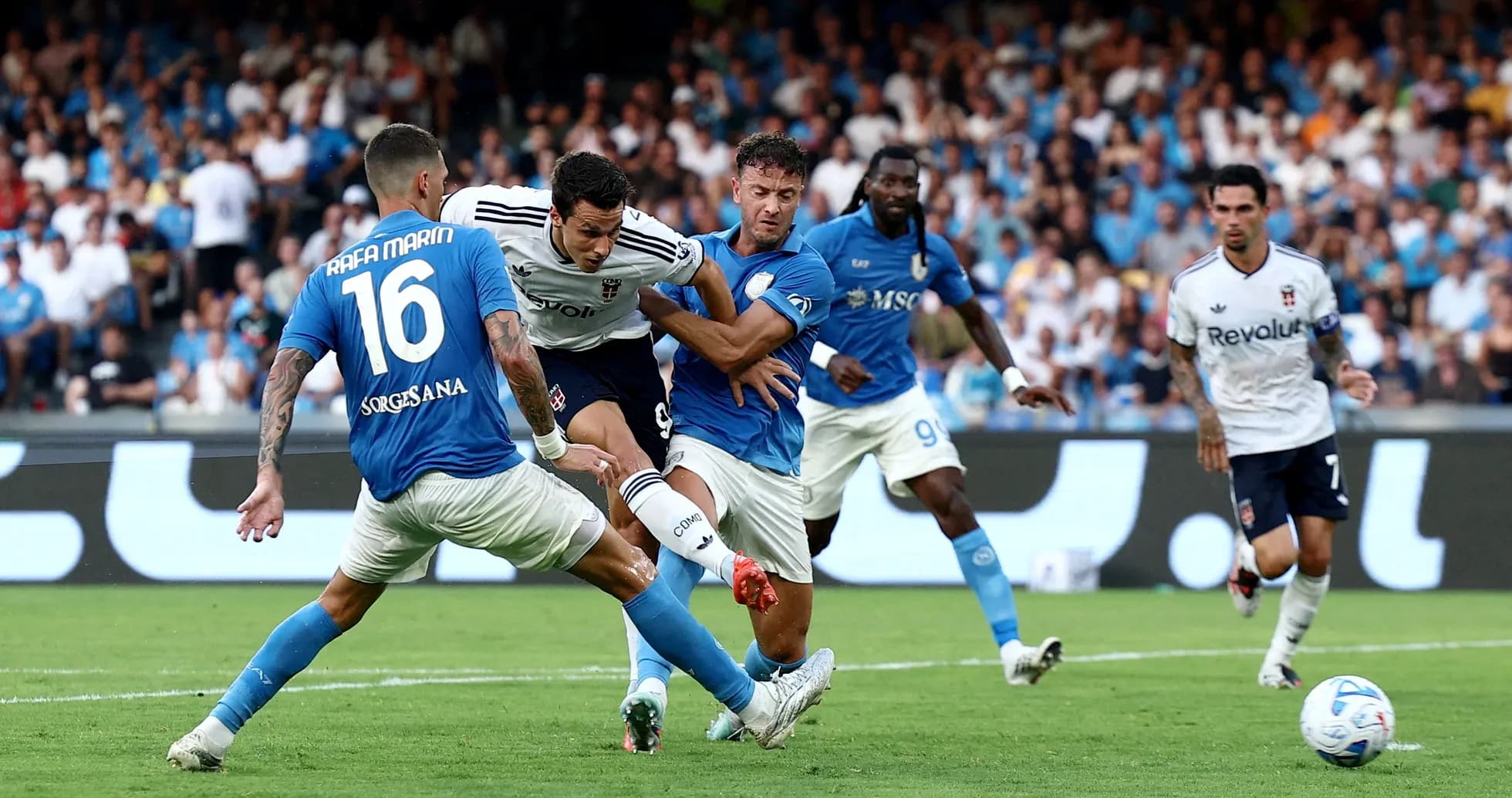
Under the late-summer light of the Stadio Diego Armando Maradona, this was supposed to be Napoli’s statement of intent under Massimiliano Allegri: a familiar 4-3-3, a roaring home crowd, and a newly assembled spine built to control Serie A. Instead, a 2–1 defeat to Como left more questions than answers, and offered a revealing snapshot of two sides at very different stages of their tactical evolution.
I. The Big Picture – contrasting early-season identities
Following this result, both teams sit on three league goals scored and two conceded overall, but their trajectories diverge. Napoli, 10th with three points and a goal difference of +1 (3 scored, 2 conceded overall), have split their opening two games: one win away, one defeat at home. The pattern is already stark. On their travels, they have been efficient and secure, scoring 2 and conceding 0. At home, they have now scored just 1 and conceded 2, with an average of 1.0 goal for and 2.0 against per match in Naples.
Como, meanwhile, are 8th with four points and the same overall goal difference of +1 (3 for, 2 against overall), but their stability away from home is the story. All of their football so far has been on the road: two away matches, one win and one draw, 3 goals scored and 2 conceded, averaging 1.5 goals for and 1.0 against away. For a newly assembled group under Cesc Fabregas, this is the profile of a side that can suffer, counter, and still impose technical quality between the lines.
The formations told their own tale. Allegri’s 4-3-3 was classic in shape but modern in personnel: A. Meret behind a back four of G. Di Lorenzo, A. Rrahmani, R. Marin and M. Olivera; a midfield trio of F. Anguissa, S. Lobotka and S. McTominay; and a front line of M. Politano, R. Hojlund and N. Lang. Como’s 4-2-3-1 under Fabregas was more elastic: J. Butez in goal; a defence of Y. Couto, J. Ramon, T. Chalobah and A. Valle; a double pivot of L. Milla and L. Da Cunha; an advanced trio of A. Diao, N. Paz and M. Baturina supporting lone striker T. Douvikas.
II. Tactical Voids – absences and structural gaps
Napoli came into this with a notable defensive handicap. A. Buongiorno, L. Marianucci and P. Mazzocchi were all ruled out with knee injuries, stripping Allegri of depth and versatility across the back line. With no natural left-sided alternative of Buongiorno’s profile, R. Marin and A. Rrahmani were locked in as the central pairing, leaving little room to adjust height or aggression in the line.
The season data already hints at the consequences: at home, Napoli have conceded 2 goals from a single league fixture, and have yet to keep a clean sheet in Naples. Their clean sheet so far came away, reinforcing the sense that the Maradona pitch is currently a place of tactical tension rather than comfort.
Como were missing J. Addai through an Achilles tendon injury, but Fabregas’ squad had more defensive cover on the bench: A. Dossena, I. Smolcic, W. Kambwala, Kaiki, M. O. Kempf and E. Goldaniga all offered different profiles to protect a lead. That depth allowed Como to preserve their unbeaten start; they still have no defeats overall after two away matches.
Disciplinary trends are also revealing. Napoli’s yellow cards this season have been concentrated in the 31–45 and 46–60 minute windows, with 50.00% of their cautions arriving just before half-time and 50.00% just after the restart. It points to a side that tightens the screws in the middle phases, sometimes overstepping as they chase control. Como, by contrast, have yet to record a yellow or red card in the league data so far, which fits with the image of a compact, tactically disciplined unit that defends more by structure than by last-ditch interventions.
III. Key Matchups – hunter vs shield, engine room battles
The headline duel was always going to be T. Douvikas against Napoli’s makeshift central defence. Douvikas arrived at the Maradona as one of Serie A’s early leading scorers: 2 goals from 2 appearances, 6 shots with 5 on target, plus 2 key passes and 6 fouls drawn. He is not just a finisher but a focal point, happy to play with his back to goal and invite contact.
Against a Napoli side that concedes an average of 2.0 goals at home, Douvikas’ movement between A. Rrahmani and R. Marin was a constant stress test. His duel numbers – 28 contests overall this season, with 12 won – show a striker comfortable in physical battles. Every long ball into his zone forced Napoli’s centre-backs to step into areas where Buongiorno’s aggression and timing were conspicuously absent.
Behind him, M. Baturina operated as the creative hinge. With 1 goal and 1 assist in the league, 4 shots, 2 key passes and an 88% pass accuracy, he is already emerging as Como’s metronome in the final third. Drifting between the lines, he targeted the channel between S. Lobotka and S. McTominay, pulling Lobotka away from his usual screening lane and exposing the half-spaces in front of Napoli’s defence.
On the other side, Napoli’s main creative threat did not even start. K. De Bruyne, one of Serie A’s leading assist providers so far with 1 goal and 1 assist from just 57 minutes across 2 substitute appearances, once again had to change the game from the bench. With 6 key passes and a 75% pass accuracy overall, his introduction tilted the rhythm, but Allegri’s decision to begin with a more workmanlike trio of Anguissa, Lobotka and McTominay left Napoli short of line-breaking passes in the first half, when Como did their damage.
The “engine room” duel was therefore asymmetrical. L. Milla and L. Da Cunha could sit, shuffle and protect the back four, knowing that Baturina, A. Diao and N. Paz had the technical licence to exploit transitions. Napoli’s midfield, by contrast, had to both build and destroy, often leaving Lobotka overloaded and Anguissa chasing shadows in wide areas.
IV. Statistical Prognosis – what this result tells us going forward
Following this result, both teams share identical overall scoring and conceding averages: 1.5 goals for and 1.0 against per match. But the split by venue is decisive. Napoli are a different side away, where they score 2.0 and concede 0.0, compared to 1.0 scored and 2.0 conceded at home. Como, entirely tested on their travels, have already proven they can consistently score (1.5 away) while keeping games within a single goal (1.0 conceded away).
Neither team has yet taken or missed a penalty this season; the margins are being defined in open play and in the subtleties of structure rather than in dead-ball drama. Napoli’s reliance on late midfield introductions – particularly De Bruyne and the high-impact A. Vergara, who also has 1 goal and 1 assist in just 23 minutes – suggests Allegri still sees his bench as a corrective rather than a weapon deployed from the outset.
For Como, the spine of J. Butez, Chalobah, M. Milla and Douvikas, with Baturina threading passes in between, looks sustainable. They have no clean sheets yet, but their capacity to manage away fixtures without defeat, and to lean on a striker in form, points to a side that will remain awkward opponents for anyone.
For Napoli, the story is more complex. The 4-3-3 remains their default – they have used it in both league matches – but the blend is not yet right at home. Until the injured defenders return and Allegri finds a way to integrate De Bruyne’s creativity earlier without unbalancing the midfield, the Maradona may continue to feel like a stage where they chase games rather than dictate them.