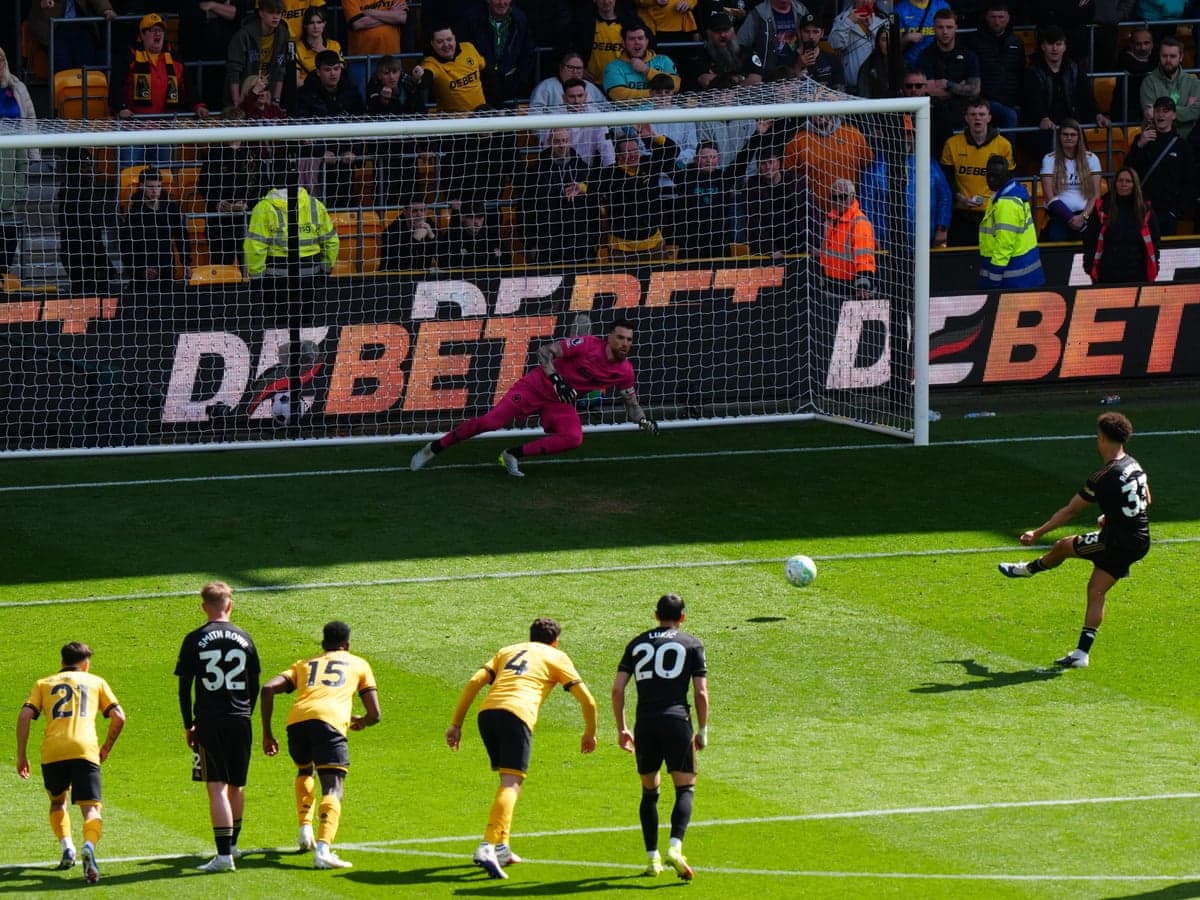
Wolves vs Fulham: A Tactical Stalemate in Premier League Draw
Molineux felt caught between farewell and defiance as Wolves, already marooned in 20th, met a mid-table Fulham side with just enough edge left in their season to be dangerous. The Premier League’s Round 37 script delivered a 1-1 draw, a scoreline that neatly reflected the broader balance of power: Wolves’ desperation and structural fragility against Fulham’s more polished, if inconsistent, 4-2-3-1.
Following this result, the table tells its own story. Wolves remain bottom on 19 points with a brutal goal difference of -41, the product of 26 goals for and 67 against overall. Fulham sit 13th on 49 points, with a goal difference of -6 from 45 scored and 51 conceded. One team has spent the campaign trying to stem the bleeding; the other has oscillated between slick attacking spells and defensive lapses, particularly away from home.
I. The Big Picture – Two 4-2-3-1s, two very different identities
Both managers mirrored each other on the whiteboard. Rob Edwards set Wolves up in a 4-2-3-1: J. Sa behind a back four of D. M. Wolfe, L. Krejci, S. Bueno and Y. Mosquera; a double pivot of Joao Gomes and Andre; a three of Hwang Hee-Chan, M. Mane and R. Gomes behind lone striker A. Armstrong.
Marco Silva answered with his own 4-2-3-1: B. Leno in goal; T. Castagne, I. Diop, C. Bassey and A. Robinson across the back; S. Lukic and S. Berge anchoring midfield; O. Bobb, E. Smith Rowe and A. Iwobi supporting Rodrigo Muniz.
The symmetry of shape disguised contrasting seasonal DNA. Heading into this game, Wolves had played 37 league matches, winning only 3 in total, drawing 10 and losing 24. At home, they had 3 wins, 5 draws and 11 defeats, scoring 19 and conceding 34. On their travels, Fulham had 4 wins, 5 draws and 10 losses from 19 away fixtures, with 17 goals for and 31 against. Where Wolves’ 0.7 total goals for per game (1.0 at home) has been undermined by 1.8 conceded per match both home and away, Fulham’s 1.2 total goals for (0.9 away) has been paired with 1.4 conceded overall and 1.6 away.
II. Tactical Voids – Suspensions, injuries and the disciplinary shadow
Both squads arrived with notable absences. Wolves were without L. Chiwome and E. Gonzalez, both sidelined by knee injuries, and S. Johnstone with a knock. It forced Edwards to lean heavily on J. Sa’s presence and to trust the young defensive line of Mosquera, S. Bueno and Krejci in front of him.
Fulham’s most significant absentee was J. Andersen, suspended after a red card. His season numbers underline the loss: 33 league appearances, 2884 minutes, 45 tackles, 19 blocked shots and 36 interceptions. His red card record this campaign – 1 dismissal – also underlines the edge he brings to Fulham’s back line. Without him, Silva turned to the Diop–Bassey pairing, a duo more aggressive in duels but less authoritative in build-up.
Discipline has shaped Wolves’ season as much as any tactical choice. Their yellow-card distribution shows a clear spike between 46-60 minutes, where 28.21% of their cautions arrive, followed by 20.51% between 61-75 and 19.23% from 76-90. Red cards are evenly split across 31-45, 46-60 and 61-75, each window accounting for 33.33% of their dismissals. Fulham, by contrast, tend to collect yellows late: 20.55% between 76-90 and a striking 23.29% in stoppage time (91-105), with their solitary red card this season arriving between 46-60.
In a match that finished 1-1, that disciplinary profile mattered. Wolves’ tendency to fray just after half-time forced Joao Gomes and Andre to walk a tightrope in the engine room, while Fulham’s late-card habit shaped how Silva managed his substitutions from the 70th minute onward.
III. Key Matchups – Hunter vs Shield, Engine Room battles
With no Wolves player among the league’s top scorers, the “Hunter” mantle was effectively collective: a side that, at home, averages 1.0 goals for per game trying to break down an away defence conceding 1.6. The duel between A. Armstrong and the Diop–Bassey axis framed much of Wolves’ attacking story. Armstrong’s task was to pin Fulham’s centre-backs and create space for Hwang Hee-Chan and R. Gomes to attack the half-spaces.
On the other side, Fulham’s most potent attacking weapon across the season has been H. Wilson, even though he started this one on the bench. With 10 total league goals and 6 assists, plus 50 shots (25 on target) and 38 key passes, he is both finisher and creator. When introduced, Wilson’s left-footed threat from the right and his 769 completed passes at 81% accuracy offered Fulham a different dimension between the lines, especially against a Wolves side that has kept only 4 clean sheets in total (3 at home, 1 away) and failed to score in 19 matches overall.
The “Engine Room” duel was brutal and central to the narrative. For Wolves, Joao Gomes and Andre have been the heartbeat and the bruises. Joao Gomes has 108 tackles, 6 blocked shots and 36 interceptions in the league, while Andre has 78 tackles, 12 blocked shots and 29 interceptions. Their card records are telling: 10 yellows for Joao Gomes, 12 for Andre, both among the league’s most-booked players. They were tasked with disrupting Fulham’s double pivot of S. Berge and S. Lukic and limiting the supply into E. Smith Rowe and Rodrigo Muniz.
Without Andersen’s passing from the back, Fulham leaned more on Berge’s ability to progress the ball and on Smith Rowe’s positioning between the lines. Wolves responded by tightening the central corridor, with M. Mane and R. Gomes collapsing inwards out of possession, turning the 4-2-3-1 into a compact 4-4-1-1.
IV. Statistical Prognosis – A draw that fits the numbers
From a season-long lens, a 1-1 feels almost pre-ordained. Wolves’ home attack, at 1.0 goals for per match, up against Fulham’s away defence at 1.6 conceded, points towards the hosts finding a goal but struggling to dominate. At the other end, Fulham’s 0.9 away goals for per game against a Wolves home defence conceding 1.8 suggests the visitors were always likely to score.
Both sides have perfect penalty records this season: Wolves have scored 2 from 2, Fulham 5 from 5, with no penalties missed for either side. With no spot-kicks here, the match leaned instead on open-play patterns and set-piece delivery, areas where Fulham’s technical quality and Wolves’ aerial presence through Mosquera and S. Bueno roughly cancelled each other out.
Defensively, Wolves’ overall concession rate of 1.8 per game and Fulham’s 1.4 underline why neither side was ever likely to shut the other out. Fulham’s 8 total clean sheets (5 at home, 3 away) and Wolves’ 4 simply do not describe teams that lock games down, especially this deep into the season with fatigue and pressure mounting.
In xG terms, the profile would skew marginally towards Fulham: a side that creates 1.2 total goals for per match against an opponent conceding 1.8, versus Wolves’ 0.7 total goals for against a defence conceding 1.4. Yet the absence of Andersen, the emotional charge of Wolves’ final home outing, and the mutual defensive flaws all pushed the contest towards equilibrium.
Following this result, Wolves remain a team defined by effort and instability, their 4-2-3-1 at Molineux a late attempt to find balance after a season of tactical searching. Fulham, safely lodged in mid-table, showed again why they sit where they do: enough quality in players like Wilson, Smith Rowe and Iwobi to trouble anyone, but an away record – 4 wins, 5 draws, 10 defeats – that stops them climbing higher.
The 1-1 at Molineux was less a surprise than a confirmation: two imperfect sides, their season-long numbers converging into a single, fitting scoreline.