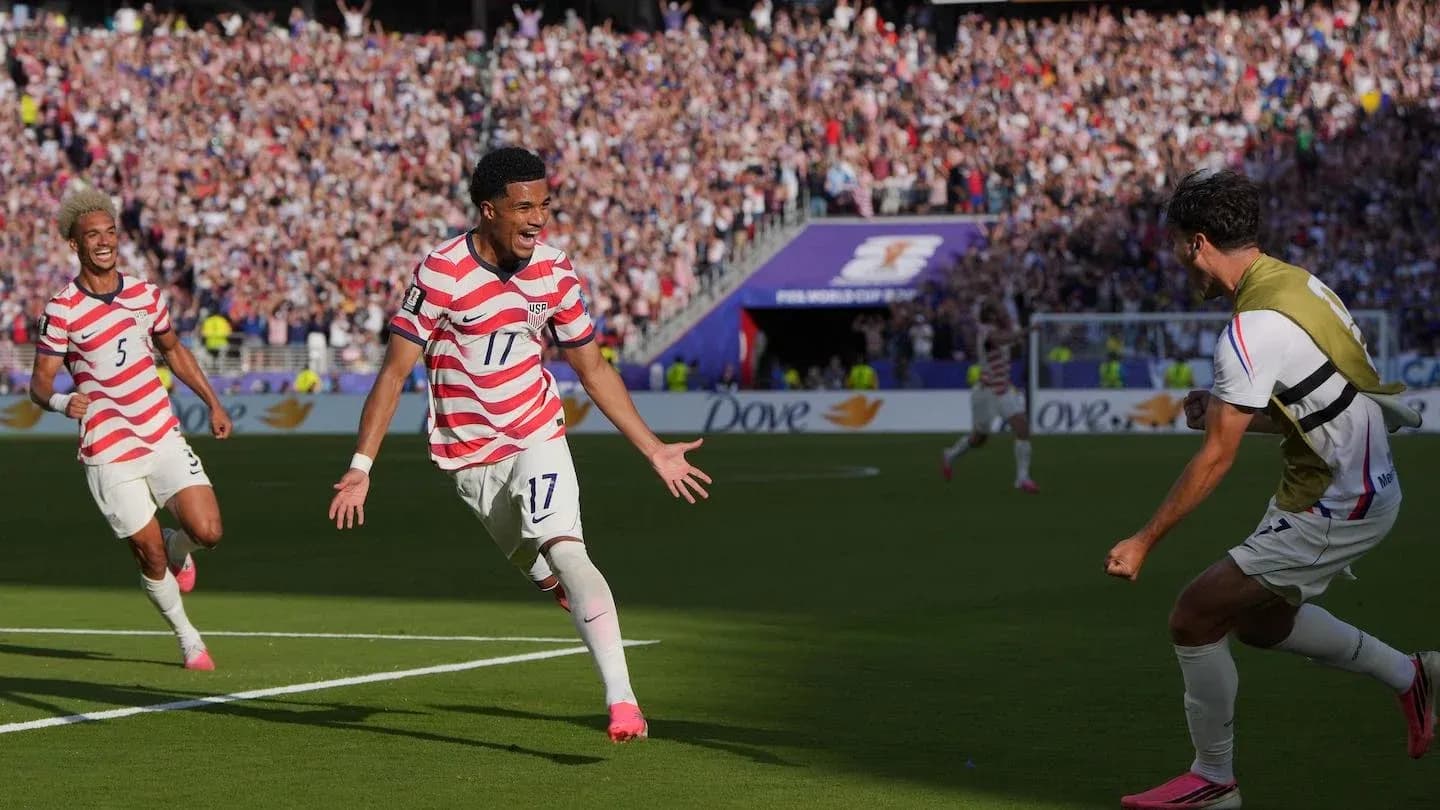
USA's Tactical Mastery Secures 2-0 Victory Over Bosnia & Herzegovina
USA’s 2-0 win over Bosnia & Herzegovina at Levi's Stadium in this World Cup Round of 32 tie was defined less by volume of chances and more by control of key spaces and game states. With both teams posting modest attacking numbers (USA 0.92 xG, Bosnia & Herzegovina 0.25 xG), the match turned on how Mauricio Pochettino’s 4-3-3 manipulated Bosnia & Herzegovina’s 5-3-2, and how the hosts managed a long spell with ten men after Folarin Balogun’s red card.
USA set up in a clear 4-3-3: Matthew Freese in goal; a back four of Antonee Robinson, Tim Ream, Chris Richards and Alexander Freeman; Tyler Adams anchoring midfield with Weston McKennie and Malik Tillman ahead; a fluid front three of Christian Pulišić, Balogun and Sergiño Dest. The structure aimed to stretch Bosnia & Herzegovina’s back five horizontally while using Adams as a stabilizing pivot against transitions.
Sergej Barbarez’s side lined up in a 5-3-2: Nikola Vasilj in goal behind a line of Sead Kolašinac, Stjepan Radeljić, Tarik Muharemović, Nikola Katić and Amar Dedić; a midfield trio of Kerim Alajbegović, Ivan Šunjić and Armin Gigović; Edin Džeko and Ermedin Demirović as the front two. On paper, this offered strong central protection and wing-back outlets, but in practice they struggled to convert their slight territorial edge (52% possession) into high-quality chances.
Out of possession, USA’s front three pressed asymmetrically. Balogun often screened passes into Šunjić, while Pulišić and Dest jumped onto Bosnia & Herzegovina’s outside center-backs. Behind them, McKennie and Tillman stepped aggressively onto Gigović and Alajbegović, leaving Adams to patrol the space in front of Ream and Richards. This compact 4-1-4-1 pressing shell limited Bosnia & Herzegovina to 10 total shots, with only 5 from inside the box and a very low 0.25 xG, underlining how effectively USA controlled central access.
With the ball, USA accepted a small possession deficit (48%) but were more purposeful. Their 415 passes at 83% accuracy, compared to Bosnia & Herzegovina’s 446 at 82%, show near-parity in circulation, but USA’s positional play was cleaner. Robinson and Freeman pushed high to pin the wing-backs, allowing Dest and Pulišić to drift into half-spaces. McKennie and Tillman frequently formed staggered vertical lanes with Adams, creating 3v2 overloads against Bosnia & Herzegovina’s midfield three. This structure produced 6 of USA’s 8 shots from inside the box, reflecting a focus on working the ball into advanced central pockets rather than speculative efforts.
The opening goal on 45' from Balogun was the logical product of this pattern. By that stage, USA had already forced Bosnia & Herzegovina’s back line to defend deep and narrow. The five-man defense struggled to track coordinated movements between the front three and the advanced interiors, and Balogun’s strike – one of only 2 USA shots on target – maximized the limited clear looks they created before half-time. Going into the break at 1-0, the hosts had the scoreline their structural superiority warranted, even if the raw shot count (8-10) suggested a relatively even contest.
Bosnia & Herzegovina’s triple substitution at 51' – Armin Gigović (OUT) for Esmir Bajraktarević (IN), Ivan Šunjić (OUT) for Benjamin Tahirović (IN), and Edin Džeko (OUT) for Ermin Mahmić (IN) – was an attempt to inject energy and more progressive passing into midfield while reshaping the front line. The idea was to improve vertical connections and second-ball presence. However, USA’s pressing discipline and Adams’ screening limited the impact of these changes. Bosnia & Herzegovina did edge USA in shots on goal (3 to 2) and total shots (10 to 8), but the low xG and reliance on 5 shots from outside the box reveal that most of their efforts came from suboptimal zones, often under pressure.
The match’s main inflection point arrived on 64', when Balogun received a straight red card for “Serious foul.” Reduced to ten men and already 1-0 up, USA shifted into a more conservative, compact block. Dest and Pulišić dropped deeper to form almost a 4-4-1 without the ball, with Tillman supporting the first line of pressure. Rather than collapsing entirely, USA managed the game state intelligently, accepting longer Bosnia & Herzegovina possessions while protecting the central lane and penalty area. The foul count (USA 7, Bosnia & Herzegovina 13) underscores how the visitors increasingly resorted to disruptive defending to halt counters, rather than USA being forced into desperate last-ditch challenges.
Bosnia & Herzegovina’s later changes – Kolašinac (OUT) for Haris Tabaković (IN) and Katić (OUT) for Amar Memić (IN) on 75' – tilted their shape towards a more aggressive, front-loaded approach, effectively loosening the original back five. This opened channels for USA to counter. The yellow card phase at 80', with a booking for the bench figure “S. Barbarez” and a separate yellow for Radeljić for “Holding,” reflected growing frustration as USA’s ten men continued to blunt their attacks.
USA’s second goal on 82' from Malik Tillman was emblematic of that altered dynamic. With Bosnia & Herzegovina pushing more numbers forward and their original defensive structure disrupted, USA found space to break. Despite being outnumbered, the hosts exploited transitional moments, and Tillman’s strike – USA’s second shot on target – effectively ended the contest. That the hosts scored twice from just 2 shots on goal, against an xG of 0.92, highlights their clinical edge and the visitors’ inability to turn possession into genuine danger.
In goal, Matthew Freese (USA) made 3 saves, aligning with Bosnia & Herzegovina’s 3 shots on target and reinforcing the idea that, while the visitors did test him, they rarely carved out clear-cut opportunities. Nikola Vasilj (Bosnia & Herzegovina), by contrast, recorded 0 saves, a function of USA’s extreme efficiency: both of their on-target efforts found the net. The goals prevented metric is negative for both sides (-1.73 each), but with USA’s goalkeeper facing low-xG shots and Bosnia & Herzegovina’s keeper beaten twice from limited volume, the more telling story lies in shot quality and defensive organization in front of them rather than pure shot-stopping heroics.
Statistically, Bosnia & Herzegovina’s slight edge in possession and shots did not translate into control of the most valuable spaces. Their 3 blocked shots and 5 attempts from outside the box point to USA’s back line, marshalled by Ream and Richards, effectively closing central lanes and forcing lower-probability efforts. Meanwhile, USA’s 2 blocked shots and 6 efforts from inside the area show a team that, even when down to ten, prioritized high-value attacking moments over volume.
In the end, USA’s 2-0 victory at Levi's Stadium was built on superior structure, intelligent adaptation after the red card, and ruthless efficiency in front of goal. Bosnia & Herzegovina’s adjustments never truly broke the hosts’ central control, and in a knockout setting like the World Cup Round of 32, that tactical clarity proved decisive.