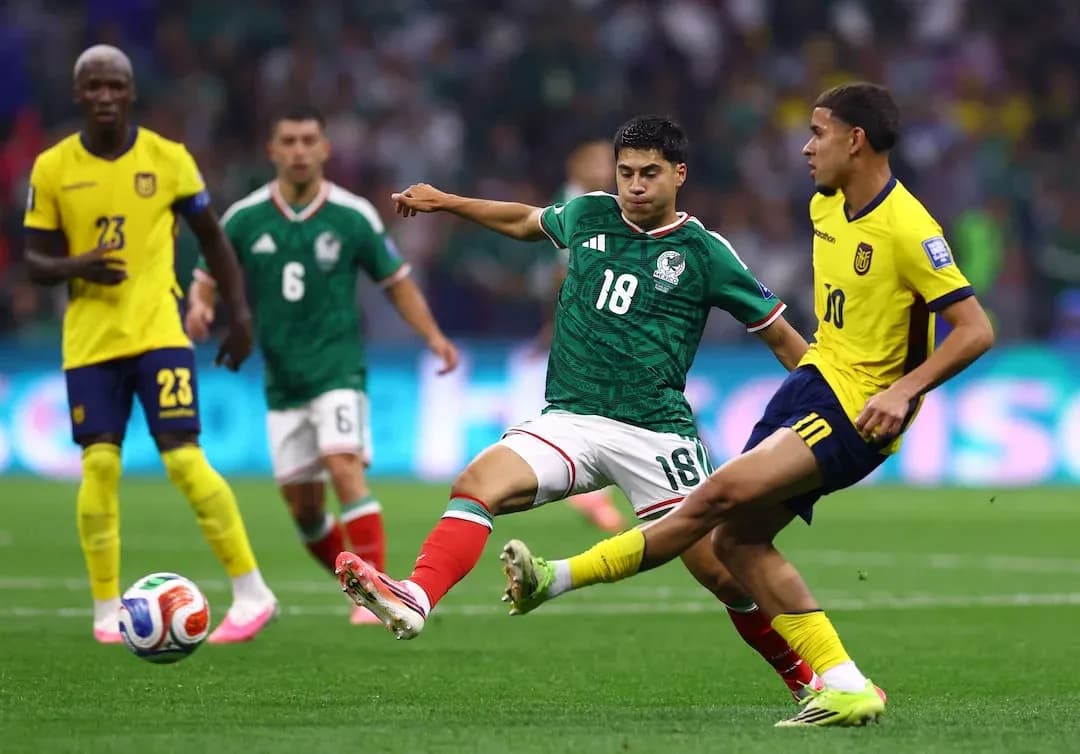
Mexico Defeats Ecuador 2-0 in World Cup Round of 32
Under the Mexico City night at Estadio Banorte, the World Cup Round of 32 brought together two sides whose group-stage journeys had carved out very different identities. Mexico arrived as Group A winners, flawless across three matches with 9 points and a goal difference of 6, their tournament built on control and clean sheets. Ecuador, third in Group E with 4 points and a neutral goal difference, came in as a more volatile proposition: capable of unsettling anyone, but still searching for a consistent attacking edge.
By full time, the scoreboard read Mexico 2–0 Ecuador, a result that felt like the logical extension of their seasonal DNA. Heading into this game, Mexico had played 4 matches in total, winning all 4. At home they had played 3 times, winning all 3, and on their travels they had added a fourth win. Their attack was efficient rather than explosive: 5 goals at home and 3 away, 8 in total, with an average of 1.7 goals at home, 3.0 away, and 2.0 overall. More telling was the defensive record: 0 goals conceded at home, 0 away, 0 in total. Four games, four clean sheets, and a back line that had yet to be breached.
Ecuador’s path was more precarious. Across 4 matches in total they had 1 win, 1 draw, and 2 defeats. At home they were steady—2 games, 1 win, 1 draw, 2 goals for and just 1 against, an average of 1.0 scored and 0.5 conceded. Away from home, however, the picture darkened: 2 matches, 0 wins, 0 draws, 2 defeats, no goals scored and 3 conceded, an average of 0.0 for and 1.5 against. Their total output—2 goals for and 4 against overall, with a scoring average of 0.5 and conceding 1.0—told of a side whose defensive structure was respectable but whose attack often ran dry.
Tactical Lineups
The lineups crystallised the tactical contrast. Javier Aguirre’s Mexico set up in a 4-3-3, a shape they had already used 3 times this tournament. R. Rangel anchored the side in goal, shielded by a back four of J. Gallardo, J. Vasquez, C. Montes, and J. Sanchez. In front of them, a midfield trio of L. Romo, E. Lira, and G. Mora formed a compact, hard-working core designed to control central zones and protect transitions. Ahead, a fluid front three of J. Quinones, R. Jimenez, and R. Alvarado offered a blend of movement, physicality, and creativity.
Opposite them, Sebastian Beccacece’s Ecuador lined up in a 4-4-2, the formation they had used most often, with H. Galindez in goal and a back line of P. Hincapie, W. Pacho, J. Ordonez, and A. Franco. The midfield four—N. Angulo, P. Vite, M. Caicedo, and J. Yeboah—were tasked with compressing space and springing forward quickly, while G. Plata and E. Valencia formed a two-pronged strike force.
Disciplinary Records
The absences list offered no restrictions, so both managers had their full squads available. That made the disciplinary histories even more significant. Mexico’s tournament card profile showed a disciplined but occasionally sharp edge: 2 yellow cards in total, both in the 16–30 and 61–75 minute ranges (each accounting for 50.00% of their yellows), and a single red card shown very late, between 91–105 minutes. Ecuador, by contrast, had lived closer to the line. Their yellow cards were spread across the 31–45, 46–60, 61–75, 76–90, and 91–105 minute windows, with 25.00% of their yellows arriving between 31–45 minutes, another 25.00% between 46–60, and 25.00% again deep into 91–105. They had also seen a red card in the 91–105 minute band. In a knockout tie, that disciplinary volatility always threatened to tilt the balance.
Key Player Matchups
Within that framework, the “Hunter vs Shield” battle was always likely to revolve around Mexico’s attacking spearheads and Ecuador’s embattled defence. J. Quinones came into the Round of 32 as one of the World Cup’s standout performers. Across the tournament he had scored 3 goals and provided 1 assist in total, from 9 shots and 5 on target, with a 7.73 average rating. His dribbling success—6 successful dribbles from 8 attempts—made him Mexico’s most direct threat between the lines. Around him, R. Alvarado, the competition’s leading creator with 3 assists in total and 10 key passes, offered the subtlety: a winger-midfielder hybrid who could drift inside, link play, and deliver the final ball.
Ecuador’s shield was built around P. Hincapie and A. Franco, both heavily involved and heavily carded. Hincapie, with 12 tackles, 2 successful blocks, and 4 interceptions in total, was the aggressive front-foot defender, willing to step out and engage. Franco, who had blocked 1 shot, added 8 tackles and 4 interceptions, and passed with 96% accuracy, was the more controlled presence but also the most combustible, with 2 yellow cards and 7 fouls committed. Their unit had held up well at home but struggled away, and against a Mexico side averaging 3.0 goals on their travels and 2.0 overall, every mistimed challenge risked becoming a turning point.
Midfield Battle
In the engine room, the duel was more subtle but just as decisive. Mexico’s midfield three, with L. Romo’s industry and E. Lira’s balance, sought to deny M. Caicedo and P. Vite the time they needed to feed Plata and Valencia. Caicedo, Ecuador’s metronome, had to fight against a team that, heading into this game, had never failed to score and had never conceded. Mexico’s total of 4 clean sheets in 4 matches, with 3 at home and 1 away, framed every Ecuadorian attack as an uphill climb.
Statistically, the prognosis always leaned Mexico’s way. They had the perfect record—4 wins from 4 in total—and had failed to score in 0 matches. Ecuador, by contrast, had failed to score in 3 matches overall, including both of their away fixtures. With neither side awarded a penalty so far (0 taken, 0 scored, 0 missed for both), there was no easy route back for Ecuador if they fell behind.
The 2–0 full-time scoreline, with Mexico already 2–0 up by half-time, simply confirmed the underlying trends. Following this result, Mexico’s aura of defensive invincibility remained intact, and their attacking leaders—Quinones as the hunter, Alvarado as the architect—continued to shape the narrative of their World Cup. Ecuador’s campaign, defined by flashes of resistance and defensive bravery from Hincapie and Franco, ultimately succumbed to a side whose structure, form, and numbers had been pointing towards a night like this from the very start.