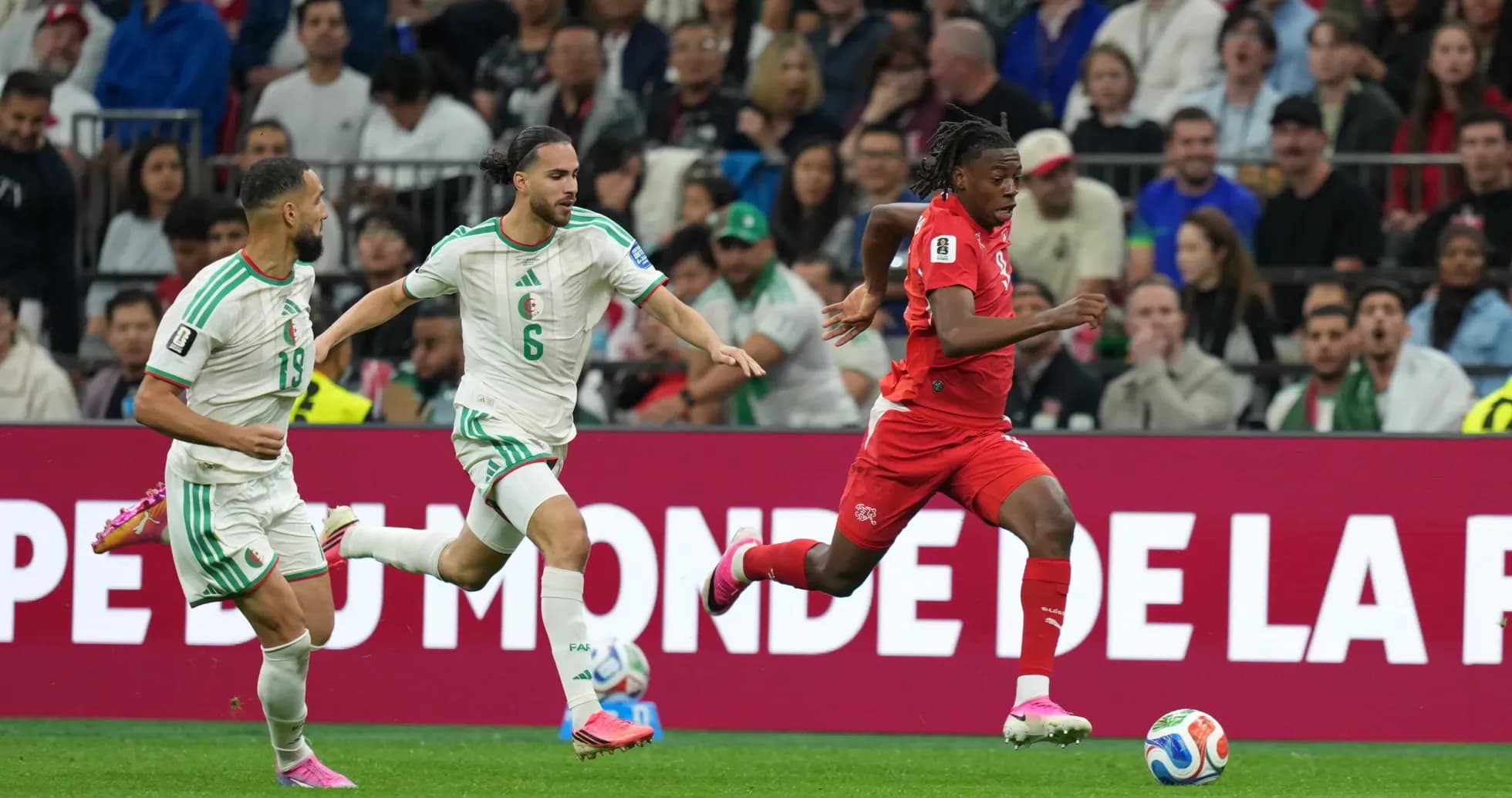
Switzerland's Tactical Mastery in 2-0 Victory Over Algeria
Switzerland’s 2-0 win over Algeria at BC Place was a textbook example of how to control a knockout tie without needing territorial dominance. In this World Cup Round of 32 fixture, Murat Yakin’s side accepted just 45% of the ball but built a structurally solid 4-2-3-1 that consistently generated higher-quality chances, reflected in a clear xG edge of 2.56 to 0.73.
Out of possession, Switzerland’s shape was the foundation. Granit Xhaka and Remo Freuler sat as a compact double pivot in front of a back four of Ricardo Rodríguez, Manuel Akanji, Nico Elvedi and Denis Zakaria. The line was relatively conservative, inviting Algeria’s 4-3-3 to play in front of them. Algeria completed 476 of 561 passes (85%) and held 55% possession, but much of this circulation was in harmless zones, with Switzerland happy to slide laterally and protect the central lane.
The pressing trigger was Algeria’s progression into the middle third. When the ball entered Nabil Bentaleb or Ramiz Zerrouki’s feet, Switzerland’s “3” line — Dan Ndoye on the right, Johan Manzambi centrally and Rubén Vargas on the left — stepped aggressively onto Algeria’s midfield, with Xhaka or Freuler jumping ahead to compress space behind them. This staggered press forced Algeria into riskier passes toward the front three of Riyad Mahrez, Ibrahim Maza and Houssem Aouar, where Akanji and Elvedi were consistently first to contact.
In goal, Gregor Kobel (Switzerland) had a relatively controlled evening. Algeria managed only 2 shots on target from 8 total attempts, and Kobel was required to make 2 saves. The low Algerian xG of 0.73 underlines how well Switzerland kept efforts to lower-quality areas, despite allowing 5 shots inside the box. The defensive line’s timing on duels and the screening work of Xhaka and Freuler meant Kobel was rarely exposed to clear one-on-ones or cut-backs.
With the ball, Switzerland’s 4-2-3-1 morphed into a 2-3-5 in settled possession. Rodríguez often tucked slightly inside from left-back, giving Xhaka the freedom to dictate from the left half-space, while Zakaria stayed a little deeper on the right to guard against Algerian counters. Vargas and Ndoye held the width high and wide, stretching Algeria’s back four and creating channels for Embolo’s runs and Manzambi’s late arrivals.
The opening goal on 10 minutes encapsulated this plan. Switzerland built through their left, pulling Algeria’s midfield across before switching quickly into the right half-space. Manzambi found the pocket between Algeria’s lines and, from that central “10” zone, slipped Breel Embolo in. Embolo’s movement across the defensive line destabilized the marking, and his finish rewarded Switzerland’s verticality: fewer passes (436 to Algeria’s 561) but more incisive ones, with 9 of their 11 shots coming from inside the box.
The second goal, immediately after half-time at 46 minutes, came from Ndoye and highlighted Switzerland’s intent to attack the intervals between full-back and centre-back. With Algeria trying to push up and reassert control, Switzerland exploited the transitional moment. Ndoye’s starting position high on the right forced Rayan Aït-Nouri and Ramy Bensebaini into difficult decisions; once the line was broken, Algeria’s rest defence was too thin to recover. Even without an assist recorded, the pattern was clearly rooted in Yakin’s structural design: win the ball, play early into the wide channels, and attack the box with Embolo and the far-side winger.
Switzerland’s passing profile — 436 total passes, 354 accurate at 81% — reflects a more direct, risk-tolerant approach compared to Algeria. They were willing to play forward early into Embolo or into the feet of Manzambi between the lines, accepting occasional turnovers in exchange for territory and pressure. The 4 corner kicks to Algeria’s 2 also speak to Switzerland’s ability to finish sequences in the final third rather than being forced back.
Algeria, under Vladimir Petkovic, stayed loyal to a 4-3-3 built around technical control. Zerrouki, Bentaleb and Farès Chaïbi formed the midfield triangle, with Mahrez and Aouar tucking inside off the wings to overload central zones while Aït-Nouri and Rafik Belghali provided width. On paper, this structure should have stretched Switzerland’s double pivot, and the possession numbers show they did manage to keep the ball. However, Switzerland’s compactness meant that many Algerian attacks stalled in front of the penalty area, forcing shots from less dangerous locations: 3 of their 8 attempts came from outside the box, and Switzerland still managed to block 2 of the 5 efforts taken inside.
Luca Zidane (Algeria) faced 5 shots on target and made 2 saves, with Switzerland scoring twice. Switzerland’s xG of 2.56 versus Algeria’s goals prevented figure of -0.29 indicates that Algeria’s goalkeeper performed slightly below the expected shot-stopping benchmark on the day, whereas Switzerland’s outfield structure did most of the work for Kobel, limiting the volume and quality of Algerian chances.
Discipline further illustrated the game’s dynamics. Switzerland committed 10 fouls but avoided any bookings, a sign of controlled aggression and clean defensive timing. Algeria, by contrast, committed 12 fouls and picked up 2 yellow cards — Farès Chaïbi for “Tripping” at 36 minutes and Hicham Boudaoui for “Roughing” at 72 minutes — as they increasingly chased the game and tried to disrupt Switzerland’s rhythm.
Substitutions in the second half were largely reactive from Algeria and protective from Switzerland. For Algeria, Jaouen Hadjam (IN) came on for Houssem Aouar (OUT) and Amine Gouiri (IN) came on for Ramiz Zerrouki (OUT), later followed by Anis Hadj Moussa (IN) for Riyad Mahrez (OUT), Hicham Boudaoui (IN) for Nabil Bentaleb (OUT), and Adil Boulbina (IN) for Rafik Belghali (OUT). These changes shifted the profile of the front line but did not fundamentally alter the structural issues in breaking down Switzerland’s block. Yakin responded by injecting fresh legs into the same framework: Fabian Rieder (IN) for Rubén Vargas (OUT), Noah Okafor (IN) for Johan Manzambi (OUT), Zeki Amdouni (IN) for Breel Embolo (OUT), Silvan Widmer (IN) for Denis Zakaria (OUT), and Michel Aebischer (IN) for Dan Ndoye (OUT). The idea was clear: preserve the 4-2-3-1’s integrity, maintain defensive intensity, and keep transition threats alive without opening central spaces.
Statistically, the verdict is decisive. Algeria’s 55% possession and superior pass completion could not compensate for Switzerland’s superior shot quality, box presence and tactical clarity. Switzerland produced more total shots (11 to 8), more shots on goal (5 to 2), and a much higher xG, while conceding only 2 shots on target and 2 corners. The Swiss block, anchored by Xhaka and Freuler and marshalled by Akanji and Elvedi in front of Kobel, turned Algeria’s territorial control into largely sterile dominance.
In a knockout context, this match underlined the primacy of structure over sheer possession. Switzerland’s 4-2-3-1 was balanced, repeatable and ruthless in key moments; Algeria’s 4-3-3 offered technical fluency but lacked the mechanisms to penetrate a well-drilled block. The 2-0 scoreline, aligned with the underlying metrics, fairly reflected a Swiss side that managed risk intelligently and maximized their attacking platforms on the World Cup stage at BC Place.