
Egypt Achieves Historic First Knockout Win with Salah's Heroics
In the end, it came down to a bar, a blaze and a man who has carried a nation for a decade.
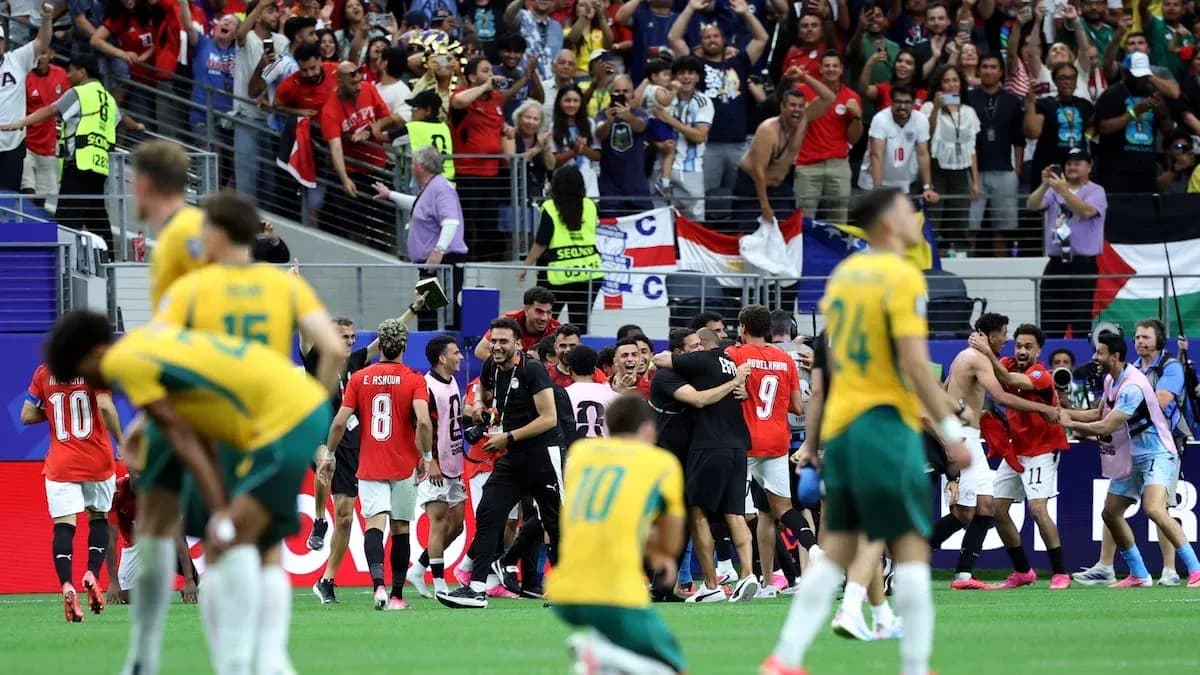
Mohamed Salah, quiet for most of the night, walked up for his penalty with 70,000 voices swirling around the air-conditioned arena that usually belongs to the Dallas Cowboys. One cool stride, one calm strike, and Egypt stepped into history. Moments later, Lucas Herrington’s effort crashed against the bar and Abdelmaguid buried the decisive kick, sending Egypt through and leaving Salah on his knees in tears of joy, while Australia’s players sank to the turf in disbelief.
It was a brutal finish for the Socceroos, who had never won a men’s World Cup knockout tie. Egypt hadn’t either. Both teams knew exactly what was at stake. The shootout felt like a shared tightrope.
Tony Popovic played his last card before it began, throwing on Mathew Ryan for the penalties in a late, high-stakes gamble. It looked bold. It looked calculated. But as Harry Souttar stepped up first, shooting toward a wall of Egypt fans and a storm of whistles, the plan immediately began to unravel. The defender smashed his kick high over the bar, handing Egypt the advantage they never let go.
Five penalties followed, each one buried with conviction. Salah’s was the pick of them, rolled in with the kind of icy composure that has become his trademark. Herrington, just 18 and carrying the weight of a country, then rattled the crossbar. Abdelmaguid finished the job, and Australia’s World Cup ended not with a roar, but with the hollow thud of ball on woodwork.
Egypt’s Path
Egypt’s path to that moment had begun early. With just 13 minutes gone, Emam Ashour ghosted in at the back post and met Karim Hafez’s cross with a firm header, guiding it past Patrick Beach to give the seven-time African champions the lead. It was Ashour’s second goal of the tournament and it arrived slightly against the run of play, with Australia having started brightly.
Cristian Volpato had already come within inches of a dream opener, rattling the top of the bar inside the first five minutes. The Roma-bred playmaker, who chose Australia over Italy on the eve of the World Cup, almost wrote his own script. Instead, the ball skimmed the frame and flew away, a warning that went unheeded by a nervy Egypt back line.
Egypt, who had tasted their first-ever World Cup win in the group stage with a 3-1 victory over New Zealand, looked jittery at the back. Passes went astray, clearances lacked conviction. Yet they struck first, and from that point the game shifted. Australia, a side that had scored only twice in the group phase, suddenly had to chase.
Popovic’s team struggled to turn possession into threat. Their first shot on target did not arrive until 10 minutes before the break, when Aziz Behich hit a tame effort straight at Mostafa Shoubir. The Egypt goalkeeper, son of 1990 World Cup keeper Ahmed Shoubir, barely had to move.
The contest grew scrappy. Salah, 34 and still feeling the effects of a recent hamstring strain, remained on the fringes in an attritional first half. He drifted, he probed, but never quite escaped the Australian attention. The half ended with another blow for the Socceroos as Jordan Bos, one of the quickest players at the tournament, crumpled after a fierce aerial challenge from Rabia. Bos had to be helped from the field and did not reappear after the interval, replaced by Kai Trewin in a significant setback to Australia’s attacking thrust.
Seconds into the second half, Egypt should have killed the contest. Omar Marmoush, the Manchester City forward, slid in at close range but somehow steered his effort off target. It was a glaring miss, and it gave Australia a lifeline they would soon seize.
The game grew more physical, exactly as Egypt’s coach had feared. Australia hurled bodies into duels, contested every ball, and forced set-piece opportunities. The pressure told from one of them. An in-swinging free-kick whipped into the box, Mohamed Hany challenged under heavy contact and, in the chaos, headed into his own net. It was his second own goal of the tournament and it dragged the Socceroos level 10 minutes after the restart.
From there, tension thickened. Egypt, stung by the equaliser, pushed again. Salah still struggled to impose himself fully, but he began to stitch moves together, dropping deeper, linking play. Deep into added time, he was involved in the build-up as Beach produced a superb, athletic save to deny Ramy and drag the match into extra time.
Egypt finished normal time on top, and that momentum carried into the additional 30 minutes. Salah finally found space early in extra time, cutting inside on his weaker right foot and firing over. It was not the finish he wanted, but it underlined where the danger now lay. Penalties loomed larger with every passing minute. Neither side could find a decisive opening, legs tired, touches grew heavy, and both benches began to glance toward the list of penalty takers.
When the shootout arrived, Egypt held their nerve. Australia did not.
Souttar’s miss set the tone. Egypt’s takers, Salah among them, struck with conviction. Herrington’s effort against the bar felt cruel on a teenager thrust into such a brutal spotlight, yet it also captured the story of Australia’s night: so close, but always just off the mark.
Egypt, by contrast, finally crossed a line that had eluded them for generations. A first knockout win at a men’s World Cup, delivered in a swirl of noise, pressure and raw emotion. Salah, often the hero with the ball in open play, this time wrote his chapter from 12 yards.
The question now is how far this breakthrough can carry them.




