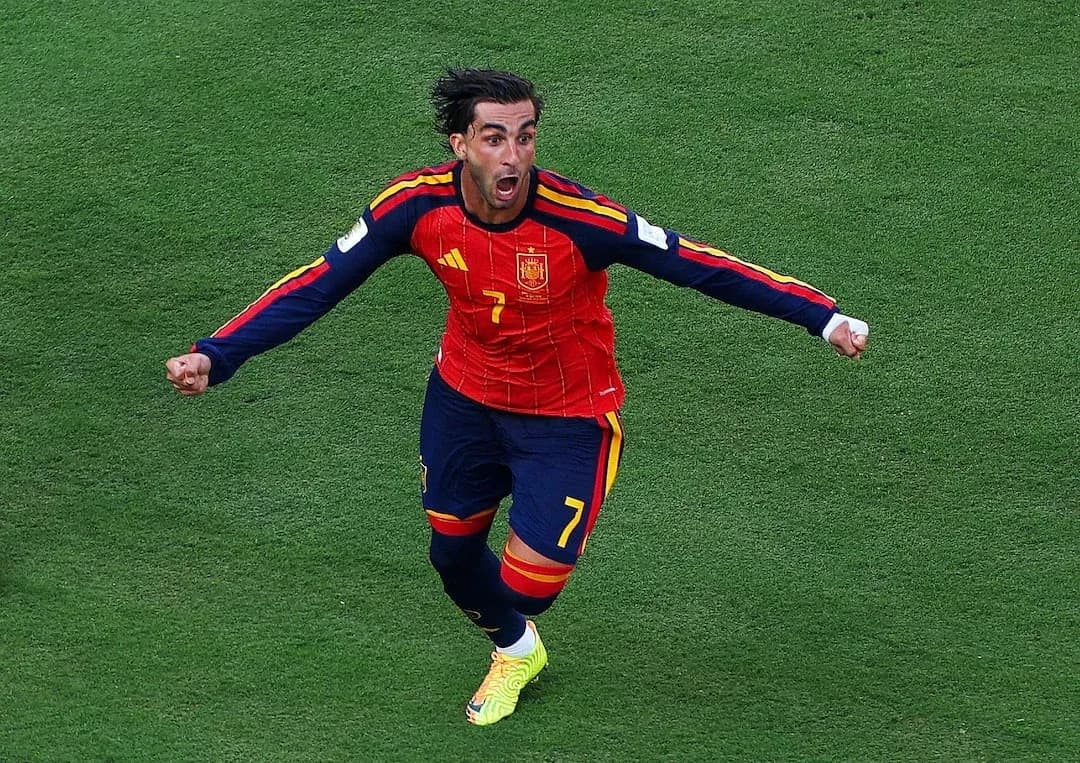
Spain and Cape Verde Islands End in Goalless Draw: Tactical Analysis
Spain’s 0-0 draw with Cape Verde Islands at Mercedes-Benz Stadium was a territorial siege that never turned into a breakthrough. Luis de la Fuente’s side imposed their usual high-possession, positionally structured game, but met a compact, well-drilled block from Pedro Leitao Brito’s team, who accepted life without the ball and trusted their defensive organisation and goalkeeper to survive.
Spain’s dominance is captured starkly in the numbers: 74% possession, 27 total shots to 6, and 11 corner kicks to 1.
Yet the World Cup Group Stage opener ended goalless, shaped tactically by Spain’s insistence on control and Cape Verde Islands’ commitment to low-risk defending and selective transitions rather than constant counter-attacking.
Spain’s Positional Structure
Spain’s positional structure revolved around a clear ball-circulation triangle in midfield. Rodri anchored the centre, repeatedly dropping close to Pau Cubarsí and Aymeric Laporte to create a 3v1 or 3v2 against Cape Verde Islands’ first pressing line. With 801 total passes and 734 accurate (92%), Spain recycled possession relentlessly, using Marcos Llorente and Marc Cucurella as high, wide outlets to stretch the defensive block horizontally.
Fabián Ruiz and Pedri operated between Cape Verde Islands’ midfield and defence, constantly searching for pockets to receive on the half-turn. However, the visitors’ central compactness forced Spain to funnel much of their play into wide zones. The shot profile underlines this: 16 shots inside the box but also 11 from outside, suggesting that when central lanes were closed, Spain often settled for efforts from distance rather than consistently breaking the last line.
Attacking Dynamics
Up front, Ferran Torres, Mikel Oyarzabal and Pablo Gavi formed a flexible front three, frequently rotating positions to unsettle markers. Gavi’s classification as a forward reflected his advanced role, often arriving late into the box rather than acting as a fixed striker. Despite this movement, Cape Verde Islands’ back four stayed narrow and disciplined, rarely following runners into wide areas and instead protecting the central corridor.
Cape Verde Islands’ Defensive Strategy
Cape Verde Islands’ defensive game plan hinged on a compact mid-to-low block. With only 279 passes (205 accurate, 73%), they had no intention of matching Spain in possession. Instead, Kevin Lenini and Laros Duarte shielded the back line, while Jamiro Monteiro and Jovane Cabral tracked Spain’s interiors. The early yellow card at 16' for Sidny Lopes Cabral (Foul) illustrated the physical edge required to contain Spain’s wide play, but overall Cape Verde Islands committed only 1 foul all match, indicating that their defensive success was based more on positioning and anticipation than constant last-ditch challenges.
In goal, Unai Simón (Spain) had a quiet but concentrated evening, registering 1 save as Cape Verde Islands managed just 1 shot on target from their 6 attempts. Spain’s high line and counter-press effectively smothered most transition moments before they could develop into clear chances, reflected in Cape Verde Islands’ low xG of 0.3.
Key Performances
At the other end, Vozinha (Cape Verde Islands) delivered the key individual performance. He made 7 saves, directly facing Spain’s 7 shots on goal, and his influence is reinforced by the defensive metrics: Cape Verde Islands finished with 1.46 goals prevented, matching Spain’s xG of 2.29. That figure quantifies how much above an average keeper’s expectation Vozinha performed; it effectively turned a game Spain “should” have scored in into a clean sheet for the underdogs.
Substitutions and Tactical Changes
Spain’s substitutions at 71' and beyond were clearly tactical attempts to alter the attacking dynamic. Mikel Merino (IN) came on for Fabián Ruiz (OUT), adding more vertical running and aerial presence from midfield. Lamine Yamal (IN) replaced Pablo Gavi (OUT), introducing one-versus-one dribbling threat from wide areas and a more direct approach against a tiring back line. Later, Dani Olmo (IN) came on for Ferran Torres (OUT) at 81', offering a different profile between the lines, and Nico Williams (IN) replaced Rodri (OUT) at 87', signalling a final push with even more width and pace at the expense of some central control.
Cape Verde Islands’ triple change at 61' was equally instructive. Deroy Duarte (IN) came on for Laros Duarte (OUT), Nuno Da Costa (IN) for Dailon Rocha Livramento (OUT), and Willy Semedo (IN) for Jovane Cabral (OUT). This cluster of substitutions refreshed both midfield legs and the forward line, aiming to maintain pressing intensity and provide an outlet for clearances. Later, João Paulo (IN) came on for Sidny Lopes Cabral (OUT) at 76', and Telmo Arcanjo (IN) replaced Jamiro Monteiro (OUT) at 79', further reinforcing the midfield screen as the game tilted deeper into Cape Verde Islands’ half.
Disciplinary Log
Discipline remained controlled despite Spain’s territorial pressure. Cape Verde Islands finished with 1 yellow card, Spain also with 1, for a total of 2. The disciplinary log, in chronological order, was:
- 16' Sidny Lopes Cabral (Cape Verde Islands) — Foul
- 90+3' Pedri (Spain) — Foul
These bookings underline that while the match was tactically intense, it never descended into chaos; both teams largely maintained structure and composure.
Statistical Summary
Statistically, Spain’s attacking volume and quality were clear. Their xG of 2.29 against Cape Verde Islands’ 0.3, combined with 27 total shots to 6 and 11 corners to 1, paints a picture of near-total control. The 8 blocked shots for Spain also show how often Cape Verde Islands got bodies in front of efforts, reinforcing the narrative of a low, committed block.
From a broader lens, Spain’s overall form in this match reflects a high-possession, high-precision side that struggled with final-third efficiency and shot selection rather than chance creation. Defensively, their index was strong: they limited Cape Verde Islands to minimal threat and protected Unai Simón (Spain) effectively.
For Cape Verde Islands, the defensive index was outstanding. With 7 saves from Vozinha (Cape Verde Islands), 2 blocked shots, and 1.46 goals prevented, their collective and individual defending turned a statistically one-sided contest into a valuable Group Stage point, validating a pragmatic, compact tactical approach against elite opposition.