Australia vs Türkiye: Tactical Insights from World Cup Opener
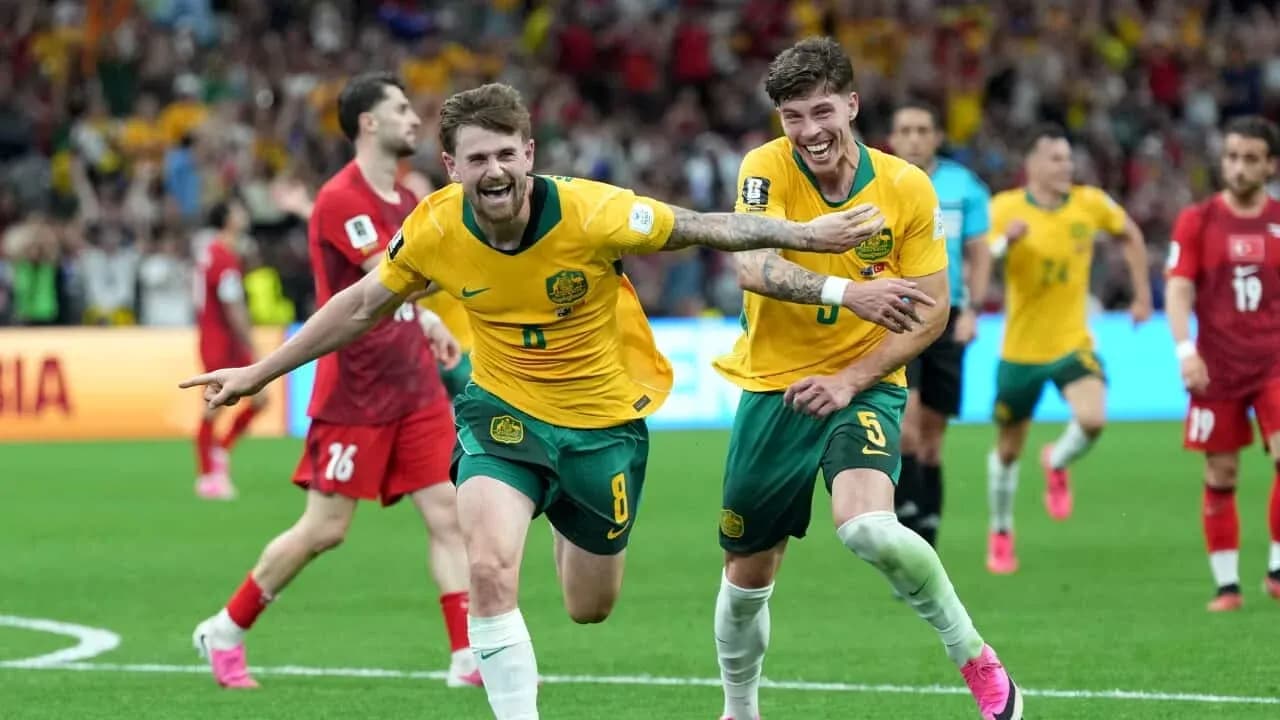
The roof was closed at BC Place, but the game felt wide open from the first whistle. Under the lights in Vancouver, Australia and Türkiye walked out not just to open their World Cup campaigns, but to set the tone for Group D. By the end of 90 minutes, the scoreline – Australia 2, Türkiye 0 – had redrawn the early group map and revealed two very different tactical identities.
I. The Big Picture – Structure, Scoreline, Stakes
Heading into this game, both sides were still theoretical entities: no long tournament sample, only ideas, reputations and one clear choice each – formation as a statement of intent.
Tony Popovic’s Australia lined up in a 5-4-1, a shape that on paper suggests caution but in practice became a springboard. With this win, Australia’s overall record in the World Cup group phase stands at 1 match played, 1 win, 0 draws, 0 defeats. Overall they have scored 2 goals and conceded 0, giving them a goal difference of +2 (2 minus 0). At home – this was logged as a home fixture – they have played 1, won 1, drawn 0, lost 0, with 2 goals for and 0 against, averaging 2.0 home goals for and 0.0 home goals against.
Vincenzo Montella’s Türkiye went with a 4-2-3-1, ostensibly a proactive, possession-friendly structure. But following this result, their overall World Cup record reads: 1 match played, 0 wins, 0 draws, 1 defeat. On their travels they have played 1, lost 1, with 0 goals for and 2 against, an away average of 0.0 goals scored and 2.0 conceded. Their goal difference sits at -2 (0 minus 2), a numerical mirror of Australia’s early efficiency.
The standings snapshot in Group D underlines the divergence: Australia in 2nd with 3 points and that +2 goal difference, Türkiye 3rd with 0 points and -2, already under pressure.
II. Tactical Voids and Discipline – Where Control Was Won
There were no listed absences in the data, so both coaches had their full squads available. The tactical voids, then, were structural rather than personnel-based.
Australia’s back five of Jacob Italiano, Alessandro Circati, Harry Souttar, Cameron Burgess and Jordan Bos created a broad, stable base. The wing-backs, Italiano and Bos, were crucial: starting as nominal defenders but constantly threatening to step into midfield, they allowed the central trio of Connor Metcalfe, Aiden O’Neill and Paul Okon-Engstler to stay compact and screen second balls.
Türkiye’s double pivot of İsmail Yüksek and Hakan Çalhanoğlu had the opposite problem. On paper, it was a strong blend of energy and orchestration, but with Arda Güler, Orkun Kökçü and Barış Alper Yılmaz all seeking advanced pockets, the pivot was often left with too much grass to patrol. The 4-2-3-1 stretched vertically, leaving gaps between lines that Australia’s counters could pierce.
Disciplinary patterns added another layer. Australia’s season card data is blank by minute range, suggesting they have not yet been drawn into persistent fouling phases. Türkiye, by contrast, already show a clear late-game edge: 100.00% of their yellow cards so far have arrived in the 76-90 minute window. Yunus Akgün embodies that profile. In 35 minutes of action, he committed 1 foul, drew duels and took a yellow card that underlines how Türkiye’s frustration peaks late, just when composure is most needed.
III. Key Matchups – Hunter vs Shield, Engine Room vs Enforcer
Hunter vs Shield
In the absence of a detailed goals-against timing chart, the “Hunter vs Shield” duel is best framed through Australia’s emerging attacking spearheads and Türkiye’s defensive spine.
Nestory Irankunda, operating from the midfield line in the 5-4-1, was Australia’s most incisive hunter. In total this campaign he has 1 goal from 1 appearance, with 2 shots, both on target. A rating of 7.5 across 61 minutes reflects how his directness – 1 successful dribble from 1 attempt, 1 foul drawn – forced Türkiye’s back four to constantly adjust their line. His threat was amplified by the lone forward Mohamed Touré, whose presence pinned centre-backs and opened channels for Irankunda’s surges.
On the other side, Türkiye’s shield was built around Merih Demiral and Abdülkerim Bardakcı, supported by Zeki Çelik and Ferdi Kadıoğlu. Yet the numbers show that on their travels they have already conceded 2 goals in 1 match, with an away average of 2.0 goals against and 0 clean sheets. The structural issue was not just individual defending but exposure: once Australia broke the first line of pressure, Türkiye’s back four were repeatedly facing runners without adequate midfield cover.
Engine Room – Playmaker vs Enforcer
The game’s quiet but decisive duel ran through the middle: Paul Okon-Engstler against Türkiye’s central operators.
Okon-Engstler’s World Cup profile is that of a modern two-way midfielder. In total this campaign he has 1 assist, 32 passes at 81% accuracy, and 2 key passes. Defensively, he has 3 tackles, 2 successful blocks and 3 interceptions. That line tells the story: he is both the metronome and the breaker. Every time Türkiye tried to thread vertical passes into Arda Güler or Kerem Aktürkoğlu, Okon-Engstler’s positioning and anticipation disrupted the pattern.
For Türkiye, Hakan Çalhanoğlu and Orkun Kökçü were meant to be the playmaking axis, but they were repeatedly funneled into safer zones. Without clean access to the half-spaces, their 4-2-3-1 lost its central sharpness, forcing more hopeful balls into wide areas where Australia’s wing-backs could defend facing play.
Yunus Akgün’s cameo is also telling for the Turkish engine. In his 35 minutes he completed 21 passes at 90% accuracy and produced 2 key passes – clear evidence of creative spark – but the yellow card and the timing of Türkiye’s disciplinary spike (that late 76-90 surge) suggest that their attempts to chase the game came with a cost in control.
IV. Statistical Prognosis – What This Game Predicts
Following this result, the statistical balance is stark. Australia’s overall averages are clean: 2.0 goals for per match, 0.0 against, 1 clean sheet in 1 game, and 0 matches where they have failed to score. Their biggest home win is already 2-0, and their preferred formation – 5-4-1, played in 1 of 1 games – has delivered immediate stability.
Türkiye, conversely, sit on 0.0 goals scored per match overall, 2.0 conceded, 0 clean sheets and 1 total failure to score. Their biggest away defeat is 2-0, and their 4-2-3-1 has so far produced more sterile possession than penetration.
Without xG values in the data, the prognosis must lean on these structural and scoring patterns. Australia look like a side whose defensive solidity is baked into their system: a back five that rarely breaks, a midfield led by Okon-Engstler capable of both shielding and springing transitions, and a match-winner in Irankunda who can convert limited chances into decisive moments.
Türkiye, meanwhile, must recalibrate. The numbers say their late-game emotional curve – yellow cards concentrated in the final quarter-hour – is at odds with the patience their 4-2-3-1 requires. Unless the double pivot finds better protection for the back line and clearer vertical lanes for Güler and Kökçü, their possession will continue to run aground on compact blocks like Australia’s.
In Vancouver, the story was simple: a disciplined structure beat a looser, more expansive idea. On the evidence of this 2-0, the tournament’s early tactical ledger writes Australia down as a pragmatic, efficient contender in Group D, and Türkiye as a talented but unbalanced side already chasing the numbers.