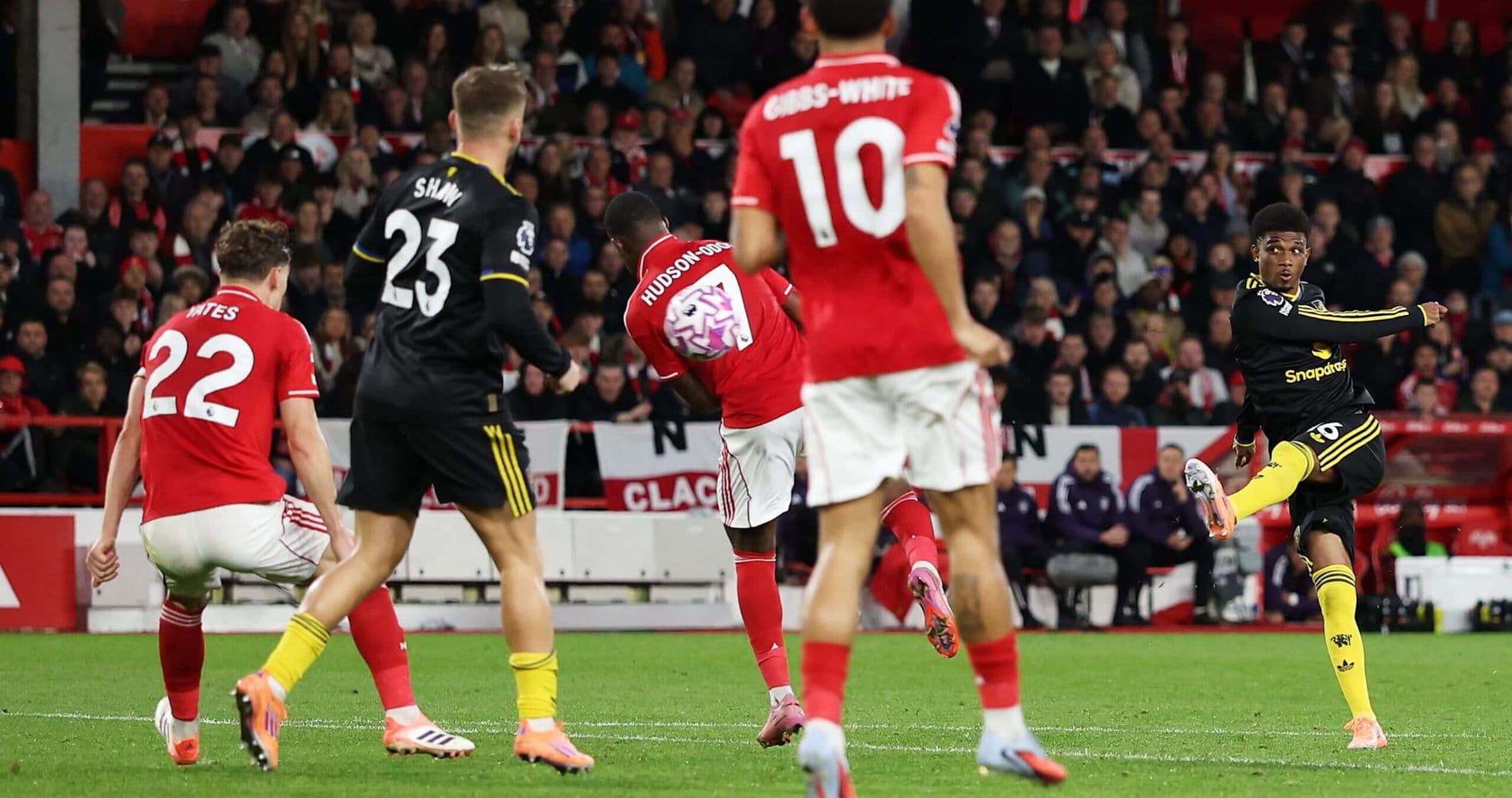
Manchester United Edges Nottingham Forest 3-2 in Premier League Clash
Old Trafford had the feel of a season’s verdict rather than a routine league game. In the penultimate round of the 2025 Premier League season, Manchester United, chasing a top-three finish, edged Nottingham Forest 3-2 in a match that distilled both clubs’ seasonal identities: United’s attacking weight at home, Forest’s volatility on their travels.
Following this result, United sit 3rd on 68 points, their overall goal difference at +16, the product of 66 goals for and 50 against. At Old Trafford they have been a force: 13 wins from 19, with 39 home goals at an average of 2.1 per match and only 24 conceded (1.3 on average). Forest, by contrast, leave Manchester as a 16th-placed side on 43 points, their overall goal difference a tight -3 from 47 scored and 50 conceded. Yet away from home they have been more dangerous than their league position suggests: 7 wins from 19, 28 away goals at 1.5 per game, and 28 conceded at the same 1.5 rate.
I. The Big Picture – Structures and Season DNA
Michael Carrick stayed loyal to United’s season-long blueprint, sending his side out in a 4-2-3-1 – the club’s most-used shape, deployed in 19 league fixtures. S. Lammens stood behind a back four of D. Dalot, H. Maguire, L. Martinez and L. Shaw. In front, Casemiro and K. Mainoo formed the double pivot, with a high-creative line of A. Diallo, Bruno Fernandes and Matheus Cunha behind lone forward B. Mbeumo.
Vitor Pereira countered with a 4-4-2, a departure from Forest’s primary 4-2-3-1 but still rooted in familiar principles: verticality, directness, and hard running. M. Sels anchored a back line of N. Williams, N. Milenkovic, Morato and L. Netz. Across midfield, O. Hutchinson and E. Anderson worked the flanks, N. Dominguez and M. Gibbs-White occupied the central lanes, while Igor Jesus partnered C. Wood up front.
Heading into this game, the statistical clash was stark. United’s total average of 1.8 goals for per match and 1.4 against framed them as an open, high-event side. Forest mirrored that chaos: 1.3 total goals for per game and 1.4 against, with a notable split between a cautious home attack (1.1) and a bolder away one (1.5). This was never likely to be cagey.
II. Tactical Voids – Absences and Discipline
Both managers had to negotiate significant absences that shaped the tactical story. For United, B. Šeško – 11 league goals and a classic penalty-box presence – was ruled out with a leg injury, while M. de Ligt’s back injury removed a high-level organiser from the defensive rotation. The consequence was twofold: Carrick leaned heavily on Mbeumo’s channel running and Cunha’s all-action movement to compensate for Šeško’s penalty-area gravity, and he entrusted Maguire–Martinez as the core pairing without De Ligt’s aerial dominance.
Forest’s voids were even more structural. O. Aina, W. Boly, Murillo and N. Savona were all missing from the defensive group, stripping Pereira of both depth and variety in his back line. C. Hudson-Odoi’s absence removed a key transition threat on the wing. The knock-on effect was a back four that had to defend higher and more often in space, with Morato and Milenkovic exposed against United’s rotating front four.
Disciplinary trends added a layer of tension. United’s yellow-card distribution shows a clear spike between 46-60 minutes and again from 76-90, each window accounting for 20.63% of their cautions. Forest are similarly combustible after the break: 25.42% of their yellows arrive between 46-60, with another 22.03% from 61-75. In a game that stayed alive until the end, those patterns mattered; the second half was always likely to become fragmented, with tactical fouls and stoppages breaking rhythm.
III. Key Matchups – Hunter vs Shield, Engine Room Battles
The headline “Hunter vs Shield” duel revolved around Forest’s top scorer M. Gibbs-White and a United defence that, overall, concedes 1.4 goals per match. Gibbs-White came into this fixture with 14 league goals and 4 assists, underpinned by 57 shots (31 on target) and 47 key passes. Operating nominally as a midfielder in the 4-4-2, he frequently stepped into the half-spaces behind Wood and Igor Jesus, trying to exploit the zones either side of Casemiro.
United’s “shield” was layered rather than singular. Casemiro, with 90 tackles, 27 blocked shots and 32 interceptions this season, patrolled the central corridor, while Martinez’s aggression on the front foot denied Gibbs-White the luxury of turning under little pressure. Yet Forest’s away record – 28 goals on their travels – meant that every United turnover carried jeopardy. When Gibbs-White drifted wide to combine with N. Williams, whose 94 tackles and 17 blocked shots speak to a relentless two-way role, Forest could overload Shaw’s flank and test United’s rest defence.
In the “Engine Room” matchup, Bruno Fernandes versus N. Dominguez and E. Anderson decided the game’s tempo. Bruno’s season has been extraordinary: 8 goals, a league-leading 20 assists, 133 key passes and 1,940 total passes at 82% accuracy. From the No. 10 slot he constantly searched for vertical lanes into Mbeumo and Cunha, using Mainoo’s calmer distribution as a platform. Forest’s central pair had to juggle double duty – pressing Bruno while screening passing lanes into Casemiro to stop United from endlessly recycling attacks.
On the flanks, Mbeumo’s duel with L. Netz and Morato was decisive. Mbeumo’s 10 goals, 3 assists and 52 dribble attempts (17 successful) show a player who mixes end product with persistent probing. Against a Forest back line shorn of Boly and Murillo, his diagonal runs into the right half-space repeatedly forced Milenkovic into uncomfortable foot races, stretching the 4-4-2 into a lopsided 4-2-3-1 out of possession.
IV. Statistical Prognosis – What This Result Tells Us
Following this result, the numbers underline why United are heading for Champions League football. Overall they have 19 wins from 37, with just 7 defeats and only 4 matches in which they failed to score. Their clean-sheet total of 7 is modest, but their attacking weight – 66 goals, a home average of 2.1 – consistently bails out a defence that remains vulnerable to direct, away-oriented sides like Forest.
Forest’s profile is that of a team living on a knife-edge. With 11 wins, 10 draws and 16 losses from 37, and a total goals-against figure of 50 matching United’s, they inhabit the same defensive tier but without the same attacking ceiling. The fact they have failed to score in 14 league matches overall, despite that 1.5 away-goal average, reveals their streaky nature: when the transitions click, they can trouble anyone; when they are forced into structured possession, they run dry.
In Expected Goals terms, the tactical shapes and season-long data suggest a contest tilted towards United. Their sustained chance creation, Bruno’s volume of key passes and the multi-pronged threat of Cunha, Mbeumo and the late-arriving Casemiro point to a higher xG baseline in almost every home outing. Forest, meanwhile, rely heavily on efficiency: Gibbs-White’s shot profile and Wood’s penalty-box instincts must overperform to bridge the gap.
This 3-2 at Old Trafford felt like the logical expression of those trends. United’s home firepower overwhelmed Forest’s patched-up back line, but Pereira’s side once again showed why their away numbers keep them afloat – dangerous, opportunistic, and never entirely beaten until the final whistle.