Chelsea's Tactical Masterclass in 2-1 Victory Over Tottenham
Chelsea’s 2-1 win over Tottenham at Stamford Bridge was a study in controlled sacrifice of the ball for territorial and structural advantages. Despite ceding 56% possession and facing a higher xG (0.63 vs 1.72), Chelsea’s 4-2-3-1 was the more coherent out-of-possession system, while Tottenham’s mirror shape struggled to convert sterile dominance into truly destabilising situations.
Calum McFarlane’s 4-2-3-1 hinged on the double pivot of Andrey Santos and Moises Caicedo screening a relatively high defensive line. Chelsea accepted long Tottenham passing sequences (425 passes vs 538), but their compactness between the lines limited central progression. The block narrowed aggressively when the ball entered the half-spaces, with Enzo Fernandez stepping up from the left interior and Cole Palmer tucking inside from the right to form a situational midfield box around Tottenham’s creators.
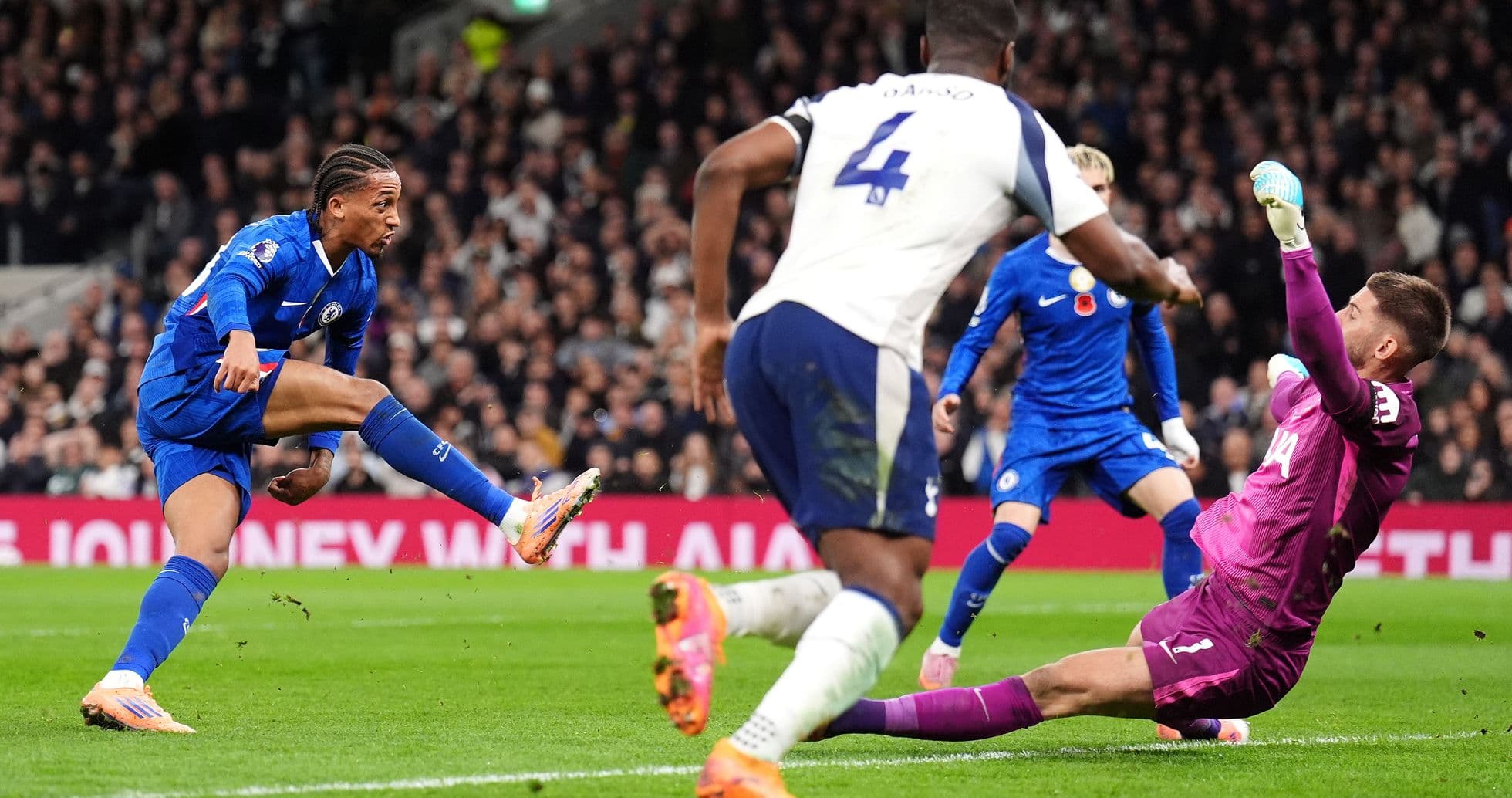
In possession, Chelsea were more direct and vertical. With only 44% of the ball and 9 total shots, they focused on sharp, pre-planned patterns rather than volume. The first goal at 18 minutes – Enzo Fernandez finishing from a Pedro Neto assist – reflected this: quick progression from the double pivot, Neto attacking space between full-back and centre-back, and Fernandez arriving late from the left half-space. It was a classic “third-man” style run from midfield, exploiting Tottenham’s advanced full-backs and the space behind their pressing eights.
Tottenham, in Roberto De Zerbi’s 4-2-3-1, tried to build patiently through Joao Palhinha and Rodrigo Bentancur. Their 88% pass accuracy (473 accurate from 538) underlined technical control, but much of it remained in front of Chelsea’s block. The key structural issue was spacing between the lines: Richarlison often received with his back to goal against two centre-backs, while the line of three behind him – Randal Kolo Muani, Conor Gallagher, and Mathys Tel – were frequently on the same horizontal line, making it easier for Chelsea’s midfield to defend in numbers.
Tottenham’s shot profile tells the story: 8 of their 9 shots came inside the box, yet only 3 were on target. They managed to reach advanced zones but struggled to create clear, unpressured finishing situations. Chelsea’s back four, with Jorrel Hato and Wesley Fofana central, defended the box aggressively, stepping out to block shooting lanes (Chelsea recorded 2 blocked shots vs Tottenham’s 1) and trusting their covering angles more than their goalkeeper volume. Robert Sanchez (Chelsea) was called on for only 2 saves; the defensive unit in front of him did much of the heavy lifting by forcing rushed or off-balance efforts.
The second Chelsea goal on 67 minutes, scored by Andrey Santos and assisted by Enzo Fernandez, was emblematic of their transitional punch. Tottenham’s structure, already stretched by their attempts to chase the game, left gaps between the double pivot and the back line. Chelsea’s midfield won the second ball, Enzo found a pocket between the lines, and Santos timed his forward run from deep to break beyond Tottenham’s centre-backs. It was a direct exploitation of Tottenham’s rest-defence: full-backs high, pivots separated, centre-backs exposed to late runs from midfield.
De Zerbi’s triple substitution at 69 minutes – James Maddison (IN) for Randal Kolo Muani (OUT), Djed Spence (IN) for Destiny Udogie (OUT), and P. M. Sarr (IN) for Joao Palhinha (OUT) – was an attempt to add creativity, width, and fresh legs in midfield. The immediate effect was a more chaotic, higher-tempo game. Tottenham finally broke through on 74 minutes, Richarlison finishing from a P. M. Sarr assist. This sequence reflected the new dynamic: Sarr’s energy and vertical passing from midfield, Maddison’s presence occupying Chelsea’s block, and Richarlison attacking the near-post channel between centre-back and full-back.
However, Tottenham’s push came at a disciplinary and structural cost. They committed 18 fouls to Chelsea’s 11 and collected 3 yellow cards – Pedro Porro, Micky van de Ven, and Destiny Udogie all booked for “Foul” – a sign of repeated tactical halts to Chelsea’s counters and late recovery runs after losing the ball high. Chelsea’s four yellows – Jorrel Hato for “Time wasting”, Marc Cucurella for “Argument”, Liam Delap for “Foul”, and Dário Essugo for “Foul” at 90+2 – reflected a different game-state: protecting a lead, managing tempo, and engaging in duels as Tottenham piled forward.
From a passing and circulation perspective, Tottenham’s 538 passes at 88% accuracy created a clear territorial edge but not a qualitative one. Their xG of 1.72 shows they did engineer good positions, yet the final actions were either under pressure or poorly selected. Chelsea, with 425 passes at 84%, were less precise but more purposeful. Their xG of 0.63, turned into two goals, underlines clinical exploitation of high-value moments rather than sustained siege.
Both goalkeepers were relatively underworked. Robert Sanchez (Chelsea) made 2 saves, as did A. Kinsky (Tottenham), numbers that align with the shots on target totals (4 for Chelsea, 3 for Tottenham) when accounting for goals conceded. The goals prevented values (both at -1.08) indicate that each goalkeeper conceded more than the post-shot data would typically expect, reinforcing the idea that the finishing – particularly from Enzo and Santos – was of high quality relative to shot difficulty.
Ultimately, this was a match where Chelsea’s tactical clarity without the ball and their vertical punch in transition outweighed Tottenham’s possession and shot volume. McFarlane’s side controlled the zones that mattered – the half-spaces in front of their box and the channels behind Tottenham’s full-backs – and turned limited xG into a decisive 2-1 victory, while De Zerbi’s Tottenham were left with the familiar frustration of dominance on the ball not translating into dominance on the scoreboard.