
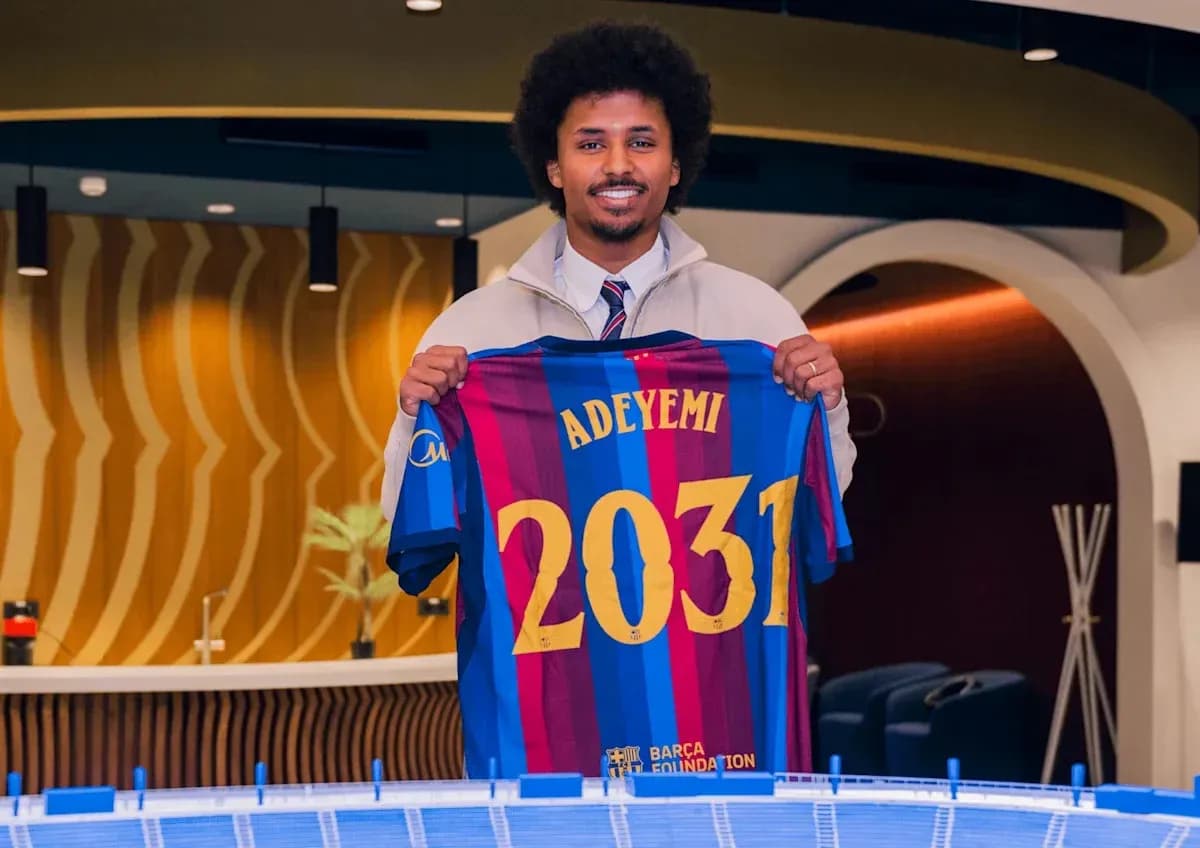
Barcelona Signs Karim Adeyemi: A Shift in Dortmund's Transfer Strategy
Barcelona’s move for Karim Adeyemi has done more than hand Hansi Flick another weapon in attack. It has quietly snapped one of modern football’s most reliable patterns: Borussia Dortmund buying low, polishing a rough diamond, and selling for a fortune.
This time, the machine didn’t spit out a jackpot.
Adeyemi has joined Barcelona for a fixed €22 million, with a further €7 million tied to performance-related add-ons. For a player entering the final year of his contract, Dortmund can argue they protected value, avoided losing him for nothing and banked a reasonable fee.
But by their own standards, this is not a win. It is a break in character.
A rare misfire in Dortmund’s money-printing model
Dortmund paid RB Salzburg €30 million for Adeyemi in 2022, convinced they had landed another electric young attacker who could be shaped into a world-class star and, in time, sold at a premium.
Four seasons on, Barcelona have picked him up in a package that tops out at €29 million if every add-on lands. On the balance sheet, that leaves Dortmund short of their original outlay, even before you factor in wages and bonuses across his spell in Germany.
For almost any other club, that would be an acceptable outcome in a difficult market. For Dortmund, it jars. This is a club that has built its modern identity on doing the exact opposite: identifying young talent, giving it a platform, then cashing in at eye-watering levels.
The Adeyemi deal is not a disaster. It is something rarer in Dortmund’s recent history: a wash.
From Dembele to Bellingham: the gold standard
To understand why this transfer feels so different, you only need to glance at Dortmund’s recent sales sheet.
In 2017, Barcelona came calling for Ousmane Dembele. Dortmund had plucked him from Rennes for €15 million. One year later, they sold him to Camp Nou in a deal worth €135 million including bonuses. Roughly €120 million in profit from a single player. That move became the emblem of their model.
Then came Jude Bellingham. Signed from Birmingham City in 2020 for €29 million, he developed into one of Europe’s most complete midfielders in black and yellow. Real Madrid paid €127 million to take him to the Bernabeu in 2023. Another colossal gain, another validation of the strategy.
Around those headline acts, the pattern has repeated again and again. Jadon Sancho, Christian Pulisic, Erling Haaland, Pierre-Emerick Aubameyang, Henrikh Mkhitaryan, Mario Götze, Jamie Bynoe-Gittens: different profiles, different eras, the same underlying story. Dortmund spot the potential early, provide minutes, absorb the growing pains, then sell at the top of the curve.
Those deals turned the club into a case study in smart recruitment and ruthless timing. They didn’t just compete with Europe’s giants on the pitch; they traded with them, and often outwitted them.
Adeyemi: the exception that proves the rule?
Set against that backdrop, Adeyemi’s move to Barcelona stands out. No huge margin. No record fee. No new benchmark for the model.
Instead, it underlines the risk baked into Dortmund’s approach. Not every signing will explode in value. Not every young star will follow the Dembele or Bellingham trajectory. Contracts run down, form dips, circumstances change, and sometimes a club has to take a pragmatic exit rather than a spectacular one.
For Barcelona, this is an opportunity: a 22-year-old winger with Bundesliga and Champions League experience, signed for less than Dortmund paid. For Dortmund, it is a reminder that even the sharpest operators in the market cannot win every trade.
Their reputation as one of world football’s smartest sellers remains intact. But Adeyemi’s transfer is a rare blot on an otherwise glittering ledger — and a sign that even the most reliable models can occasionally be forced to bend.




