Atalanta vs Bologna: Tactical Analysis of a Narrow Defeat
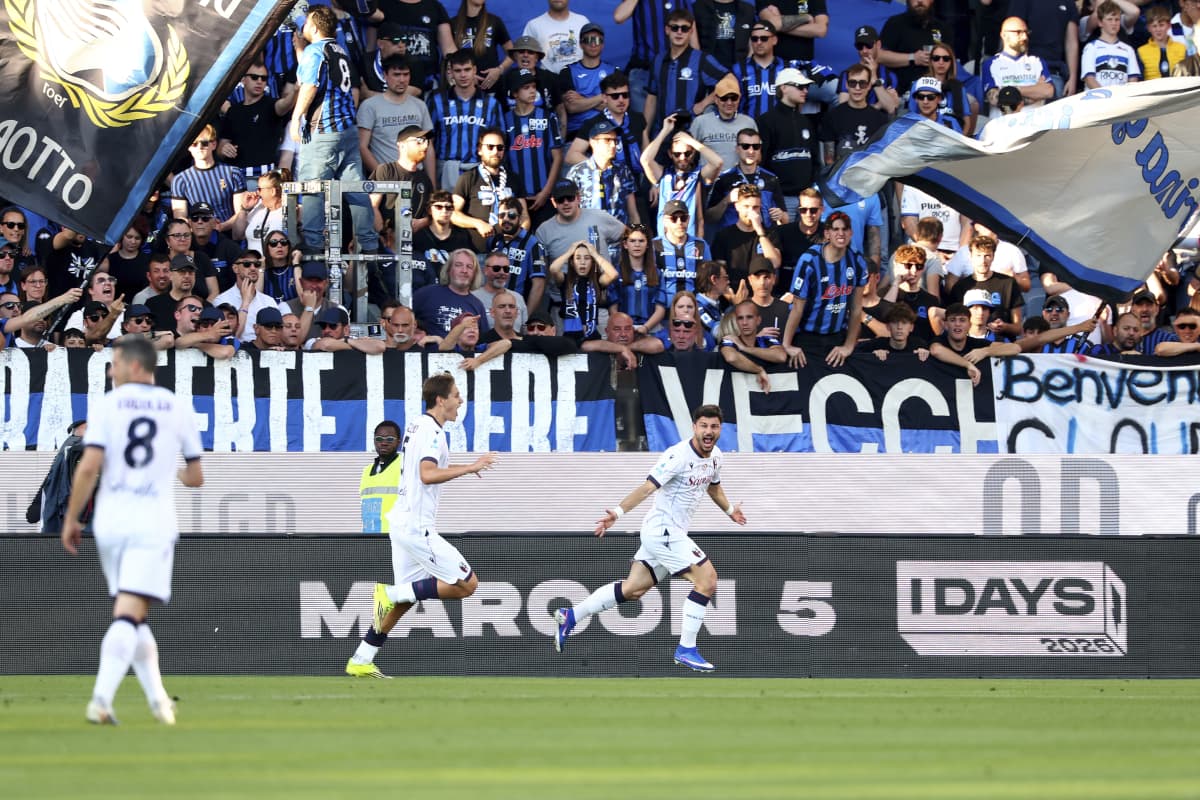
The New Balance Arena closed its Serie A season under a grey Bergamo sky, and Atalanta’s afternoon ended in a colour that matched it: Bologna leaving with a 1–0 win after 90 minutes that underlined the razor-thin margins between seventh and eighth in the table. Following this result, Atalanta sit on 58 points with a goal difference of 15, Bologna on 55 with a goal difference of 3; two sides separated by style as much as by standings.
I. The Big Picture – Structures and Seasonal DNA
Atalanta lined up in their familiar 3-4-2-1, a shape they have used in 33 league matches this season. The structure is now their tactical signature: three centre-backs to launch play, wing-backs to stretch, and two creators behind a single focal point. At home this campaign they have been efficient rather than explosive, scoring 25 goals in 19 matches at an average of 1.3 per game and conceding only 15 at an average of 0.8. That defensive tightness has delivered 7 home clean sheets and underpins their push for European qualification.
Bologna arrived in Bergamo with a twist. Their seasonal identity has largely been a 4-2-3-1 (27 appearances), but here Vincenzo Italiano opted for a 4-3-3, one of their secondary structures. It was a decision that leaned into their away strength: on their travels they have scored 30 goals in 19 matches at an average of 1.6, conceding 23 at an average of 1.2, and winning 10 times away from home. The 4-3-3 in Bergamo was about verticality and direct threat from the front three, trusting a reconfigured back line to cope despite absences.
II. Tactical Voids – Absences and Discipline
Both coaches had to build around conspicuous gaps. For Atalanta, Raffaele Palladino was without L. Bernasconi (knee injury), I. Hien (suspension for yellow cards) and O. Kossounou (thigh injury). The absence of Hien and Kossounou reshaped the defensive hierarchy and helped explain the start for H. Ahanor alongside G. Scalvini and B. Djimsiti. It left Atalanta with a back three where Scalvini became the de facto organiser and first distributor, while Ahanor was asked to be aggressive in duels without the safety net of more experienced partners.
Bologna’s defensive puzzle was even more complex. K. Bonifazi (inactive), N. Cambiaghi (muscle injury), N. Casale (calf injury), J. Lucumi (suspension for yellow cards) and M. Vitik (ankle injury) all missed out. Without Lucumi and Vitik, Italiano turned to E. Fauske Helland and T. Heggem as the central pairing, flanked by Joao Mario and J. Miranda. On paper, it looked like a line that Atalanta’s front trio could stress; in practice, Bologna’s collective compactness and Skorupski’s command of his box held firm.
Disciplinary tendencies also framed the risk profile of the contest. Overall this season, Atalanta’s yellow-card distribution peaks late, with 24.14% of their cautions arriving between 76–90 minutes and 22.41% between 61–75. Bologna mirror that late volatility: 26.87% of their yellows come between 61–75 minutes and 25.37% between 76–90. Both sides are prone to fraying as the clock winds down, and though this match did not descend into chaos, the final quarter-hour always carried the potential for a decisive mistake.
III. Key Matchups – Hunter vs Shield, Engine Room
The headline duel was always going to be “Hunter vs Shield”: Atalanta’s attacking spear against Bologna’s reshaped defence. Nikola Krstovic, Atalanta’s top scorer with 10 league goals and 5 assists, led the line. Across 33 appearances he has taken 75 shots, 34 on target, and his profile is that of a volume shooter who thrives on service and chaos in the box. Behind him, C. De Ketelaere and G. Raspadori floated between the lines, tasked with unlocking Bologna’s block.
Bologna’s shield, however, was more than just four defenders. The 4-3-3 became a 4-5-1 without the ball, with L. Ferguson, R. Freuler and T. Pobega forming a dense central triangle in front of the back line. Freuler, returning to Bergamo as the metronome in Bologna’s midfield, anchored the structure, dropping deep to help Fauske Helland and Heggem deal with Krstovic’s presence. Ferguson and Pobega stepped out to harry De Ketelaere and Raspadori, trying to deny them the time to thread passes into the channels.
On the other side, Bologna’s own “hunter” was more collective than individual in the starting XI. S. Castro, J. Rowe and F. Bernardeschi formed a front three that stretched Atalanta’s back three horizontally. Their job was to exploit any hesitation from Ahanor and to isolate the wide centre-backs when Atalanta’s wing-backs, D. Zappacosta and N. Zalewski, advanced. The real individual threat, though, lurked on the bench: R. Orsolini, Bologna’s top scorer with 10 league goals and 4 penalties converted out of 4, ready to enter as a late-game specialist. His season includes 66 shots (31 on target) and 26 key passes, and he is the one Bologna player who can change the geometry of a match with a single touch.
In the “Engine Room”, Atalanta’s double pivot of M. De Roon and Ederson faced Ferguson and Freuler. De Roon’s role was to screen and recycle, Ederson’s to carry and break lines. De Ketelaere, with 5 league assists and 62 key passes, floated into the half-spaces to overload Pobega’s side, looking to combine with Zalewski and Raspadori. Yet Bologna’s compactness meant that many of those moves died in congested central zones, forcing Atalanta into crosses rather than the incisive combinations they prefer.
IV. Statistical Prognosis – xG Logic and Defensive Solidity
Across the season, the numbers suggested a narrow contest tilted slightly towards the hosts. Heading into this game, Atalanta’s overall scoring rate of 1.4 goals per match and defensive concession of 0.9 framed them as a side that generally wins on control and structure. Bologna, with 1.2 goals scored and 1.2 conceded overall, but a much sharper 1.6 scored away, came in as a dangerous traveller whose matches often open up.
The 1–0 scoreline is consistent with a match where xG would likely show Atalanta with more volume but Bologna with one or two high-quality breaks. Atalanta’s 13 clean sheets overall underline how rarely they collapse; when they lose, it is usually by a single moment rather than systemic failure. Bologna’s 12 clean sheets overall, including 5 on their travels, highlight a side that can dig in and suffer, particularly once they have something to protect.
In narrative terms, this was a meeting of a structured, possession-heavy host against a counter-punching visitor whose away record has been one of the stories of the Serie A season. The tactical voids in both back lines gave the forwards a glimmer of opportunity, but it was Bologna who found the one action that mattered. Following this result, the table still says Atalanta are slightly ahead, but the 90 minutes in Bergamo told a story of a Bologna side whose tactical flexibility and away resilience make them every bit as dangerous as their more heralded hosts.