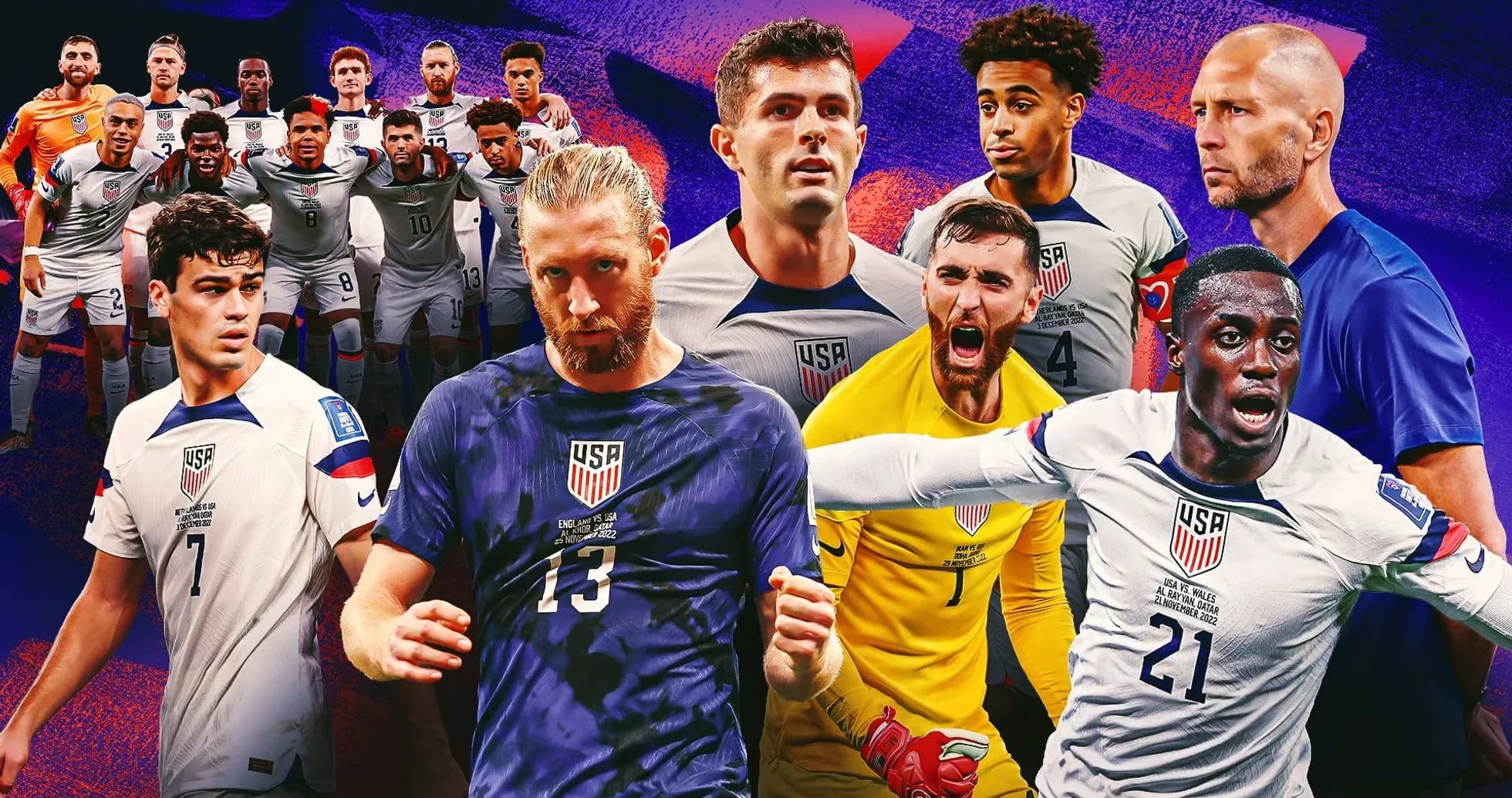
The Journey of U.S. Soccer Players at the 2022 World Cup
On the eve of Wales, Gregg Berhalter pulled his 26 players into a circle and shrank a century of U.S. World Cup history into a single number.
Walker Zimmerman’s was 152.
“He said, ‘Each one of you guys has been assigned a number specific to you,’” Zimmerman recalls. “For me, it was 152. I was the 152nd player to represent the U.S. in a World Cup.”
Back in his room, the jersey was waiting. Name, number, and a tiny stamp of history.
You look at it and think: 152. That’s it?
Not millions. Not thousands. Barely more than a hundred men had ever done what he was about to do. Narrow it by position, by starts, by minutes, and the number shrinks again. A sliver of a sliver.
That was the point. Before a ball was kicked in Qatar, Berhalter wanted his team to feel the weight of what they already were.
A generation that grew up together
For Tyler Adams, Christian Pulisic, Weston McKennie and the rest of that core, the moment wasn’t just about numbers. It was about years.
They had grown up in the same camps, on the same buses, through the wreckage of 2018 and the long climb back. Tim Weah, Josh Sargent, Sergiño Dest — different paths, same story. By the time they arrived in Doha, they weren’t simply teammates. They were co-authors.
“That’s why you played soccer,” Adams says. “My memories with Weston are always going to be more valuable as a kid. It’s the memories of us getting to that stage, even more than where we are now.”
Then the whistle blew on nostalgia.
The tournament came at them like a storm. No long buildup, no leisurely training block. Club on Sunday, World Cup on Monday.
“It’s so quick,” Tim Ream says. “You’re in such a bubble. The games are late, you’re playing at 10 PM, staying up until three in the morning. Even on days we weren’t playing, they wanted us to stay up until 2.”
Breakfast at noon. Lunch at four. Training at night. Body clocks flipped. Days melted into each other.
Sargent tried to slow it down with a mental coach. Deep breaths. Gratitude. Take it all in. Haji Wright looks back now and calls the whole thing “a fever dream.”
Three group games in eight days. Wales, England, Iran. Training, recovery, team meetings. The rhythm of a World Cup played on fast‑forward.
Some barely stepped on the grass. Joe Scally never did.
“A World Cup is a World Cup,” he says. “To be there was an awesome experience… but it also lit a fire underneath me.”
The anthem, the full stadium, the world watching — he could feel it from the bench. He wanted more.
The three who scored
Before Qatar, only 22 American men had ever scored at a World Cup. Three more joined that club in 2022, each carrying a very different memory of the moment.
Weah went first.
Wales. Match one. Pulisic slices through, threads the pass, Weah glides onto it and slips the finish home. A generation’s re‑entry onto the world stage, delivered with one right-footed touch.
“Leading up to that World Cup, I dreamt of scoring,” Weah says. “Years were passing by, and I literally always dreamt of that one moment… For it to become a reality, it was — man, it was amazing.”
Playing in a World Cup was the dream. Scoring in one? That was the dream inside the dream.
Next came Pulisic.
The U.S. went into the final group game needing a win over Iran. Tension on the pitch, tension off it. One goal would change everything.
Pulisic provided it and paid for it in the same breath. He crashed into goalkeeper Alireza Beiranvand as his shot crossed the line, injured his pelvis, and never really got to live the celebration he’d imagined for years.
He didn’t sprint to the corner flag. He didn’t leap into a pile of teammates. He lay in the goal, then went to the hospital.
“It would have been, and it was, a huge moment,” he told GOAL in 2024. “I would have had a pretty cool celebration with the team… but I just didn’t have that.”
He insists he wouldn’t change it. The goal sent the U.S. through. The image is him on the turf, not on the advertising boards, but the job got done.
“I hope to have many big moments,” he says. “I want to go in and I want to win these tournaments. At the end of the day, people will talk about that and that’s what they’ll remember.”
Wright’s goal came last, and in many ways, it is the strangest of the three.
Round of 16 against the Netherlands. The U.S. are 2-0 down, hanging on. A cross flicks off Wright’s foot and loops, improbably, over the keeper and in. It’s a lifeline, a weird, looping, hopeful lifeline.
“It felt crazy,” Wright says. “I kind of felt like the momentum might change a little bit and felt we might get another opportunity. Obviously, that’s not how it went.”
The Netherlands scored again. The U.S. went out 3-1. Wright walked off the pitch a World Cup goalscorer — and devastated.
“Being a World Cup goalscorer is amazing,” he says. “Being knocked out of that same game, though?… That’s what I remember.”
Only with time, and with social media throwing those clips back into their feeds, have the three of them started to understand what those goals meant beyond their own heads.
“We were just seeing the reactions online,” Weah says. “Seeing the fans back home when I scored or when Christian scored, it was amazing… just to see the impact that we have.”
The goals were loud. The memories that really stuck for many of them were quieter.
Yedlin’s perspective, and the bubble within the bubble
DeAndre Yedlin had been here before. In 2014, he was the kid. In 2022, he was the only one who knew what a World Cup actually felt like.
After every game, he led a small group back onto the field. No cameras, no interviews, just players standing in the middle of a half‑empty stadium trying to freeze time.
“It feels like adversity gets multiplied by 10 because there’s always a camera on you,” Yedlin told GOAL. “I think it’s important to find that space and peace.”
He’d come to see the sport in stark terms.
“At the end of the day… we’re literally just entertaining people,” he said. “That can bring inspiration, that can bring hope… but we’re so minuscule in the grand scheme of things. We’re such tiny figures… but we also play a huge part.”
His teammates searched for that same balance. Some stayed off their phones. Some tried to memorize everything. Some, like Ream, remember only flashes.
“I can see glimpses of it,” Ream says. “I’m so insanely focused. It’s like tunnel vision. There’s a whole lot that you forget.”
What none of them forget is the setting.
Qatar was unlike anything they had known. The call to prayer echoing over Doha. Souqs sitting a short drive from brand‑new stadiums. A city running on World Cup time, every conversation looping back to the next kickoff.
“I enjoyed every bit of it,” goalkeeper Matt Turner says. “It was so cool to be in a culture I’ve never experienced before… It was special because we were in this foreign land all together… we had just this rock solid bubble.”
Doha itself became a bubble. The tournament lived outside their hotel walls, humming and shouting and singing. Sergiño Dest would slip up to the rooftop and just listen.
“I was just living in that moment,” he says. “I would just sit there, drink my water, and watch these people enjoy life… I remember being like, ‘This is it.’”
He’d open his balcony door and let the noise in — flags, horns, chants, the sound of life. That’s what he misses most.
Inside the team hotel at The Pearl, the soundtrack changed. Televisions blared other World Cup games. Music. Laughter. Ping‑pong balls clacking, pool cues cracking, controllers clicking. The Players’ Lounge became the beating heart of the U.S. tournament.
They never had to move hotels. The Marsa Malaz Kempinski became home. It embedded itself so deeply in Yunus Musah’s mind that he went back the following summer just to walk those corridors again.
“The smell!” he said in 2025. “Everywhere smells so nice. The room, the view… it felt like I was experiencing all of those moments from the World Cup all over again.”
Tyler Adams still sees that lounge when he thinks of Qatar.
“We had so much downtime with one another that it really just allowed us to connect,” he says. “That Players’ Lounge… it was like our own little sanctuary.”
Gregg Berhalter pushed that idea hard. Camaraderie wasn’t an add‑on; it was a tactic. It worked.
“I got even closer to some guys that I didn’t even know I could get closer with,” Adams says. “In those times, you just bond. That’s all there is to do.”
Bonding, of course, meant competition. When games weren’t on, they invented their own.
“Sean Johnson and DeAndre Yedlin had their crazy style of pool,” Zimmerman laughs. “It was basically snooker. They barely hit the ball and just tried to make you lose by scratching.”
Cristian Roldan avoided his room like it was another opponent.
“I remember being around the boys in the Players’ Lounge and making sure I didn’t spend any time in my room and didn’t take any moment for granted,” he says.
The people who got them there
The World Cup didn’t belong only to the 26 players and the staff. It belonged to the people who had dragged them to that circle in the first place.
Zimmerman felt that acutely before the opener against Wales. As the anthem played, he scanned the stands until he found the U.S. family section.
Mothers. Fathers. Siblings. Partners. Children. Friends. Dozens of lives stitched into each of the 26 stories on the field.
“Everyone’s story is tied up with what that group of supporters has done to get us into this spot,” he says. “All of the sacrifices that those people made… That, for me, was a special moment.”
For Ream, the only time he could breathe during the tournament was when family came to the hotel.
“It’s so much work and focus,” he says. “Those were the only moments where you felt you could actually sit back and breathe… My wife and kids and I, we’re all here in this place together.”
The families started to bond with one another, too. After years of sharing locker rooms, U.S. players finally saw the other halves of each other’s lives.
“We were all really close already,” Weah says, “but having that period of time to connect and meet everyone’s family, share our lives together, that was amazing… It’s one of those memories that, even when you’re old and gray, you’ll remember.”
Life has moved on since. Some of those players are now fathers. Some are married. Kids who were toddlers in 2022 are old enough now to ask questions.
For Roldan, that shift has sharpened everything.
“It was almost like it was a collective effort to get there,” he says. “I think that’s where I got the most joy: getting to see my loved ones there and enjoying it.”
His daughter is almost two. The idea of her watching him at a World Cup — not just standing on the touchline, but playing — fuels him.
“Part of my motivation to extend my career and continue to play at a high level is that I want her to watch me play,” he says. “I want her to watch daddy play.”
Sebastian Berhalter saw Qatar from the stands, not the bench. He was there as a son.
“Going to that World Cup was so special,” he says. “Seeing your dad coach against some of the best teams in the world was something I’ll never forget.”
Not every family memory from 2022 is bathed in warmth.
Reyna, rupture, and hard lessons
For Gio Reyna, the World Cup he had dreamed of since childhood became something far more complicated.
He arrived managing injuries. His role turned out smaller than he expected. Emotions boiled over. What happened next spilled far beyond the dressing room and into the headlines: questions about his effort in training, limited minutes, and then, after the tournament, the Reyna family informing U.S. Soccer of a decades‑old domestic violence incident involving Gregg Berhalter.
It was messy, painful, and public. It was about far more than tactics.
Berhalter eventually returned in 2023, then departed after Copa América 2024. Reyna remained in the player pool. Time moved on, if not cleanly.
Looking back, Reyna frames Qatar as a harsh but necessary education.
“I think just individually and collectively, we were all very, very young and maybe a little bit inexperienced at the time,” he says. The U.S. ran into a Netherlands side that was “a little bit more experienced, a little bit better, a little bit more savvy,” and that was that.
“It’s a World Cup. Obviously, it’s an amazing experience. I learned so much from that,” he says. “You learn that it’s about just trying to do whatever you can to help the team. This is your whole country that’s fighting something.”
Now the next World Cup is coming to his home country. The stakes — and the expectations — will be different.
“This one is in our home country, too, so it would be a dream come true just to be there,” he says. “It’s about the collective.”
Reyna isn’t alone in feeling unfinished business from Qatar.
The ones who never got there
Miles Robinson was penciled into most people’s 2022 squads. He’d been a rock in qualifying. Then his Achilles went, and with it, his World Cup.
By November, he had a choice: shut it out or lean in. He chose the latter.
“Man, I was outside watching that sh*t,” he told GOAL with a grin. “We were partying, watching, cheering on my guys. I really wanted to experience that real-life energy because that’s who I am.”
Chris Richards didn’t have the luxury of time to process. A hamstring injury with Crystal Palace hit just before the squad announcement. It was always going to be tight. It turned out to be impossible.
He rehabbed in London while his friends played on the biggest stage in the sport.
“I’m in London watching the boys kill it at the World Cup,” he says. “I was so, so happy for them, but for myself, it was lonely.”
He didn’t want to watch soccer at all. The dream felt ripped away.
Mark McKenzie’s exclusion came not from injury but from selection. That made the blow feel even sharper.
“Missing out on the 22 World Cup? It ripped me apart, bro,” he says. “It was gutwrenching because I was so close.”
The call that he wasn’t going landed like a punch.
“It’s an important feeling to have,” he adds. “It puts everything in perspective… Maybe I put too much onus on this, so much that I lost who I was.”
Since then, the landscape has shifted. Berhalter is out. Mauricio Pochettino is in. Another 26 names will be read out soon, another group asked to carry the shirt and the number and the weight.
From prelude to main event
For the sport in the U.S., this next World Cup is different. It’s not on another continent. It’s not at an awkward time zone. It’s here.
For the players, the aftershocks of 2022 were real. Adams only truly felt it once he came home.
“From a notoriety standpoint, people all of a sudden knew who I was walking back home in the streets of New York City,” he says. “It’s a city that I never imagined I’d get recognized in.”
He was juggling that new visibility with the arrival of his first child. Professional life. Personal life. Both changed by one winter in Qatar.
Now comes the sequel, staged on home soil, with the volume turned up.
“How the USMNT navigates the pressures that come with 2026” will define the summer. In many ways, 2022 was the dress rehearsal. This is the show.
“It’s an amazing feeling, but also a responsibility at the same time,” McKennie says. He talks about the kids watching — on TV, on their phones, maybe in the stands — and the duty that comes with being the face of a pathway.
“Hopefully, people see that there is a pathway out there for them,” he says. “The ultimate thing is to believe in yourself and bet on yourself always.”
Soon, 26 more players will walk into their own bubble. Some will arrive with Qatar already etched into them. Others will be wide‑eyed, experiencing it all for the first time. Some will start every game. Some won’t play a minute. All of them will leave changed.
That’s what 2022 did to this group. It welded them together. For some, it was the moment. For others, it was the moment that got away. But ask any of them and they’ll tell you the same thing: it was singular. Unrepeatable.
“I can understand how people call it emotionally draining,” Wright says. “After it was over, it felt like soccer had changed me… It’s hard to get that feeling again outside of a World Cup.”
“It all just feels like yesterday,” he adds. “Now, the next one’s already here.”
Turner feels the pull just as strongly.
“I had some amazing experiences,” he says. “That’s why I need to get back there, because I really want that feeling again.”
In a few weeks, another generation of U.S. players will find out exactly what he means.