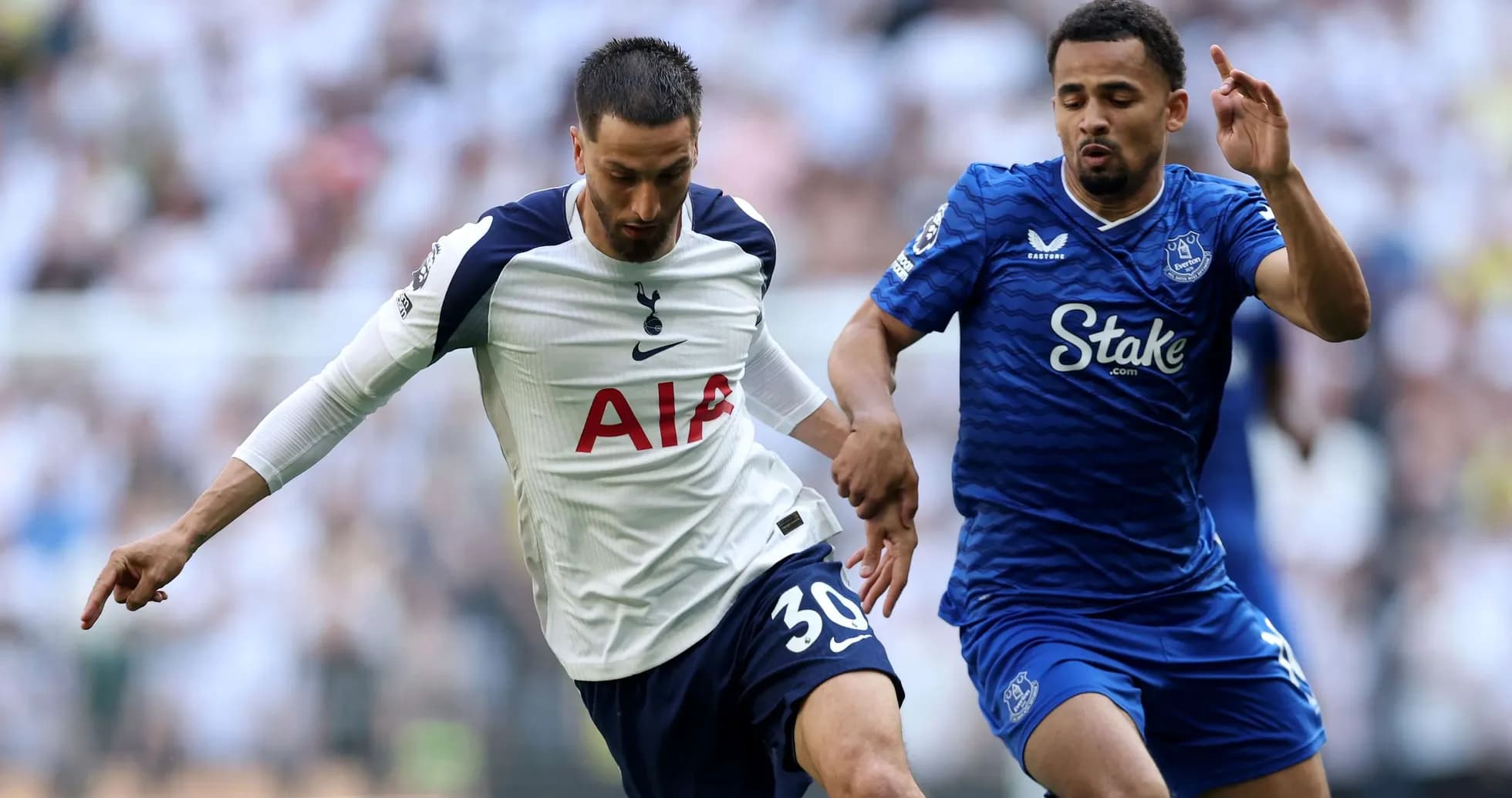
Tottenham's Season Finale: Tactical Epilogue Against Everton
The curtain fell on Tottenham’s season at Tottenham Hotspur Stadium with a narrow 1-0 win over Everton, a result that felt less like a finale and more like a tactical epilogue to two very different campaigns.
I. The Big Picture
Following this result, Tottenham close the Premier League season in 17th place with 41 points and a goal difference of -9, built from 48 goals scored and 57 conceded in total. Their struggles at home have been a defining storyline: across 19 home games they produced just 3 wins, 6 draws and 10 defeats, scoring 22 and conceding 31. Everton, by contrast, finish 13th on 49 points with a total goal difference of -3 (47 for, 50 against overall), a mid-table landing that reflects a more stable, if inconsistent, campaign.
Both sides lined up in a 4-2-3-1, but the symmetry on paper disguised very different intentions. Roberto De Zerbi leaned into technical control and vertical running, while Leighton Baines set Everton up in a compact, workmanlike block, built on the double pivot and heavy running from the wide midfielders.
Tottenham’s seasonal DNA has been paradoxical: on their travels they were far more effective, with 7 away wins, 5 draws and 7 defeats, scoring 26 and conceding 26, while at home their attacking average of 1.2 goals per game was dragged down by defensive fragility (1.6 goals conceded per home match). Everton, meanwhile, have been balanced in their split: 7 away wins and 21 away goals, conceding 23, almost mirroring their home profile.
II. Tactical Voids and Absences
This match was shaped by who was missing as much as who played. Tottenham were stripped of an entire layer of personality and chaos: C. Romero, X. Simons, D. Kulusevski, M. Kudus, W. Odobert and B. Davies were all listed as missing with various injuries. That removed their most aggressive centre-back, a key ball-carrier between the lines, and multiple one-v-one threats in the final third.
In response, De Zerbi turned to a back four of P. Porro, K. Danso, M. van de Ven and D. Udogie, in front of A. Kinsky. The double pivot of R. Bentancur and J. Palhinha gave structure, while D. Spence, C. Gallagher and M. Tel floated behind Richarlison. It was a side built less on star power and more on functional roles: Porro and Udogie to provide width, Gallagher and Tel to attack half-spaces, Bentancur to connect, Palhinha to destroy.
Everton’s voids were different but equally significant. J. Branthwaite, I. Gueye and J. Grealish were all unavailable. Without Branthwaite, Baines had to lean on the experienced but less mobile pairing of J. Tarkowski and M. Keane, flanked by V. Mykolenko and J. O’Brien. Without Gueye’s screening and Grealish’s ball-carrying, the creative and defensive burden tilted heavily onto J. Garner and the young T. Iroegbunam in the pivot.
Disciplinary profiles also hung over the contest. Across the season, Tottenham have shown a tendency to lose control in the middle of games: 24.75% of their yellow cards arrived between 61-75 minutes, with another 16.83% from 76-90, a clear late-game spike in aggression. Everton, by contrast, peaked even later; 21.62% of their yellows came in the 76-90 window, with 20.27% between 46-60. Both sides, in other words, are at their most combustible just as legs tire and spaces open.
III. Key Matchups
Hunter vs Shield
Richarlison entered the day as Tottenham’s leading scorer, with 11 league goals and 4 assists in total this season. His profile is that of a duelist-forward: 325 total duels, 137 won, 47 shots with 26 on target, and 33 fouls drawn. Against an Everton defence that has conceded 50 goals overall (27 at home, 23 on their travels) at an away rate of 1.2 per game, his job was to constantly stress the central pairing.
Tarkowski and Keane were tasked with containing him, but the more subtle battle was Richarlison’s movement against Everton’s full-backs. O’Brien, who has accumulated 1 red card and 6 yellows this season, is aggressive in contact and can be tempted into risky challenges. Richarlison’s habit of drifting into the right half-space invited exactly that confrontation, creating the sort of marginal duels that swing momentum and territory.
Engine Room
In midfield, the game’s central narrative ran through two duos. For Tottenham, J. Palhinha and R. Bentancur formed a classic destroyer-creator axis. Palhinha’s remit was clear: protect Danso and Van de Ven, step into passing lanes and give Tottenham a platform to compress Everton in their own half. Bentancur, by contrast, had to link quickly into Gallagher and Tel, ensuring Tottenham’s attacks didn’t stall in front of Everton’s block.
For Everton, J. Garner was both metronome and shield. Over the season he has delivered 7 assists, 56 key passes and 1792 total passes with an 87% accuracy, while also making 120 tackles, 10 blocks and 57 interceptions. Listed as a defender in the data but operating as a deep midfielder here, he is Everton’s true “engine room” figure. The duel between Garner and Gallagher/Tel was as much about control as creativity: if Garner could step out to intercept and then play early into I. Ndiaye or K. Dewsbury-Hall, Everton had a route to break Tottenham’s rhythm.
On the flanks, Porro’s duel with Dewsbury-Hall and T. Barry was decisive. Porro’s season has been defined by high volume involvement: 1469 passes, 56 key passes, 75 tackles and 10 blocked shots. His willingness to step high created overloads with Spence, but also exposed space behind him for Barry to attack in transition.
IV. Statistical Prognosis and Tactical Verdict
Following this result, the numbers underline how narrow Tottenham’s margin for error was. Overall, they average 1.3 goals scored and 1.5 conceded per game, while Everton sit at 1.2 for and 1.3 against. There is no explicit xG data in the snapshot, but the profiles are clear: Tottenham are a slightly more open, higher-variance side; Everton are marginally tighter and more pragmatic, with 11 clean sheets in total to Tottenham’s 9.
At home, Tottenham’s 22 goals from 19 matches (1.2 per game) against 31 conceded (1.6 per game) suggest they usually need to outscore problems rather than control them. Everton, on their travels, have shown enough resilience — 21 goals scored and 23 conceded — to stay in games and punish mistakes.
In this match, De Zerbi’s adjusted 4-2-3-1, forced by injuries, produced something Tottenham have lacked all season at home: a clean, controlled 1-0. The back four, anchored by Van de Ven and Danso, finally aligned with Palhinha’s screening to deliver the sort of defensive solidity their numbers rarely promised.
Everton, missing Grealish’s incision and Gueye’s protection, relied heavily on structure and Garner’s all-round game, but lacked the extra layer of creativity needed to crack a Tottenham side that, for once, did not implode in those high-card late phases.
As a tactical epilogue, this fixture suggested a blueprint. Tottenham’s path forward lies in stabilising their home performances and leaning into the double pivot’s balance, while Everton’s mid-table platform will demand an evolution in chance creation if they are to turn their solid base into something more ambitious.