Saudi Arabia vs Uruguay: Defensive Resilience in World Cup Draw
Saudi Arabia’s 1-1 draw with Uruguay at Hard Rock Stadium was a classic clash of defensive compactness against territorial and statistical dominance. In a World Cup group opener where Uruguay controlled 67% of the ball and launched 27 shots, Saudi Arabia leaned into a low-possession, deep 4-4-2 block, maximising set-piece value and goalkeeper resilience to protect a precious point.
The game’s tactical story is defined by structural contrast. Georgios Donis set Saudi Arabia in a clear 4-4-2: Mohammed Al-Owais in goal; a back four of Moteb Al-Harbi, Hassan Altambakti, Abdulelah Al-Amri and Saud Abdulhamid; a narrow, hard-working midfield line of Salem Al-Dawsari, Abdullah Al-Khaibari, Mohamed Kanno and Mohammed Abu Al-Shamat; with Firas Al-Buraikan and Musab Al Juwayr up front. The emphasis was on vertical compactness, denying space between the lines to Uruguay’s No.10 and wide playmakers, and protecting the central lane in front of the centre-backs.
Marcelo Bielsa’s Uruguay, in contrast, lined up in a 4-2-3-1 with Fernando Muslera in goal, a back four of Matías Viña, Mathías Olivera, Sebastián Cáceres and Guillermo Varela, a double pivot of Manuel Ugarte and Rodrigo Bentancur, and an aggressive attacking line of Maximiliano Araújo, Federico Viñas and Federico Valverde behind Darwin Núñez. The structure aimed to pin Saudi Arabia back through width, high tempo circulation and overloads around the half-spaces.
Out of possession, Saudi Arabia retreated into a mid-to-low block, ceding the first and often the second line of build-up. Their 33% possession reflects a clear choice rather than an inability to keep the ball: the priority was to keep distances tight between defence and midfield, with Al-Khaibari and Kanno screening central access and shuttling laterally to close passing lanes into Valverde and Viñas. The back four stayed relatively narrow, inviting crosses but protecting the box. Uruguay’s 16 shots inside the box show how often they managed to reach dangerous zones, but the density of green shirts in the area turned many of those into contested or rushed efforts.
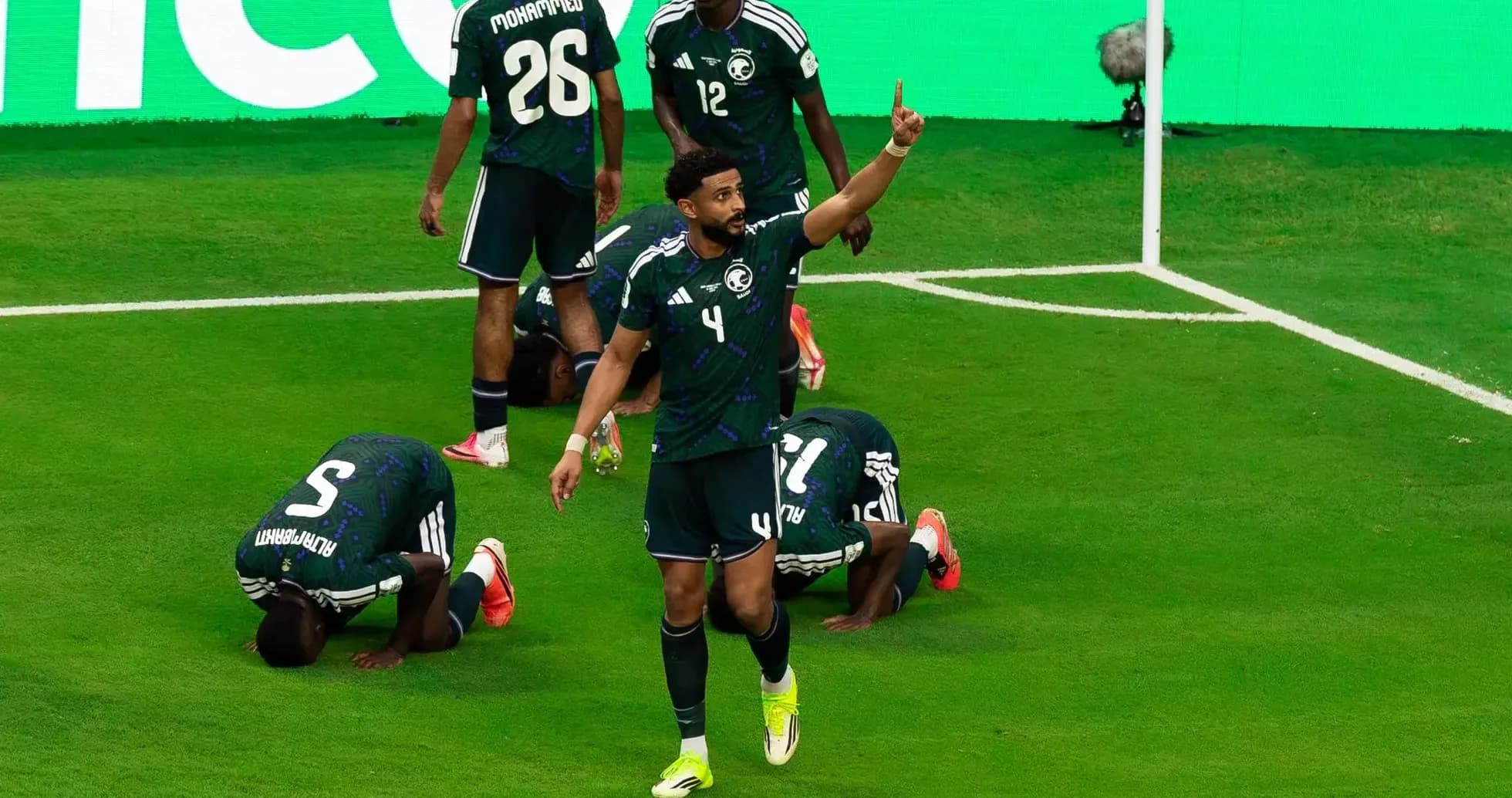
With the ball, Saudi Arabia’s plan revolved around direct progression and exploiting transitional moments. Total passes stood at 322 with 236 accurate (73%), numbers that underline a willingness to go long or early rather than sustain long possession chains. The front pair’s task was to stretch Uruguay’s centre-backs and create second-ball opportunities for the advancing midfielders, especially Kanno and Salem Al-Dawsari. Set plays and dead-ball situations were a key offensive weapon, and the first-half goal from Abdulelah Al-Amri underlined that emphasis on aerial threat and timing of runs from deep.
Uruguay’s 4-2-3-1 morphed into a very aggressive attacking shape in possession, often resembling a 2-3-5. The full-backs, Viña and Varela, pushed high to create width, while Ugarte and Bentancur anchored circulation and provided rest defence against Saudi counters. Valverde roamed between lines, Araújo attacked the left half-space and back post, and Núñez led the line, constantly looking to run in behind or attack crosses. The volume of 14 corner kicks and 7 blocked shots speaks to sustained pressure and Saudi Arabia’s last-ditch defending around their own area.
In goal, Mohammed Al-Owais (Saudi Arabia) was central to the result. He faced a barrage of attempts and registered 9 saves, repeatedly intervening to keep Saudi Arabia in front and then level. His shot-stopping underlined strong positioning and reflexes, even if the goals prevented metric of -0.35 suggests Uruguay did eventually find a finish he might statistically be expected to stop. Still, under heavy fire, his command of the box and handling on crosses were vital in relieving pressure at key moments.
At the other end, Fernando Muslera (Uruguay) had a quieter but more frustrating evening from his perspective. Saudi Arabia produced only 7 total shots, 3 on goal, and Muslera made 2 saves. Uruguay’s defensive structure, with a high line and aggressive counter-press, limited Saudi Arabia’s ability to reach the final third in numbers, but the one lapse on the set-piece cost them the lead. With Saudi Arabia generating just 0.66 xG, Muslera was rarely exposed to repeated high-quality chances, yet he left the pitch having conceded once from a low-volume attack.
The substitutions reflected tactical fine-tuning rather than wholesale structural change. For Uruguay, the introduction of Agustín Canobbio (IN) for Darwin Núñez (OUT) and Juan Sanabria (IN) for Matías Viña (OUT) at 46' shifted the attacking dynamics, refreshing the flanks and adding energy to the press while maintaining the same 4-2-3-1 framework. Later, Nicolás de la Cruz (IN) for Manuel Ugarte (OUT) at 72' added more creativity and vertical passing from midfield, contributing to the late-wave pressure that culminated in Maximiliano Araújo’s equaliser.
Saudi Arabia’s changes were more about energy management and preserving compactness. Nasser Al-Dawsari (IN) came on for Musab Al Juwayr (OUT) at 63', adding fresh legs and defensive work rate in midfield to help absorb Uruguay’s mounting pressure. Nawaf Boushal (IN) for Mohammed Abu Al-Shamat (OUT), Ali Lajami (IN) for Saud Abdulhamid (OUT), Ala'a Al-Hejji (IN) for Firas Al-Buraikan (OUT) and Abdullah Al-Hamdan (IN) for Moteb Al-Harbi (OUT), all at 81' and 90', were clearly aimed at shoring up the block, adding height and defensive focus, and sacrificing some offensive presence to secure the draw.
Statistically, Uruguay’s superiority is stark: 27 total shots to 7, 10 shots on goal to 3, and 67% possession to 33%. Their xG of 1.72 compared to Saudi Arabia’s 0.66 confirms that Bielsa’s side created more and better chances over the 90 minutes. The 540 accurate passes out of 612 (88%) underline their technical control and ability to circulate the ball patiently, while 7 blocked shots show how often Saudi defenders were forced into last-moment interventions.
Yet Saudi Arabia’s defensive index for this match is strong: only 6 fouls by Uruguay versus 11 by Saudi Arabia reflects how often Donis’s side had to break up play, but the low card count (just one yellow) indicates discipline within that aggression. They also limited Uruguay to a single goal despite a negative goals prevented value for both goalkeepers (-0.35 each), underscoring the collective defensive effort in front of Al-Owais.
In synthesis, Uruguay’s overall form metrics and attacking volume suggest a team capable of dominating group-stage opponents, but the inability to convert control into a win raises questions about efficiency in the box. Saudi Arabia, meanwhile, emerge with a point that matches their game plan: low-possession resilience, set-piece threat, and a goalkeeper-led rearguard that bent under pressure but did not break.