Ivory Coast Triumphs Over Ecuador in Tactical Battle
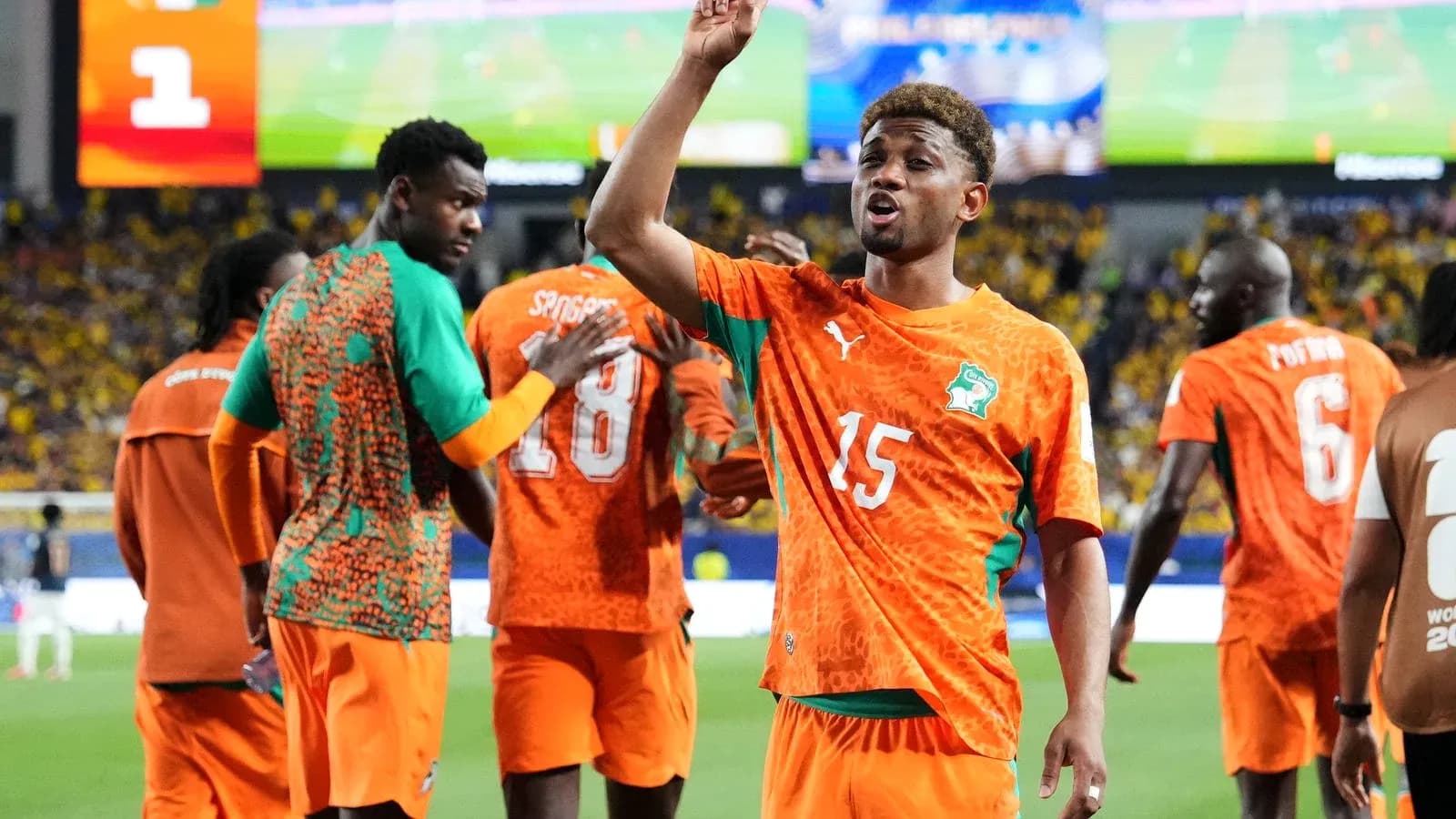
Under the lights of Lincoln Financial Field in Philadelphia, Ivory Coast and Ecuador opened their World Cup 2026 stories with a tight, tactical 1–0 that said as much about identity as it did about points. Following this result, Ivory Coast sit 2nd in Group E on 3 points, with a goal difference of +1 (1 goal for, 0 against). Ecuador, beaten by the same margin, are 3rd with 0 points and a goal difference of -1 (0 for, 1 against). Over 90 minutes, two sides both set up in a 4-4-2 formation revealed sharply contrasting ways of interpreting the shape.
I. The Big Picture – Two 4-4-2s, one statement win
Ivory Coast’s campaign begins with a perfect home record in this tournament context: played 1, won 1, scored 1, conceded 0 at home. Their overall attacking output so far is modest but efficient, with 1.0 goalsFor average at home and overall, and a clean defensive slate with 0.0 goalsAgainst on every split. The win extends their biggest streak to 1 consecutive victory, but more importantly, it validates Emerse Fae’s choice of a classic 4-4-2 that leans on physical dominance and vertical threat.
Opposite them, Ecuador’s 4-4-2 under Sebastian Beccacece is still a work in progress. On their travels, they have played 1 and lost 1, failing to score and conceding once, for a total goalsFor average of 0.0 and goalsAgainst average of 1.0 overall. Their biggest away result so far is a 1–0 defeat, a reminder that they are defensively competitive but short of cutting edge.
The scoreline—Ivory Coast 1, Ecuador 0—fits the broader statistical picture: one side already built for tournament attrition, the other still searching for an offensive reference point.
II. Tactical Voids and Discipline – Where the cracks appeared
There are no listed injuries or absentees, so both coaches essentially had their full squads available. That makes the selection choices revealing.
For Ivory Coast, Fae trusted a back four of G. Konan, E. Agbadou, W. Singo and G. Doue ahead of goalkeeper Y. Fofana, with a powerful midfield band of B. Toure, S. Fofana, F. Kessie and Y. Diomande, supporting a front two of N. Pepe and E. Wahi. The bench was deep with options like A. Diallo, S. Adingra and E. Guessand ready to tilt the game late.
Discipline-wise, Ivory Coast showed an early edge and a potential fault line. Their yellow-card timing distribution is heavily front-loaded: 33.33% of their yellows arrived between 16–30 minutes, and 66.67% between 31–45 minutes. That means every card so far has been in the first half, hinting at an aggressive, sometimes overzealous press before the interval. S. Fofana embodies that edge: in his 77 minutes, he committed 1 foul and picked up 1 yellow card, while still blocking 1 shot and making 2 interceptions.
Ecuador’s card profile is different: a single yellow so far, and it came in the 61–75 minute window, which accounts for 100.00% of their yellows. They grow more desperate and stretched as the game wears on, a pattern that could haunt them if they continue chasing deficits. The disciplinary spotlight falls on J. Porozo, who in 28 minutes from the bench committed 2 fouls and was booked once, underlining the risk in Ecuador’s late-game defensive rotations.
III. Key Matchups – Hunter vs Shield, Engine Room vs Enforcer
Hunter vs Shield
In attacking terms, Ivory Coast’s most incisive figure is not one of the nominal starters but A. Diallo, already on the World Cup top scorers list. In total this campaign, he has 1 goal from 2 shots, both on target, and an 8.2 rating across 34 minutes. He dribbled 6 times and succeeded with 5, won 6 of 8 duels, and completed 17 passes at 82% accuracy. He is the pure “hunter” in this Ivorian squad: direct, technically sharp, and devastating in broken-field situations.
Ecuador’s “shield” is a collective more than an individual, but the spine of W. Pacho and P. Hincapie in central defence, with H. Galindez behind them, kept the game alive until the decisive moment. Overall, Ecuador have conceded 1 goal in 1 match, an overall goalsAgainst average of 1.0, which suggests solidity but not invulnerability. Against a player like A. Diallo, who thrives on isolation and 1v1s, that central block will need help from wide players like A. Franco and P. Hincapie stepping out aggressively without leaving gaps.
Engine Room – Kessie and S. Fofana vs M. Caicedo
The true battle of identities sits in midfield. For Ivory Coast, F. Kessie and S. Fofana are the dual pistons. Kessie, even without appearing in the individual stat leaders, is the metronome and breaker, while S. Fofana’s numbers tell the story of a box-to-box disruptor: 36 passes at 88% accuracy, 1 key pass, 4 shots (1 on target), 1 blocked shot and 2 interceptions. He is both the first wave of pressure and the late runner into the box.
For Ecuador, M. Caicedo is the enforcer and distributor rolled into one. Operating centrally in the 4-4-2, he must screen the back four while providing progression to P. Vite and A. Minda. With Ecuador having failed to score in total so far and having a total goalsFor average of 0.0, the burden on Caicedo is immense: he has to win duels against Kessie and S. Fofana while still finding early passes into the channels for G. Plata and E. Valencia.
IV. Statistical Prognosis – A defensive tournament team vs a side chasing balance
Following this result, the numbers frame Ivory Coast as an archetypal tournament side: compact, patient, and ruthless in moments. They have 1 win from 1, 1 clean sheet, and have failed to score in 0 matches. Their penalty record is clean but untested—0 penalties taken, 0 scored, 0 missed—so there is no evidence yet of strength or weakness from the spot.
Ecuador, by contrast, are already under pressure. They have lost their only game on their travels, failed to score once in total, and have yet to keep a clean sheet. Their defensive record—1 goal conceded overall, no clean sheets—suggests they are not porous, but they lack the margin for error that a more prolific attack would provide.
From an xG-style lens, even without explicit Expected Goals numbers, the shot and chance profiles hint at a narrow but deserved Ivorian edge: a side generating volume through midfield surges (S. Fofana’s 4 shots, Diallo’s 2 on target in limited minutes) against an Ecuador outfit whose most notable defensive contributor so far is a substitute centre-back with a yellow card and 2 fouls.
If these trends hold across the group, Ivory Coast look primed to grind their way into the knockouts as a low-scoring, defensively tight unit that leans on individual flair—especially from the bench—to unlock games late. Ecuador, meanwhile, must quickly find a way to turn M. Caicedo’s industry and the front pair’s movement into real chances, or their solid-but-not-elite defence will be asked to survive too many one-goal margins.