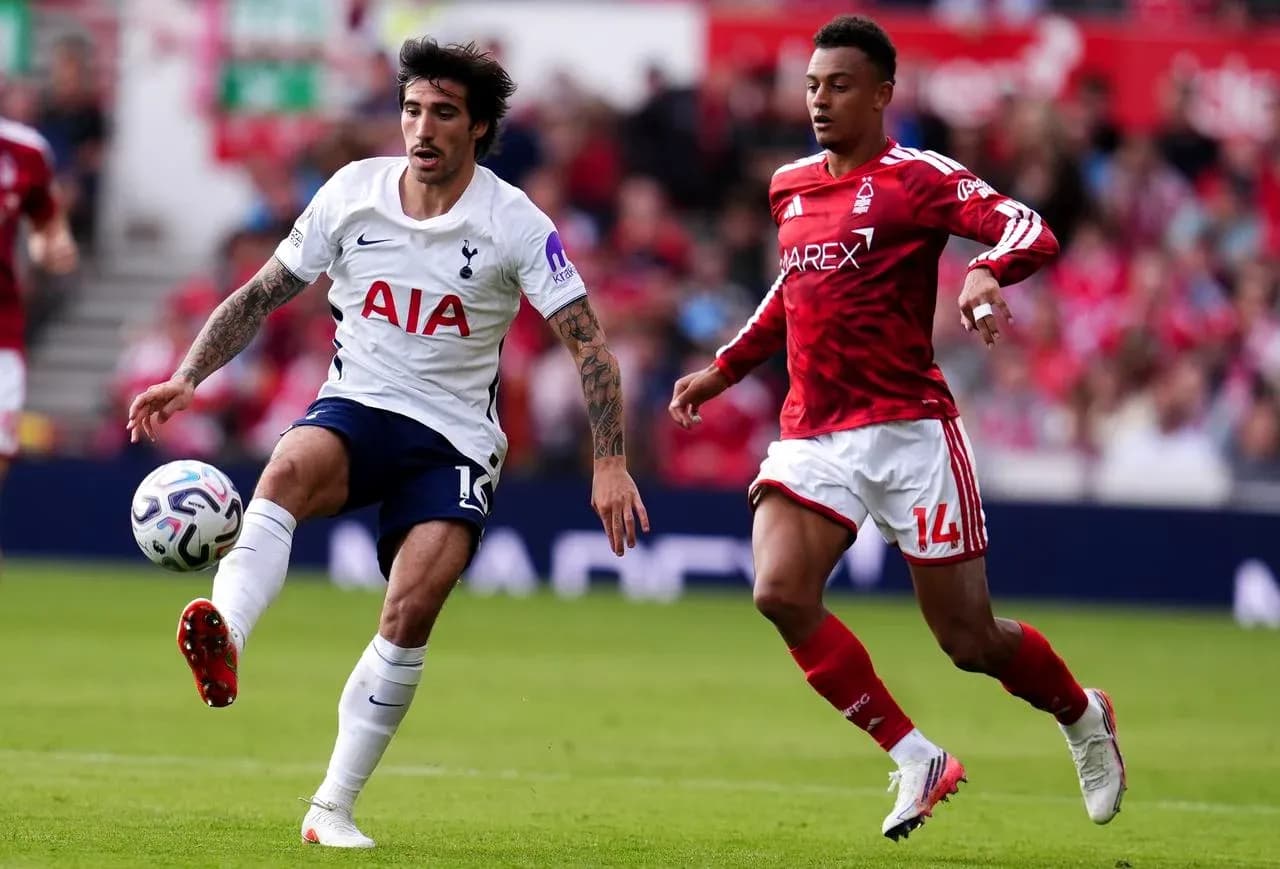
Nottingham Forest vs Tottenham: Early Season Pressure Builds
The City Ground had the feel of a crossroads fixture: two sides with new identities forming, both still waiting for a first league win, both discovering that reshaping a squad is easier on paper than in the Premier League trenches.
I. The Big Picture – Two Projects Under Early Pressure
Following this result, Nottingham Forest sit 16th with 2 points from 3 matches, their overall goal difference at -1 from 2 goals scored and 3 conceded. The numbers sketch a team that is awkward to break down but still learning how to turn structure into threat. Overall this campaign, Forest have drawn 2 and lost 1, with their three outings all in a 3-4-2-1 shape. At home, the picture is stark: 2 games, 0 goals scored, 1 conceded, and 2 failures to score. On their travels, they look a different animal, with 2 goals scored and 2 conceded in a single away game.
Tottenham, meanwhile, leave Nottingham marooned in 18th with just 1 point from 3 games and a goal difference of -5, having failed to score at all this season. Overall, they have drawn 1 and lost 2, conceding 5 without reply. At home they have played 1, losing 2-0; away, they have played 2, drawing 1 and losing 1, with 0 goals for and 3 against. The clean sheet on their travels shows they can be compact in moments, but the broader pattern is a side whose defensive leaks and attacking bluntness are yet to be reconciled with the ambition of a 4-2-3-1.
The goalless draw here felt less like a stalemate and more like a tactical sketchbook: Forest’s back three and double “10s” versus Tottenham’s fluid band of three and aggressive full-backs.
II. Tactical Voids – Who Was Missing, and What That Changed
Both managers were forced to redraw key attacking lines.
For Forest, N. Savona’s knee injury removed a depth option and, more importantly, a rotation piece in a squad that already leans heavily on M. Gibbs-White for invention. Oliver Glasner’s decision to start him again as one of the two advanced midfielders behind L. Delap underlined how central he is to Forest’s creative identity. Gibbs-White comes into this fixture with 1 goal and 1 assist in total this campaign, 7 shots (2 on target), and 81 passes at 82% accuracy. He is Forest’s primary connector between midfield and attack, and his 8 attempted dribbles with 4 successful highlight the risk-taking that this system requires.
For Tottenham, the absences were more structural. D. Kulusevski (knee), J. Maddison (knock), W. Odobert (knee), and X. Simons (knee) all missed out, stripping Roberto De Zerbi of four creative and ball-carrying profiles. The result: a 4-2-3-1 that leans on S. Tonali and R. Bentancur for tempo, with Sávio, C. Gallagher, and M. Tel tasked with producing the final-third spark usually associated with Maddison or Kulusevski. Omar Marmoush led the line, but with no goals scored overall this season, Tottenham’s attacking patterns are still theoretical rather than proven.
Disciplinary trends framed the edge to the contest. Forest’s yellow-card distribution this season shows a clear spike between 46-60 minutes, where 50.00% of their cautions arrive, hinting at a side that emerges from half-time aggressively and sometimes rashly. Tottenham’s bookings are spread evenly across 0-15, 31-45, 46-60, and 76-90 minutes (25.00% each), suggesting a persistent edge rather than isolated bursts.
Individually, O. Aina is a walking warning sign for Forest. With 2 yellow cards in 3 appearances, 35 duels contested and 7 tackles, he plays right on the disciplinary line. For Tottenham, D. Udogie and Mateus Fernandes each carry 1 yellow card; Fernandes, in particular, has committed 5 fouls in 3 games, underlining his role as an aggressive disruptor when introduced from the bench.
III. Key Matchups – Hunter vs Shield, Engine Room vs Enforcer
The “Hunter vs Shield” narrative for Forest is less about a pure striker and more about their creative fulcrum. Gibbs-White, with his 1 goal and 1 assist in total, is the de facto hunter in a side that otherwise lacks proven scorers at this early stage. His duel numbers (25 contested, 12 won) and 4 successful dribbles make him the player most likely to destabilise a block.
He was up against a Tottenham defence that, overall, has conceded 5 goals, with an average of 1.5 goals against on their travels. The centre-back pairing of J. van Hecke and M. van de Ven is still coalescing, and the flanks are manned by the adventurous Pedro Porro and Udogie. The tension for Tottenham is obvious: push the full-backs high to sustain pressure, and you risk leaving channels for Gibbs-White and D. Ndoye to slide Delap into; sit them deeper, and you blunt your own attacking width in a side already missing key creators.
In midfield, the “Engine Room” battle was fascinating. For Forest, X. Schlager and J. McAtee had to knit the 3-4-2-1 together, supported by the industrious wing-backs Aina and N. Williams. Schlager’s role as a controller and presser is vital in a team that has kept 1 clean sheet overall and concedes just 0.5 goals per game at home. Their central block is hard to pull apart, and the back three of Jair, N. Milenković, and Murillo gives them both aerial presence and aggression in duels.
Against them stood Tonali and Bentancur, the double pivot that must both protect and progress. Tonali’s passing range is meant to be the platform for De Zerbi’s positional play, while Bentancur’s intelligence in pressing triggers is essential to win the ball high. Ahead of them, Gallagher is a perpetual motion machine, linking and pressing, while Sávio and Tel offer the one-v-one threat that Tottenham need in the absence of Maddison and Kulusevski.
The full-back duel on Forest’s right was particularly pivotal. Aina, already one of the league’s leading figures for cards, had to manage the overlapping runs of Udogie and the inward drifting of Sávio or Tel. One mistimed challenge and Forest risked tilting the game in Tottenham’s favour, especially with their own bookings clustered in that 46-60 minute window when intensity spikes.
IV. Statistical Prognosis – A Cagey Future, Defined by Margins
From a statistical lens, this fixture always threatened to be tight. Forest’s overall scoring rate of 0.7 goals per game, combined with Tottenham’s total average of 1.7 goals conceded but 0.0 scored, pointed toward a low-scoring contest where the first goal would almost certainly be decisive.
Forest’s defensive numbers at the City Ground – 1 goal conceded in 2 games, 1 home clean sheet – suggest a side whose structure is ahead of its finishing. Their penalty record (1 taken, 1 scored overall, with no misses) shows composure from the spot, but their total of 2 failures to score underlines how rarely they are even earning those moments.
Tottenham’s single clean sheet away hints at a team that can, in phases, execute De Zerbi’s pressing and counter-pressing structure well enough to suffocate opponents. But their inability to score at all in three matches is the defining red flag: without Maddison and Kulusevski, the load on Sávio, Gallagher, Tel, and Marmoush is immense.
Looking ahead, Forest’s path to climbing the table will depend on turning Gibbs-White’s influence into a consistent supply line for Delap and the bench options like C. Hudson-Odoi and C. Wood. The back three and M. Sels in goal already give them a platform; the question is whether their 3-4-2-1 can add ruthlessness without losing that solidity.
For Tottenham, the prognosis is more precarious. The structure is there on paper – a 4-2-3-1 with progressive full-backs, a technical double pivot, and a mobile front four – but the absence of goals and the overall -5 goal difference leave little margin for error. Until the missing attackers return, De Zerbi will have to squeeze creativity from Sávio and Gallagher between the lines and hope that Marmoush or D. Solanke can finally crack open the season’s scoring account.
At the City Ground, the 0-0 felt like a pause rather than a resolution. Forest look like a team one decisive forward away from comfort; Tottenham, a team one big performance away from believing in their blueprint. The numbers say caution; the tactical shapes hint at potential. The next rounds will decide which side of that divide each club falls on.