Ipswich vs Liverpool: A Tactical Analysis of the Premier League Clash
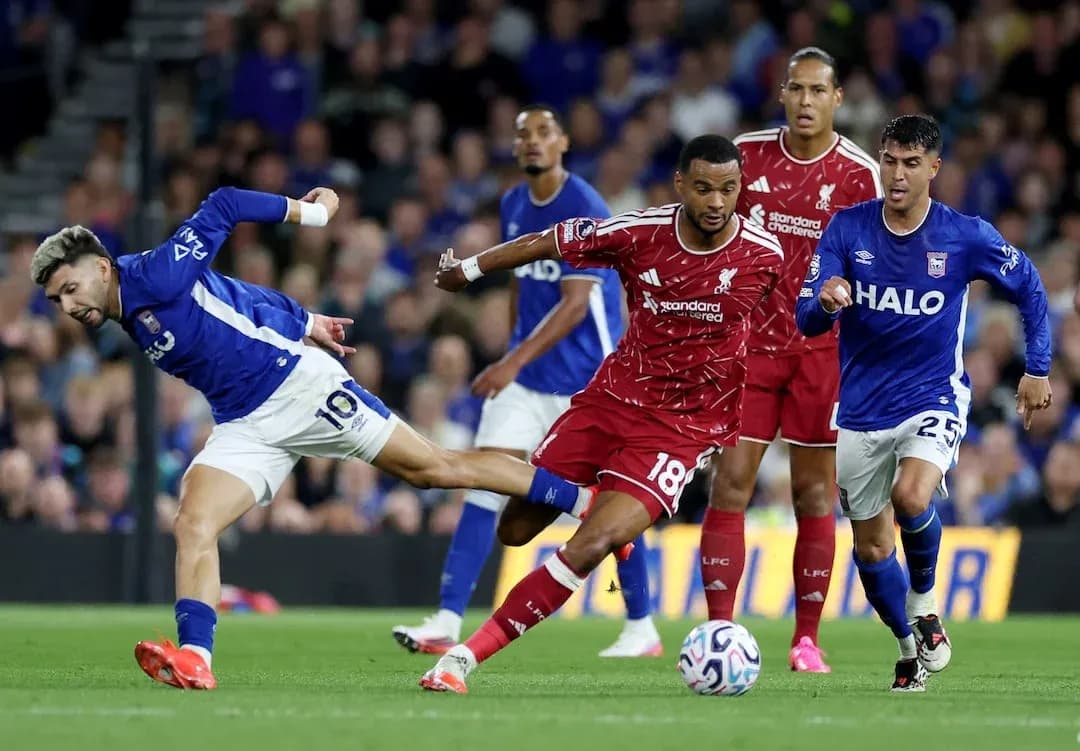
Portman Road under the Friday night lights has rarely felt so starkly divided. On one side, a newly returned Ipswich side still learning the cruelty of the Premier League. On the other, a Liverpool team that already looks like it has found a new attacking grammar under Andoni Iraola. The 2–0 away win, sealed inside 90 minutes, felt less like an upset of the league’s early table and more like its logical extension.
Heading into this game, the numbers had already drawn the outlines. Ipswich sat 14th with 3 points from 3 matches, their overall goal difference at -4, the product of 4 goals scored and 8 conceded. At home they had been competitive but fragile: 2 matches, 1 win and 1 defeat, with 2 goals for and 3 against. Liverpool arrived in Suffolk in a very different mood: 6th in the table, unbeaten with 5 points from 3 games, and a positive overall goal difference of 2 (6 scored, 4 conceded). On their travels, they had already shown steel: 2 away games, 1 win and 1 draw, 4 goals scored and only 2 conceded.
Both coaches set up in mirrored 4‑2‑3‑1 shapes, but the personnel told two very different stories.
For Ipswich, Gary O’Neil’s selection was shaped as much by absences as by ambition. In midfield, the loss of A. Matusiwa and J. Taylor to injury stripped away a natural ball-winner and a vertical runner, while the absence of J. Philogene removed a one‑v‑one outlet from the flanks. That left S. Lukić and E. Palacios as a double pivot tasked with both screening and starting play, a heavy burden against an opponent that thrives on turnovers.
Ahead of them, the trio of A. Fatawu, J. Enciso and D. Maeda supported Emersonn as the lone forward. On paper, that band of three offers dribbling, creativity and pressing energy. In practice, against a side of Liverpool’s pressing intensity, they were often forced backwards, their touches coming deeper than O’Neil would have liked. Enciso’s broader season numbers – 2 assists in 3 appearances and 4 key passes overall – mark him as Ipswich’s primary creative conduit, but here he was largely starved of the ball in dangerous zones.
Defensively, Ipswich’s back four of L. Davis, J. Greaves, I. Diop and D. O’Shea faced a brutal assignment. Across the season, Ipswich’s overall average of 2.7 goals conceded per match, with 1.5 at home, underlined the fragility that Liverpool’s movement was primed to exploit. The home side had yet to keep a clean sheet in total this campaign, and against an away attack averaging 2.0 goals per game on their travels, that streak always looked likely to continue.
Liverpool’s line-up, by contrast, radiated control and threat despite their own injury list. C. Bradley, F. Chiesa, H. Ekitike, J. Gomez and G. Leoni were all missing, robbing Iraola of depth at full-back, wide forward and centre-back. Yet the starting XI still bristled with quality.
At the back, Alisson Becker anchored a defence marshalled by V. van Dijk and J. Jacquet, flanked by R. Araújo on the right and M. Kerkez on the left. Van Dijk’s presence allowed Liverpool to hold a higher line, compressing the pitch and suffocating Ipswich’s attempts to play out. Kerkez, already a magnet for cards this season with 2 yellows and a red to his name, walked the familiar tightrope between aggression and overreach, but his 6 tackles and 3 blocked shots overall this campaign speak to a defender who relishes front‑foot duels.
In front of them, the “engine room” pairing of D. Szoboszlai and A. Mac Allister underpinned Liverpool’s control. Szoboszlai’s ability to break lines with his passing and carrying dovetailed with Mac Allister’s calmer orchestration, ensuring that Ipswich’s double pivot were constantly shifting, never settled. With Liverpool’s yellow-card distribution peaking between 46–60 minutes (40% of their cautions in that window), there is a pattern of second-half intensity that often coincides with their counter-pressing surges. Ipswich, whose own cards cluster in the 31–45 minute band (75% of their yellows), tend to reach for the tactical foul earlier, a sign of first‑half firefighting rather than late-game control.
Higher up, Iraola’s attacking quartet was the game’s decisive difference. C. Gakpo, operating nominally from the left but floating into central pockets, arrived at Portman Road as the league’s top provider with 3 assists in 3 appearances and 8 key passes overall. His blend of ball-carrying and defensive work – 6 tackles and 5 interceptions this season – makes him both hunter and shield in transition.
Central to everything, though, was A. Isak. The Premier League’s leading scorer with 3 goals from 3 games, he came into this fixture having taken 7 shots with 5 on target, a ruthless profile that Ipswich’s centre-backs struggled to contain. His movement between Diop and Greaves repeatedly created the channel that Liverpool’s No. 10 zone – often occupied by F. Wirtz – could slide passes into. Wirtz, flanked by Víctor Muñoz and Gakpo, formed a fluid band of three that constantly rotated, dragging Ipswich’s back four and double pivot into uncomfortable decisions.
The “Hunter vs Shield” dynamic was brutally one-sided. Liverpool’s overall attacking average of 2.0 goals per game met an Ipswich defence conceding 2.7 per match, and on their travels Liverpool had already shown they could translate dominance into end product. Ipswich’s own attack, averaging 1.3 goals overall and only 1.0 at home, found itself running into a visiting side that, while not watertight – 1.3 goals conceded per game overall – had already produced one away clean sheet.
From a disciplinary and psychological standpoint, Liverpool’s penalty record added another layer of threat. They had won and converted 1 penalty this season with a perfect 100.00% conversion rate and no misses. Ipswich, by contrast, had yet to take a spot-kick in total this campaign. In a match where territory and pressure were likely to be tilted red, the mere presence of Isak and Gakpo in the box amplified the risk for Ipswich’s defenders.
Tactically, the key intersection lay in the wide zones. Ipswich’s best ball carriers – Fatawu and Enciso – prefer to receive facing forward, but Liverpool’s full-backs, Kerkez and Araújo, are aggressive in stepping into passing lanes. With Liverpool’s pressing often spiking after half-time, Ipswich’s tendency to pick up cards just before the interval hinted at a side already stretched by then. Once behind, O’Neil’s men were forced to open up, exposing a back line that had already conceded 5 goals on their travels and 3 at home.
Following this result, the patterns feel less like early-season noise and more like a developing script. Ipswich’s reliance on Enciso and Fatawu for creativity remains, but without a sturdier defensive platform their 4‑2‑3‑1 risks becoming a 4‑4‑1‑1 under siege. Liverpool, meanwhile, leave Portman Road with their away record strengthened, their unbeaten run intact, and their key figures – Isak the finisher, Gakpo the supplier, Van Dijk the organiser – all firmly embedded in Iraola’s emerging blueprint.
The statistical prognosis from here is clear: unless Ipswich can tighten a defence that has yet to record a single clean sheet in total this campaign and continues to concede at an overall rate of 2.7 goals per match, their attacking flashes will be drowned out against the league’s elite. Liverpool, with a balanced goal difference of 2 and an attack humming at 2.0 goals per game, look built not just to dominate the ball, but to turn that control into a season-long title conversation.