Nottingham Forest and Bournemouth End Premier League Season with Tactical Draw
Nottingham Forest and Bournemouth closed their Premier League seasons at the City Ground with a 1-1 draw that neatly reflected the tactical balance of the contest. Forest, in a 4-4-2 under Vitor Pereira, sought to create direct central connections and overloads between the lines, while Andoni Iraola’s Bournemouth, in their usual 4-2-3-1, gradually asserted control of territory and possession, finishing with 55% of the ball and a higher passing accuracy.
Forest’s 4-4-2 structure was clear from the outset. M. Sels (Nottingham Forest) sat behind a flat back four of N. Williams and Cunha as attacking full-backs, with Morato and N. Milenkovic as the central pairing. In midfield, O. Hutchinson and M. Gibbs-White nominally started wide but consistently drifted inside to form a box with I. Sangare and E. Anderson. This created central overloads against Bournemouth’s double pivot, especially in the first half, and was central to Forest’s chance creation: 15 total shots, 10 from inside the box, and an xG of 1.87.
First Half
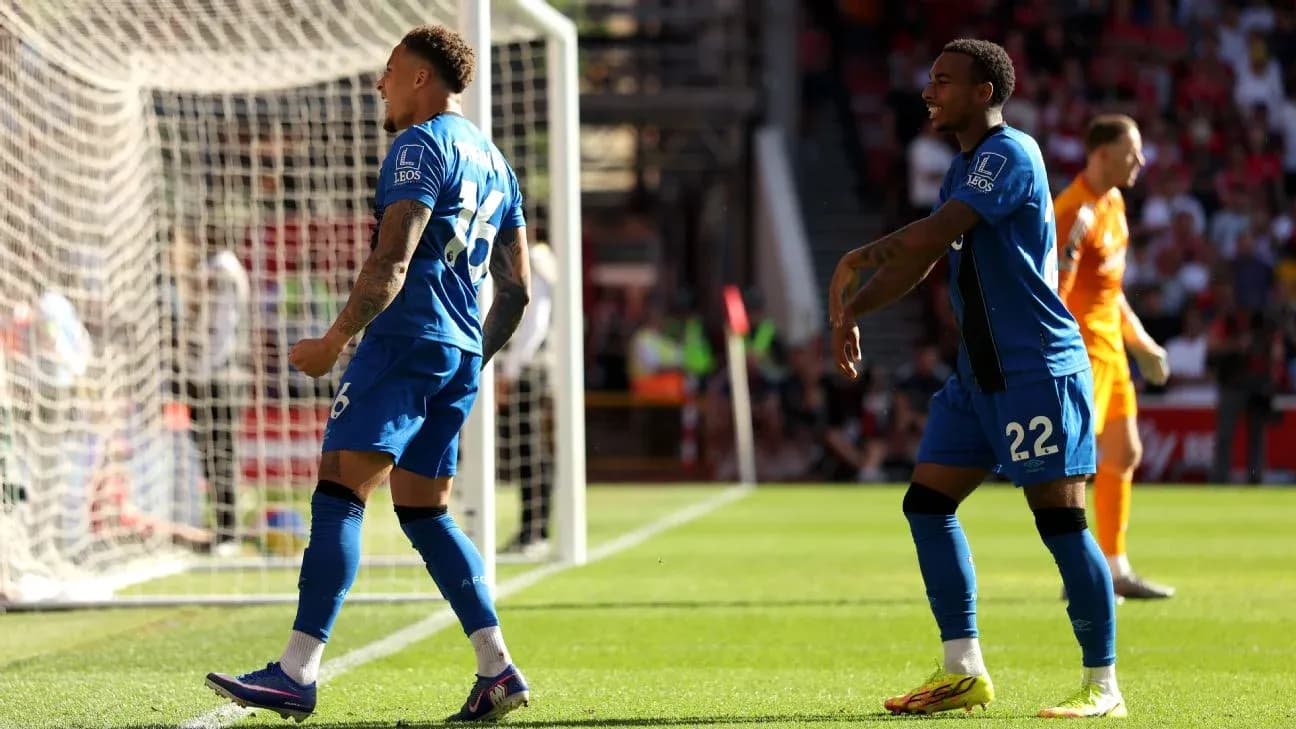
The opening goal at 34' epitomised Forest’s plan. Hutchinson, operating from the right but in a half-space pocket, provided the assist for Gibbs-White, who had moved infield from his left-sided starting zone. The 4-4-2 therefore often resembled a narrow 4-2-2-2 in possession, with the forwards Igor Jesus and C. Wood occupying both centre-backs and pinning Bournemouth’s line deep. Forest’s 6 corners and 5 blocked shots underline how often they managed to sustain pressure in the final third.
Out of possession, Forest’s 4-4-2 press was more selective than constant. The front two tried to screen passes into Bournemouth’s pivot, while the wide midfielders tracked Bournemouth’s full-backs. The cost was a relatively high foul count (11) and a yellow card for substitute Taiwo Awoniyi on 67' for “Foul”, as Forest increasingly had to break Bournemouth’s rhythm through contact once the visitors took control of the ball after the interval.
Bournemouth's Response
Bournemouth’s 4-2-3-1 began relatively cautiously, with T. Adams and A. Toth anchoring midfield in front of a back four of A. Truffert, M. Senesi, J. Hill and A. Smith. The initial plan was to build patiently, using the double pivot to escape Forest’s front-two press. However, in the first half, Forest’s compactness between the lines forced Bournemouth into more shots from distance: of their 17 total attempts, 11 came from outside the box, reflecting how often Forest managed to protect the central zone in front of their centre-backs.
The equaliser at 54' signalled Bournemouth’s tactical progression. Truffert, advancing from left-back, delivered the assist for M. Tavernier, who attacked the space between Forest’s right-back and right centre-back. This move showed Bournemouth’s adjustment: full-backs stepping higher and the wide attacking midfielders making more aggressive runs inside, turning the 4-2-3-1 into a 2-4-4 in sustained possession. From that point, Bournemouth’s territorial control was clear in the numbers: 55% possession, 483 total passes with 405 accurate (84%), compared to Forest’s 396 passes, 307 accurate (78%).
Substitutions and Tactical Changes
Iraola’s substitutions at 57' and 73' further tilted the tactical picture. B. Gannon-Doak (IN) came on for A. Toth (OUT), then E. Unal (IN) for Evanilson (OUT), J. Kluivert (IN) for E. J. Kroupi (OUT) and A. Adli (IN) for Rayan (OUT), progressively adding more attacking profiles and fresh legs in the advanced line. This transformed Bournemouth’s shape into something closer to a 4-1-4-1 in possession, with a single pivot and a line of four attacking midfielders rotating positions behind the striker, increasing their ability to find pockets between Forest’s lines.
Pereira’s response was to refresh the structure rather than change it fundamentally. T. Awoniyi (IN) for C. Wood (OUT) at 62' maintained the 4-4-2 but added more depth-running threat. L. Netz (IN) for Cunha (OUT) at 63' and R. Yates (IN) for E. Anderson (OUT) plus N. Dominguez (IN) for I. Sangare (OUT) at 65' suggested a desire to stabilise the flanks and regain some central energy. Later, J. McAtee (IN) for O. Hutchinson (OUT) at 78' aimed to reintroduce creativity between the lines. Yet, despite these changes, Forest’s attacking output after the break never matched their first-half fluidity; Bournemouth’s control of possession and spacing limited Forest to more sporadic counter-attacking situations.
Goalkeeping and Defensive Statistics
Defensively, both goalkeepers had relatively similar statistical profiles. M. Sels (Nottingham Forest) made 3 saves, while D. Petrovic (Bournemouth) also recorded 3 saves. The negative goals prevented figures for both sides (–0.5 each) indicate that each goalkeeper conceded slightly more than the model expected based on shot quality, reinforcing the idea that the finishing rather than the keeping defined the 1-1 outcome.
The card profile fits the tactical story. Bournemouth’s James Hill was booked at 33' for “Foul”, a product of Forest’s aggressive occupation of central spaces and quick combinations around the box. Later, Awoniyi’s yellow at 67' for “Foul” underlined Forest’s need to disrupt Bournemouth’s increasingly dominant circulation as the visitors pushed forward with more numbers and tempo.
Statistical Verdict
From a statistical verdict, the draw can be read as Forest’s volume and quality of chances against Bournemouth’s control of the ball. Forest generated higher xG (1.87 to Bournemouth’s 1), more shots inside the box (10 to 6) and more corners (6 to 3), all indicators of dangerous territory. Bournemouth, however, outshot Forest overall (17 to 15), had more blocked efforts (7 to 5) and used their 55% possession and superior passing efficiency to dictate large stretches of the second half.
In season-context terms, the match resembled a microcosm of both sides’ tendencies: Forest relying on structured 4-4-2 combinations, quick central overloads and directness, Bournemouth leaning on a possession-based 4-2-3-1 that, once settled, can hem opponents in and generate a steady flow of shots, even if many are from range. The 1-1 at the City Ground ultimately reflected a tactical stalemate: Forest’s first-half structure and chance creation balanced by Bournemouth’s second-half territorial control and adjustments.