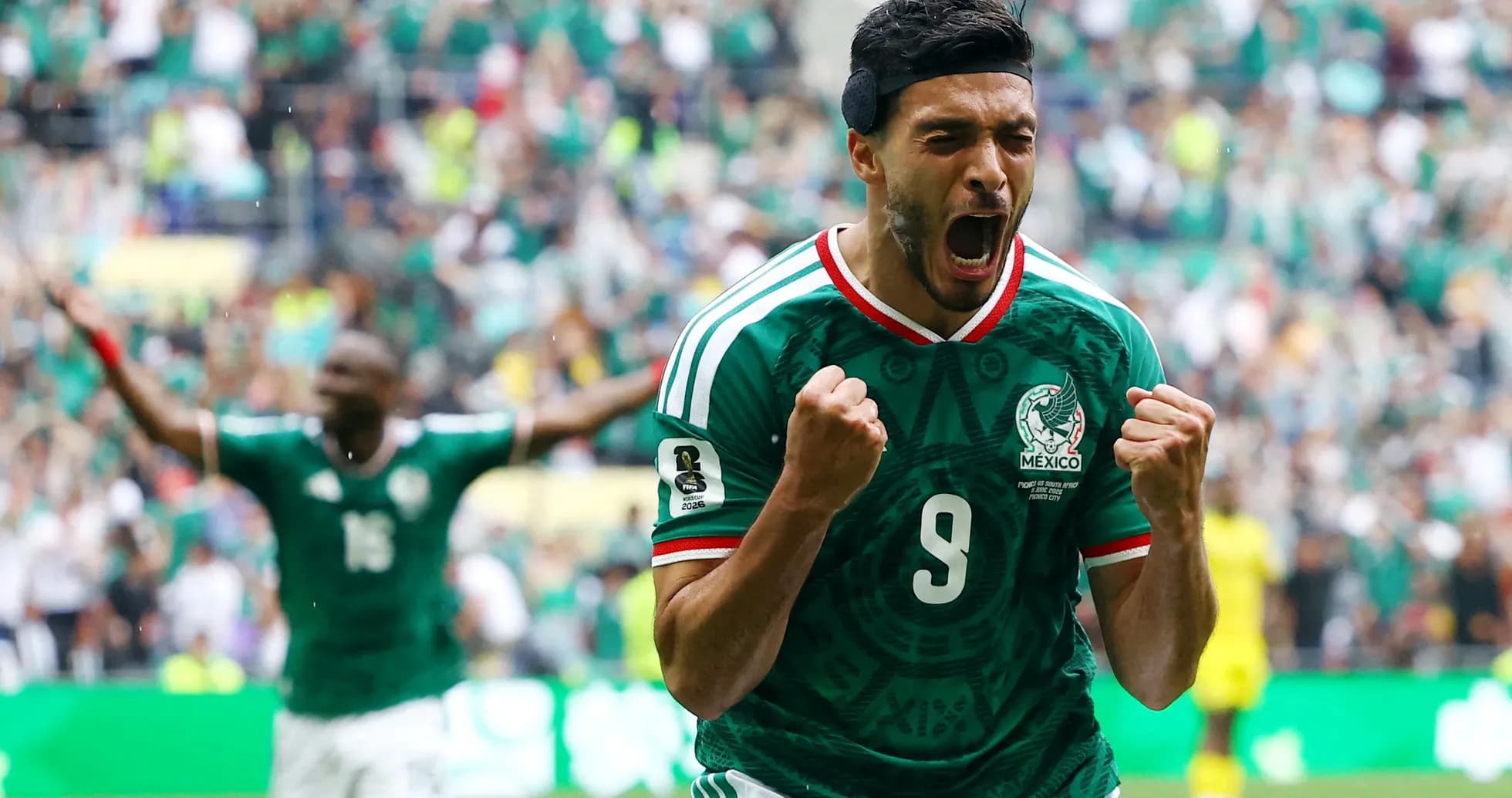
Mexico Dominates South Africa 2-0 with Tactical Mastery
Mexico’s 2-0 win over South Africa at Estadio Azteca was built on structural control, territorial dominance, and intelligent exploitation of the extra space once the visitors went down to nine men. The scoreline aligned closely with the underlying metrics: Mexico generated 1.41 xG to South Africa’s 0.07, reflecting sustained pressure against a side that rarely escaped its own half.
Javier Aguirre’s Mexico set up in a 4-1-4-1 that behaved like a high-possession, positionally disciplined unit. Erik Lira, as the single pivot, was the key reference point. Operating ahead of the back four, he connected defence to midfield and dictated the tempo, which shows in Mexico’s 520 passes with 467 accurate (90%). With 61% possession, Mexico used the ball not just to circulate but to repeatedly pin South Africa’s 5-3-2 deep.
First Goal
The first goal on 9 minutes encapsulated the structure: Julián Quiñones scored after a move involving Erik Lira, whose assist underlined his vertical passing role from the base. The “4” line of Roberto Alvarado, Brian Gutiérrez, Álvaro Fidalgo and Quiñones rotated fluidly behind Raúl Jiménez, with Fidalgo and Gutiérrez occupying the half-spaces and drawing out South Africa’s central midfielders. This forced Hugo Broos’s 5-3-2 to compress centrally, opening lanes for Gallardo and Israel Reyes to advance from full-back.
South Africa’s 5-3-2 was designed to be compact and reactive, but it never transitioned into a threatening counter-attacking structure. They completed 335 passes (272 accurate, 81%) and produced only 3 total shots, with just 1 inside the box. Teboho Mokoena and Siphephelo Sithole were overloaded by Mexico’s four-man attacking midfield band plus Lira stepping in, which meant the South African forwards, Iqraam Rayners and Lyle Foster, were often isolated and forced to press channels rather than receive in them.
Tactical Changes
The match’s tactical balance tilted further on 49 minutes when Siphephelo Sithole’s red card for “Professional foul last man” reduced South Africa to ten. Already struggling to progress the ball, South Africa’s midfield lost an essential screen. Broos responded with structural adjustments via substitutions: Thalente Mbatha (IN) came on for Lyle Foster (OUT) at 56', and Themba Zwane (IN) came on for Jayden Adams (OUT) at 61'. These moves suggested a shift toward shoring up the middle and accepting a deeper block, effectively moving from a 5-3-2 into something closer to a 5-3-1 or 5-4-0 in long phases without the ball.
Mexico, by contrast, used their bench to maintain intensity and control. Gilberto Mora (IN) came on for Álvaro Fidalgo (OUT) and Luis Chávez (IN) for Brian Gutiérrez (OUT), both at 66', refreshing the central lanes without altering the basic 4-1-4-1 structure. The immediate payoff came at 67', when Raúl Jiménez scored the second, assisted by Roberto Alvarado. The goal highlighted Mexico’s capacity to attack the spaces between South Africa’s wing-backs and outer centre-backs, especially as fatigue and numerical inferiority set in.
Later changes were about game management and rotation. Armando González (IN) came on for Raúl Jiménez (OUT) and Edson Álvarez (IN) for Erik Lira (OUT) at 76', then Alexis Vega (IN) for Julián Quiñones (OUT) at 79'. Álvarez’s introduction as a more defensive-minded presence at the base ensured Mexico could manage transitions even as they continued to push numbers forward.
Defensive Performance
Defensively, Mexico were rarely stretched. South Africa managed just 2 shots on goal, and Raúl Rangel (Mexico) was required for 2 goalkeeper saves. The back four of Israel Reyes, César Montes, Johan Vásquez and Jesús Gallardo benefited from the strong shield in front, and Mexico’s 12 fouls were mostly a function of counter-pressing rather than being under sustained threat. The late red card for César Montes at 90+2' for “Professional foul last man” came from one of the few situations where Mexico’s high line was exposed, but by then the tactical picture was set.
On the other side, Ronwen Williams (South Africa) made 2 saves as well, but the broader defensive picture was more concerning. South Africa allowed 16 total shots, 9 inside the box and 5 blocked, indicating that much of the defending was last-ditch within their own penalty area. The 2-0 scoreline combined with a goals prevented figure of -0.47 for South Africa underlines that their defensive unit conceded chances of slightly higher quality than the goals alone suggest.
Discipline and Tactics
Discipline further shaped the tactical narrative. Teboho Mokoena’s yellow card at 17' for “Foul” and Brian Gutiérrez’s at 23' for “Foul” were early markers of an intense midfield battle. After Sithole’s dismissal, South Africa’s defensive burden shifted even more onto the back five. The late sequence where a VAR “Card upgrade” review on Themba Zwane at 82' preceded his red card at 84' for “Violent conduct” left South Africa with nine men, effectively ending any possibility of meaningful pressing or counter-attacks. Mexico’s own red card for César Montes did little to change the pattern in the final minutes.
Statistically, Mexico’s 61% possession, 520 passes (467 accurate, 90%), and 16 shots to South Africa’s 3 confirmed their territorial and structural dominance. The 3-1 edge in corner kicks and the ability to keep South Africa to 0.07 xG show how effectively Mexico locked the game into the visitors’ half. South Africa’s 11 fouls and 2 red cards (plus 2 yellow cards overall) contrasted with Mexico’s 12 fouls, 1 yellow card and 1 red card, underscoring how often the visitors were forced into emergency defending and disruptive actions rather than controlled duels.
In tactical terms, Mexico’s 4-1-4-1 offered clear superiority in central zones and controlled progression, while South Africa’s 5-3-2, undermined by dismissals and limited ball progression, never evolved into a credible counter-attacking threat. The result and the underlying numbers both point to a match Mexico managed on their own terms from start to finish.