Manchester City vs Aston Villa: Tactical Analysis of a 1-2 Defeat
Manchester City’s 4-2-2-2 against Aston Villa’s 4-2-3-1 produced a match where structural control and territorial dominance from the hosts were undone by Villa’s cleaner vertical execution and superior penalty-box efficiency. At the Etihad Stadium, City had more of the ball (52% possession), more total shots (16–12) and more corners (9–4), yet lost 1-2 as Villa turned fewer but better attacks into decisive moments.
Out of possession, Villa’s 4-2-3-1 behaved like a compact 4-4-2 mid-block, with Emiliano Buendia stepping up alongside Ollie Watkins to screen City’s double pivot of Nico and Bernardo Silva. Douglas Luiz and L. Bogarde protected the central lane, allowing the back four to hold a relatively tight line. This structure limited City’s access to the half-spaces where Phil Foden and Savinho like to receive. Despite City generating 10 shots inside the box, many of those were under pressure or from crowded situations, reflected in a modest xG of 1.25 from 16 attempts and six blocked shots.
City’s build-up was heavily oriented to the left. Nathan Ake and Ruben Dias formed the base, with Rico Lewis often stepping into midfield from right-back but finding less space due to Villa’s block. Nico and Bernardo Silva alternated dropping to receive, trying to free Savinho and A. Semenyo between lines. The opening goal on 23 minutes, A. Semenyo for Manchester City, came as a reward for this territorial pressure: City had already established a rhythm of sustained attacks and second-ball recoveries around Villa’s box, pinning the visitors deep and forcing them to defend their own area for long spells.
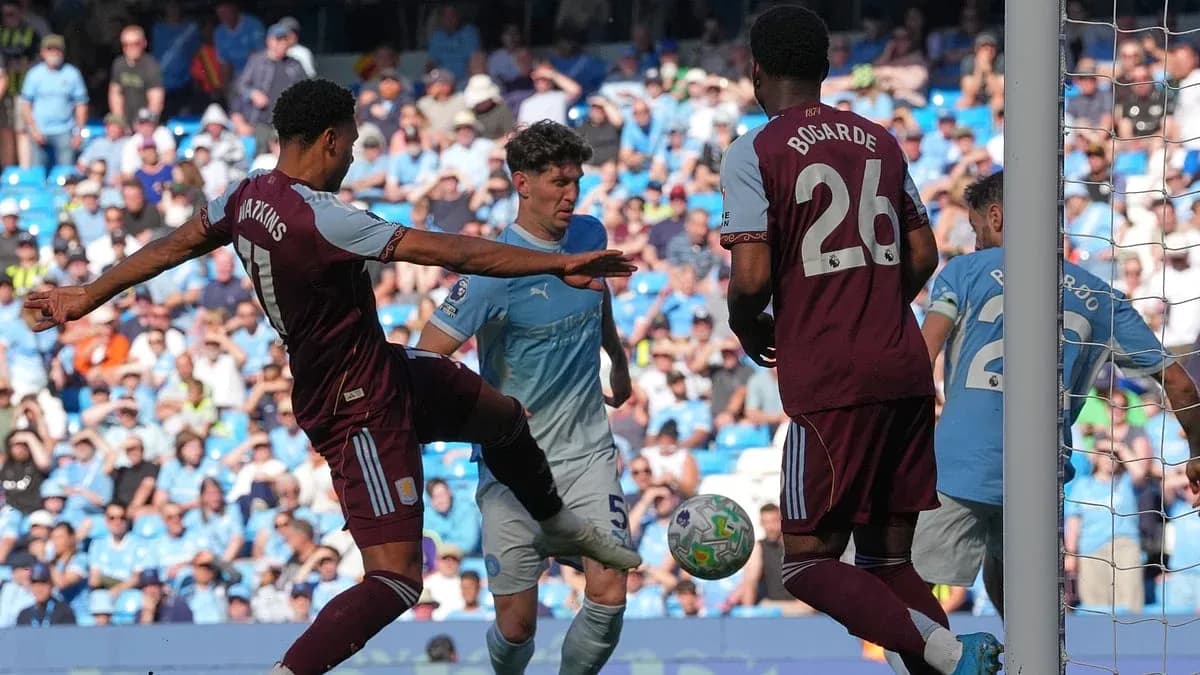
Yet the structural flaw in City’s plan emerged in transition. With both full-backs encouraged to advance and the double pivot tasked with progression, the rest defence around John Stones and Ruben Dias was repeatedly stressed by direct balls into Watkins. Villa’s equaliser at 47 minutes, again through O. Watkins, was emblematic: a quick vertical attack exploited space behind City’s midfield line before the defensive block could reset. The second Watkins goal on 61 minutes, assisted by Ross Barkley, underlined how effectively Villa attacked the same channel. Barkley’s ability to carry and then release at the right moment punished City’s high positioning, and the VAR confirmation at 63 minutes merely ratified what had already become the game’s tactical hinge.
Pep Guardiola’s response was to inject more individual dribbling and central overloads. R. Cherki (IN) came on for A. Semenyo (OUT) at 58', and M. Kovacic (IN) replaced Bernardo Silva (OUT) at 59', shifting the creative burden more centrally and looking for quicker combinations around the box. Later, J. Doku (IN) for T. Reijnders (OUT) at 77' and R. Ait-Nouri (IN) for N. Ake (OUT) at 77' added width and fresh legs, while J. Gvardiol (IN) for J. Stones (OUT) at 78' maintained left-sided build-up quality. These changes increased City’s territorial siege but did not fundamentally solve the transition vulnerability or unlock a better shot profile; the xG plateaued and Villa’s box defence held.
Unai Emery’s substitutions were more about protecting the lead and refreshing the block. At 46', M. Cash (IN) came on for A. Garcia (OUT), adding athleticism and aggression down the right to cope with Savinho and later Doku. A triple change on 73' – Y. Tielemans (IN) for Douglas Luiz (OUT), P. Torres (IN) for V. Lindelof (OUT), and A. Onana (IN) for L. Bogarde (OUT) – rebalanced midfield legs and defensive security, with Torres’ distribution helping Villa play out under pressure. Finally, J. McGinn (IN) for R. Barkley (OUT) at 86' brought extra work-rate and defensive nous to see out the final minutes.
In goal, J. Trafford (Manchester City) faced five shots on target and made three saves, while M. Bizot (Aston Villa) dealt with three shots on target and made two saves. The goals prevented metric (0.28 for each team) suggests both goalkeepers performed close to expectation given the quality of chances faced, with the decisive edge coming not from extraordinary shot-stopping but from the patterns of chance creation and conversion in front of them.
Discipline also reflected the game’s flow. Manchester City committed more fouls (8–4) and received the only booking: at 82', Rico Lewis (Manchester City) — Foul. This was consistent with City’s need to counter-press aggressively after turnovers, often higher up the pitch, whereas Villa’s more compact block allowed them to defend with positioning rather than repeated challenges.
Statistically, the story is one of control versus punch. City’s 458 total passes, 405 accurate (88%), underline their dominance of circulation, but Villa’s 436 passes, 394 accurate (90%), show they were nearly as secure when they chose to play, just more selective. Villa’s higher xG (1.58 to City’s 1.25) from fewer shots and fewer blocked attempts (2 vs City’s 6) indicates that their attacks culminated in clearer looks at goal, particularly through Watkins’ movements off the last line.
The late drama at 90+2', when a potential goal by Phil Foden was disallowed by VAR, encapsulated City’s afternoon: heavy pressure, near-misses, but ultimately insufficient incision against a Villa side that married compact defensive organisation with ruthless exploitation of City’s structural risks in transition.