Liverpool vs Nottingham Forest: A Tactical Clash of Evolving Identities
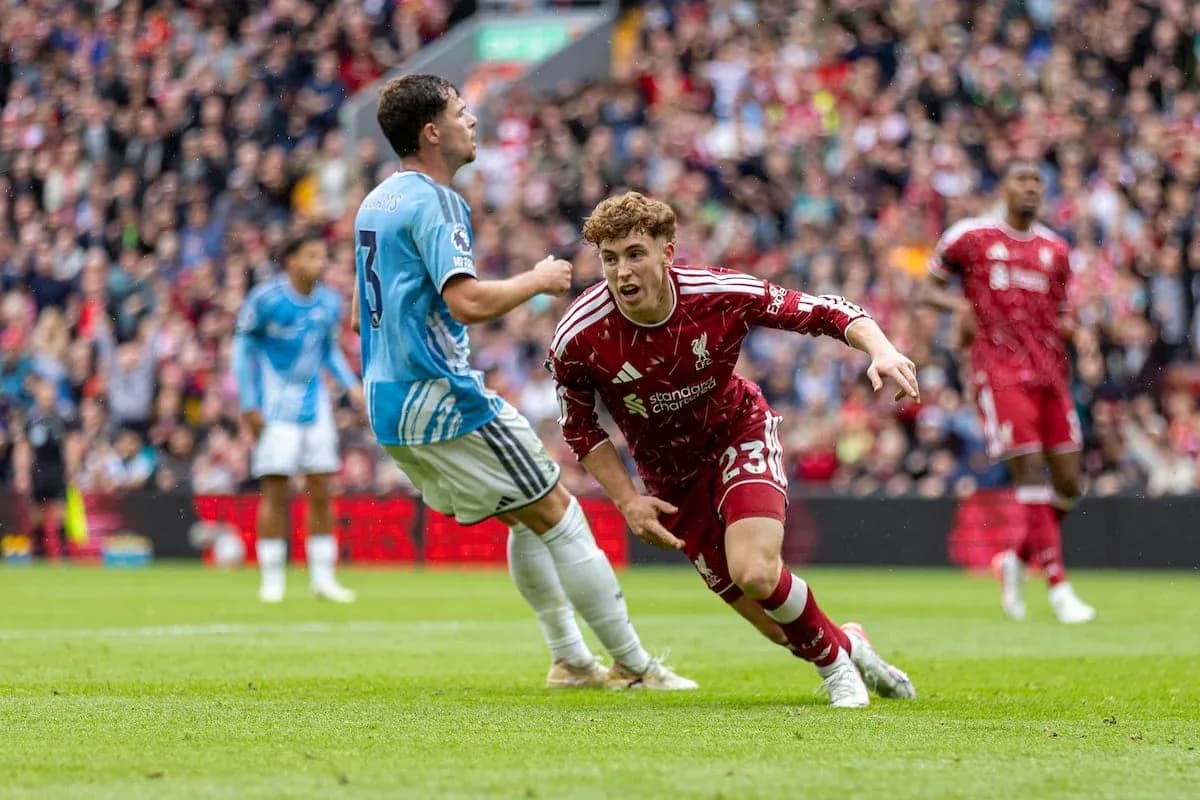
Anfield had the feel of a side still under construction as Liverpool’s new era under Andoni Iraola met Oliver Glasner’s reshaped Nottingham Forest in the early kick-off. The 2-2 draw left Liverpool sitting 13th with 2 points from 2 games, their goal difference exactly balanced at 0 after scoring 4 and conceding 4 overall. Forest, with 1 point from their opening 2 fixtures and a goal difference of -1 (2 scored, 3 conceded overall), depart Merseyside knowing they can bloody the nose of a heavyweight but still lack the control to close a game out.
I. The Big Picture – Two evolving identities
On paper this was a clash of systems as much as squads. Liverpool persisted with Iraola’s favoured 4-2-3-1, the same shape they have used in both league games so far, while Forest again lined up in Glasner’s 3-4-2-1, also unchanged as a structural idea across their 2 league outings.
Liverpool’s season profile is already clear: expansive, front-foot, but porous. Heading into this game they averaged 2.0 goals scored at home and 2.0 conceded at Anfield, mirroring identical numbers on their travels. No clean sheets in either venue, no defeats either, and a streak built entirely on draws. They have not failed to score once this campaign, but they also have not shut anyone out.
Forest arrive from the opposite emotional angle: pragmatic, reactive, and still searching for balance. Overall they have scored 2 and conceded 3, with their attack split starkly by venue: 0 goals at home, 2 away; and 1 conceded at home versus 2 on their travels. Their only point so far has come away, where they have matched opponents 2-2 on aggregate and shown a willingness to punch up the pitch when space is offered.
II. Tactical Voids – Absences and edge
Both managers were forced to work around key absences that subtly reshaped the contest. Liverpool’s missing list was long: Stefan Bajcetic (hamstring), Conor Bradley (knee), Federico Chiesa (back), Hugo Ekitike (Achilles), Harvey Elliott (coach’s decision), Joe Gomez (injury) and Gabriele Leoni (knee) all sidelined. That stripped Iraola of rotation in both full-back zones, a natural wide dribbler in Chiesa and a right-sided controller in Elliott. It pushed more responsibility onto Jeremie Frimpong and Milos Kerkez to provide width, and onto the central trio of Dominik Szoboszlai, Alexis Mac Allister and Florian Wirtz to create through the middle.
Forest’s absentees were fewer but pointed: Ibrahim Sangare (calf) and Nicolo Savona (knee) both out. Without Sangare’s screening, Glasner had to lean on Xaver Schlager and James McAtee as the central core in front of the back three, a pairing more about circulation and pressing than pure destruction. That left their 3-4-2-1 vulnerable when Liverpool managed to pin Forest’s wing-backs back and isolate the central duo.
Discipline was always going to be a subplot. Across the season, Liverpool’s yellow cards are spread with a late-game surge: 28.57% of their bookings arrive between 76-90 minutes, matching the 28.57% spikes in both the 16-30 and 46-60 ranges. Forest, by contrast, load half of their cautions into the 46-60 window (50.00%), with another 25.00% in each of the 16-30 and 31-45 ranges. That pattern pointed to a likely narrative: Forest flirting with cards as they try to disrupt Liverpool early in each half, and Liverpool’s aggression rising as matches stretch and frustration builds.
III. Key Matchups – Hunter vs Shield, Engine Room vs Enforcer
The attacking focal point for Liverpool is already defined. Cody Gakpo, operating as an advanced midfielder from the left half-space, has 1 goal and 1 assist overall, taking 3 shots and creating 5 key passes across 2 appearances. He is both scorer and supplier, his 51 completed passes and 78% accuracy underlining his dual role as progressor and finisher. Alongside him, Victor Muñoz has emerged as a sharp secondary threat: 1 goal, 3 shots, 1 key pass and 1 successful block, plus 3 interceptions, marking him out as a two-way forward who presses as hard as he runs in behind.
Alexander Isak, with 1 goal from 5 shots and 3 efforts on target, is the pure “hunter” in this structure. His duel numbers (14 contested, 7 won) show a centre-forward willing to fight for territory, making him a constant test for Forest’s central trio of Murillo, Nikola Milenkovic and Cunha.
On the other side, Forest’s offensive brain belongs to Morgan Gibbs-White. With 1 goal, 1 assist and 4 shots, plus 57 completed passes at 82% accuracy, he is the creative axis of Glasner’s attack. His 8 dribble attempts with 4 successes and 10 duels won from 21 underline a player who relishes tight spaces and contact. Dan Ndoye complements him as a more vertical runner: 1 goal, 3 shots, 5 dribbles attempted with 2 successes and 6 duels won from 14.
The “Hunter vs Shield” duel therefore runs through Isak and Gakpo against Forest’s back three and double pivot, while Gibbs-White and Ndoye probe at Virgil van Dijk and J. Jacquet, supported by Alisson behind them.
In the “Engine Room” zone, Mac Allister and Szoboszlai had to outthink Schlager and McAtee. Mac Allister’s role as tempo-setter is crucial in a side that averages 2.0 goals scored and 2.0 conceded both home and away; he must choose when to accelerate and when to protect a defence that has yet to keep a clean sheet. Szoboszlai’s task is to break Forest’s first line, drawing out Schlager and exposing the channels beside Milenkovic and Murillo for Wirtz and Gakpo to exploit.
Defensively, Liverpool’s full-backs are a story in themselves. Frimpong, with 4 tackles and 4 key passes already this season, is effectively a winger in build-up, while Kerkez’s 4 tackles, 3 successful blocks and 2 interceptions show a more balanced profile: aggressive in duels (19 contested, 9 won) but also a genuine stopper. Against Forest’s wide pair of Ola Aina and Neco Williams, that duel on the flanks shapes the game’s width. Aina, who already has 2 yellow cards and sits at the top of the disciplinary charts, walks a tightrope every time he steps out to press Wirtz or Muñoz. His 7 dribble attempts with 4 successes and 10 duels won from 20 make him a dangerous carrier, but his disciplinary profile suggests Liverpool can tempt him into late challenges, especially in that volatile 46-60 minute window where Forest collect half of their yellows.
IV. Statistical Prognosis – Chaos over control
Both sides arrive with perfect records from the spot: Liverpool have taken 1 penalty overall and scored it, Forest likewise 1 from 1. There are no missed penalties to cloud the picture, which means any future spot-kick in this matchup is statistically likely to be converted and tactically decisive.
Structurally, Liverpool are built for high-scoring draws at this stage of the season. They score freely (4 goals overall from 2 fixtures, never failing to score home or away) but concede at exactly the same rate. Forest, by contrast, are split: blunt at home but far more dangerous away, where they average 2.0 goals scored and 2.0 conceded. On their travels they mirror Liverpool’s open, end-to-end profile.
Overlay those numbers and a pattern emerges: this fixture is primed for volatility rather than control. Liverpool’s lack of clean sheets, Forest’s away scoring rate, the card distributions that peak in the middle and late stages of halves, and the presence of high-impact creators like Gakpo and Gibbs-White all point toward a game where momentum swings are inevitable.
From a tactical lens, Liverpool’s edge lies in the density of their creative core. Between Gakpo, Wirtz and Ryan Gravenberch – who has already supplied 1 assist with 57 passes at 92% accuracy – Iraola can rotate ball-players between the lines to pull Forest’s 3-4-2-1 out of shape. Forest’s counterpunch rests on Gibbs-White’s ability to drag van Dijk into uncomfortable zones and Ndoye’s willingness to run the channels behind Frimpong and Kerkez.
The statistical prognosis, then, is not of a cagey mid-table stalemate but of two evolving projects leaning into their attacking strengths and living with the consequences. Liverpool’s higher ceiling in possession suggests they will continue to dominate territory and chance creation at Anfield, but Forest’s proven away threat and Gibbs-White’s form ensure that any lapse in Iraola’s high line can be punished.
In a league table that already shows Liverpool’s goal difference at 0 and Forest’s at -1, both sides look destined for more games like this: open, breathless, and decided not by who controls the first 20 minutes, but by who manages their chaos better in the last quarter of an hour.