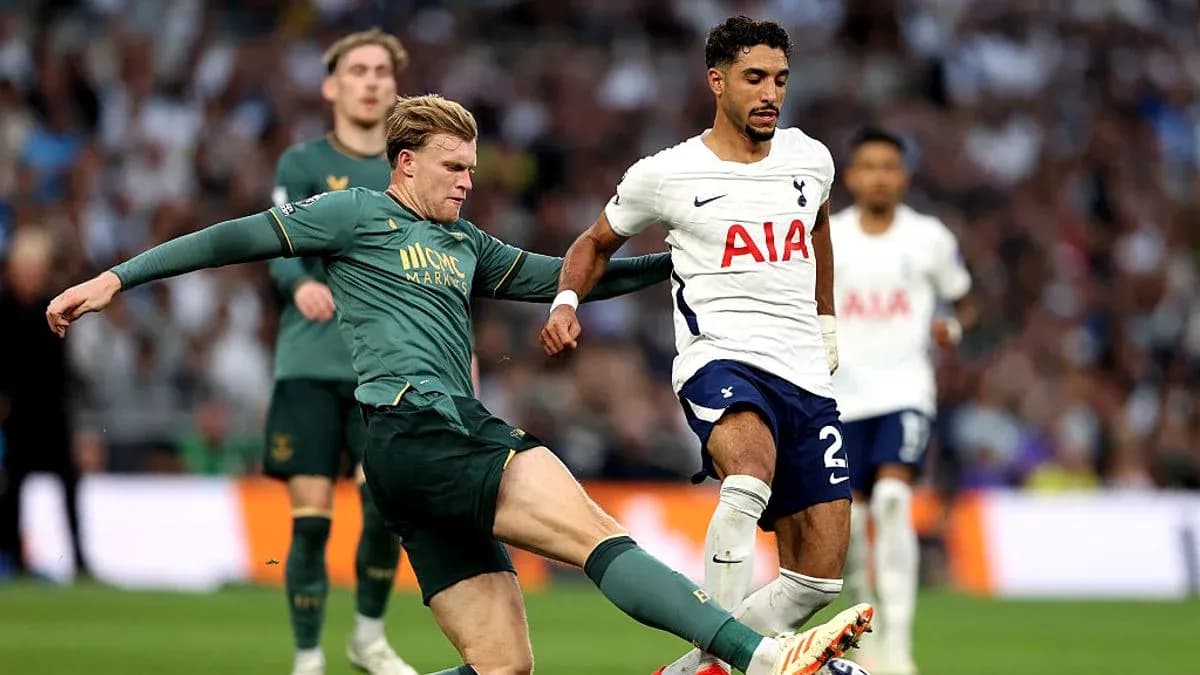
Jarrad Branthwaite's Defensive Masterclass Against Tottenham
Jarrad Branthwaite saw it coming. The cross, the chaos, the contact. He still went up anyway.
As the ball arced into a penalty area packed with white shirts and fraying nerves, the Everton defender climbed above everyone, thumped his header clear and braced for the collision that sent him crashing to the turf. The blow arrived, as he knew it would. He got up again.
It felt like the perfect final image. Everton’s most important player finishing the match exactly as he had played it: body first, questions later.
From the opening whistle, Branthwaite stood between Tottenham Hotspur and the cathartic home win their crowd had come looking for. Spurs came out flying, flooding the flanks, dragging Everton’s full-backs into uncomfortable territory and swarming the midfield. The visitors were stretched, then stretched again.
Matheus Fernandes, Omar Marmoush, Dominic Solanke and Savio all buzzed around the box, swapping positions, combining sharply, snapping off shots and crosses. For 20 minutes it looked like a mismatch. Tottenham’s movement shredded Everton’s structure.
They still could not find a way past the 24-year-old at the heart of the away defence.
Time and again Branthwaite stepped in, reading passes, throwing himself in front of goal-bound efforts, turning what should have been routine finishes into desperate blocks. Marmoush and Fernandes saw promising openings smothered by a defender who seemed to appear from nowhere. Solanke and Savio found that whenever the space opened up, it closed just as quickly – usually with a blue shirt and a late, perfectly timed intervention.
This is why, right now, no player shapes Everton’s ceiling more than Branthwaite. He has started all four league games of the campaign and the team’s resilience is built around him. The club know how fragile that feels. Last season disappeared under the weight of injury; this one is being built on his availability. Any talk of an England recall this month comes with an obvious caveat: how much can he be asked to carry?
On this evidence, plenty. Tottenham threw more than £400m worth of attacking talent at Everton over 90 minutes. None of it unsettled the £1m signing from Carlisle.
As the first-half onslaught faded into frustration, the mood inside the stadium shifted. The early crackle of anticipation dulled. Each wasted move, each overhit cross, each blocked shot frayed the patience further. Attacks broke down, the crowd groaned, and Everton slowly began to breathe.
Jordan Pickford, protected superbly, barely had a serious save to make before the closing stages. The only time he was truly extended came late on, when Lucas Bergvall finally forced him into action – a chance that stemmed from Pickford’s own errant pass. It summed up Tottenham’s afternoon: when they did threaten, they needed help from Everton.
When referee Darren England blew for full time, the reaction told its own story. Spurs trudged off to boos, their winless run deepening. Everton’s players crossed to the away end and were met with songs and applause, their defensive stand recognised by those who had travelled south.
David Moyes will know this was a performance that merited respect more than celebration. Everton’s first half was grim. They barely laid a glove on Spurs and created nothing of note until stoppage time, when James Garner’s free-kick forced Antonin Kinsky into a sharp save around the post.
The restart changed everything.
Everton came out with purpose and, crucially, belief. That belief grew when Thierno Barry ghosted in at the back post early in the second half, only for Kinsky to deny him. Suddenly, the game no longer felt like a siege. It felt like a contest.
Tottenham, still searching for their first league win, grew twitchy. Passes that had zipped in the first half now looked laboured. The crowd’s anxiety seeped onto the pitch. When Kinsky played out to Kiernan Dewsbury-Hall, the midfielder drove forward but fired straight at the keeper. A better finish and Spurs would have been spared the boos.
Dewsbury-Hall then released Brennan Johnson bursting into the box. Johnson had time, space and the angle. He lashed high and wide. Heads dropped. The sense of inevitability that had accompanied Tottenham’s early pressure vanished.
Everton will leave north London with a twinge of regret. For all their early suffering, they had the chances after the break to steal more than a point. Given their miserable recent record at this ground and the storm they had to ride out, they also have every right to feel pride.
The club has lurched through turmoil in the opening weeks of the season, but the table shows an unbeaten side that looks hard to beat and increasingly sure of its defensive identity. One journalist in the press room put it bluntly: in that second half, Spurs looked further away from scoring than at any point this season.
At the centre of that verdict stood Branthwaite, clearing, blocking, rising into tackles and into headers he knew would hurt. If Everton are to turn resilience into something more ambitious this season, it will be on the shoulders of the defender who keeps getting up.