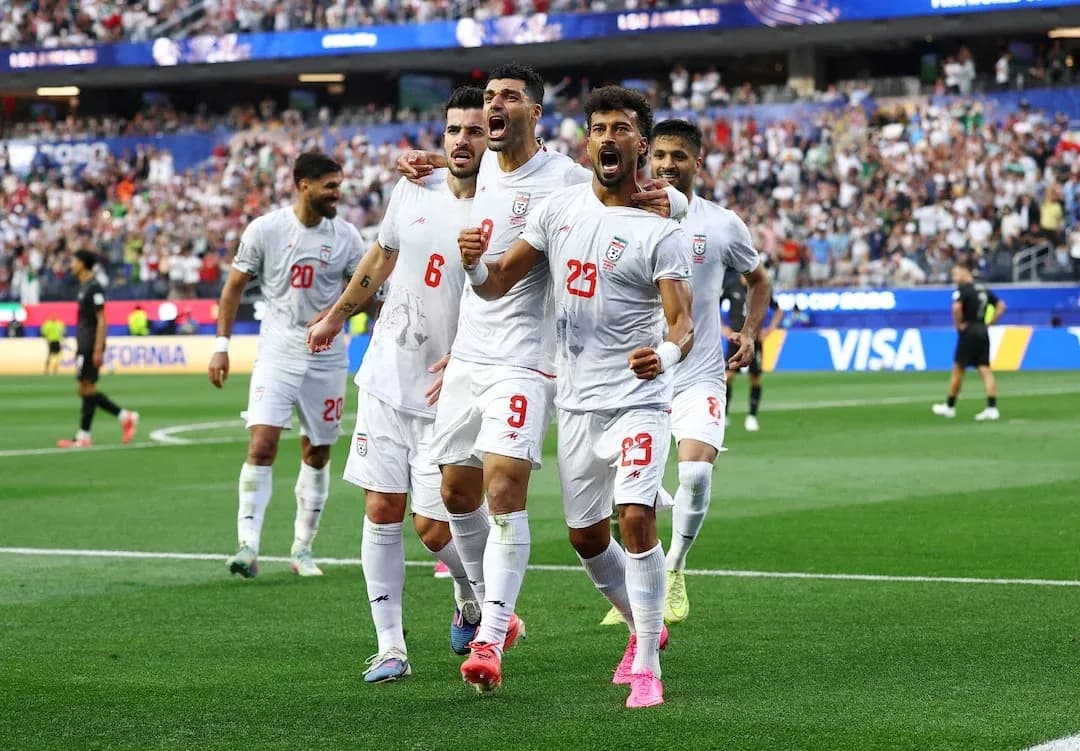
Iran and New Zealand Share Points in World Cup Opener
Under the roof of SoFi Stadium, Iran and New Zealand opened their World Cup campaigns with a 2-2 draw that felt less like a cautious group-stage sparring session and more like an early declaration of intent from both sides. Following this result, Group G’s table is delicately poised: New Zealand sit 1st and Iran 2nd, each with 1 point, identical goal differences of 0 and matching overall records of 0 wins, 1 draw, 0 defeats, with 2 goals scored and 2 conceded in total.
I. The Big Picture – Two Identities, One Shared Statement
Iran arrived as the nominal “home” side and leaned into a classic 4-4-2 under Amir Ghalenoei, a shape that has already become their default this tournament, having lined up in that formation in their only match so far. New Zealand countered with a modern 4-2-3-1, a structure built around the focal point of Chris Wood and the creative band behind him.
Statistically, both teams leave this opener with matching attacking and defensive profiles. Iran, at home, have averaged 2.0 goals for and 2.0 goals against, while New Zealand, on their travels, mirror that with 2.0 goals scored and 2.0 conceded. Neither side has yet kept a clean sheet, and neither has failed to score, underlining that this fixture was always more likely to be decided by attacking quality than by defensive perfection.
II. Tactical Voids and Discipline – Subtle Fault Lines
There were no official absences listed for either side, meaning both coaches had the full breadth of their squads at their disposal. That in itself shaped the tactical tone: Iran could deploy an experienced, balanced XI, while New Zealand could unleash their strongest attacking quartet behind Wood.
Disciplinary trends, though based on a small sample, already hint at where tension might surface later in the group. Iran’s card profile shows a stark late-game spike: 100.00% of their yellow cards so far have arrived between 76-90 minutes. The emblem of that edge is Ehsan Hajsafi. Coming off the bench, he played 25 minutes, won 2 of his 3 duels, and still found his way into the book once. His presence adds bite and leadership, but also risk in closing phases, especially if Iran are protecting a narrow margin in future matches.
New Zealand, by contrast, emerge from this match with a clean disciplinary slate: no yellow or red cards across any minute range. That restraint fits the picture of a side that wants to keep their structure intact and avoid disruptive suspensions as the group tightens.
III. Key Matchups – Hunter vs Shield, and the Engine Room
Hunter vs Shield
If this game had a single breakout star, it was Elijah Just. From the left side of New Zealand’s 4-2-3-1, he turned his World Cup opener into a personal showcase: 2 goals in total from 2 shots on target, 26 passes at 84% accuracy, and 11 duels contested with 5 won. His movement inside from the flank repeatedly asked questions of Iran’s defensive line, particularly of Milad Mohammadi on that side and the central pairing of Shoja Khalilzadeh and Ali Nemati.
On the Iranian side, the “hunter” role was unexpectedly carried by a defender. Ramin Rezaeian, nominally the right-back in the 4-4-2, produced a performance that already places him among the tournament’s standout full-backs. In total he scored 1 goal, added 1 assist, and hit the rare balance of attacking thrust and defensive reliability: 41 passes, 3 key passes, 3 tackles, and 2 interceptions, winning 7 of his 8 duels. He effectively operated as a wing-back, stretching New Zealand’s left side and forcing Liberato Cacace into long defensive shifts.
That duel down Iran’s right/New Zealand’s left was the tactical fault line of the match. Rezaeian’s surges and delivery asked New Zealand’s back four to constantly adjust their line, while Just’s inverted runs and combination play tested Iran’s ability to track runners from wide into central pockets. Neither “shield” fully contained the opposing “hunter”, which is why the scoreboard finished level at 2-2.
The Engine Room
Behind the attacking fireworks, the midfield battle was more understated but just as decisive in shaping the tempo. For Iran, Saeid Ezatolahi anchored the central band of four, providing the platform for Saman Ghoddos and Mohammad Mohebi to drift into half-spaces. Their task was to feed the front two of Shahriar Moghanlou and Mehdi Taremi while also screening transitions when possession was lost.
New Zealand’s double pivot of Joe Bell and Marko Stamenic had to manage that dual threat: Taremi’s clever movement off the front line and the late runs of Iran’s wide midfielders. Bell’s positional discipline allowed New Zealand’s advanced trio of Callum McCowatt, Sarpreet Singh, and Just to commit forward, safe in the knowledge that there was a platform behind them. Wood, though goalless, played the role of facilitator with 2 assists in total, 4 key passes, and 3 shots, 2 of them on target. He became the reference point around which the entire New Zealand attack rotated.
IV. Statistical Prognosis – A Group Shaped by Risk and Reward
Following this result, both teams carry the same overall record: 1 draw from 1 match, 2 goals scored, 2 conceded, goal difference 0. Their offensive averages are identical: 2.0 goals for in total, with the same 2.0 goals against. Neither side has earned a clean sheet or suffered a blank in attack, and both have yet to take a penalty.
The absence of minute-by-minute goal distributions in the data makes it impossible to map precise offensive peaks against defensive weaknesses, but the card profile for Iran suggests a pattern: intensity, and perhaps fatigue or desperation, spikes late, with 100.00% of their yellows arriving between 76-90 minutes. Opponents will see opportunity there—stretch Iran late, force duels in wide areas, and test the discipline of players like Hajsafi when legs are heavy.
From a tactical forecasting standpoint, Iran look like a side whose full-backs, especially Rezaeian, will continue to be central to their attacking xG, pushing high and delivering into a multi-pronged front line. That ambition, however, will keep their defensive xG against elevated, as transitions into the spaces they vacate remain a clear route for opponents.
New Zealand, meanwhile, have revealed a clear attacking hierarchy: Wood as the creative fulcrum, Just as the ruthless finisher, and a supporting cast of McCowatt and Singh linking zones. Their 4-2-3-1 appears stable, and with no cards and no penalties missed or taken, they project as a disciplined, methodical side that will trust their structure to generate chances rather than chase chaos.
In the end, this 2-2 draw at SoFi Stadium reads less like a stalemate and more like a warning shot from both Iran and New Zealand. They may share the same numbers on the table, but the paths they take from here—one leaning on adventurous full-backs and late-game edge, the other on structured buildup and a lethal wide scorer—promise very different tactical stories as Group G unfolds.