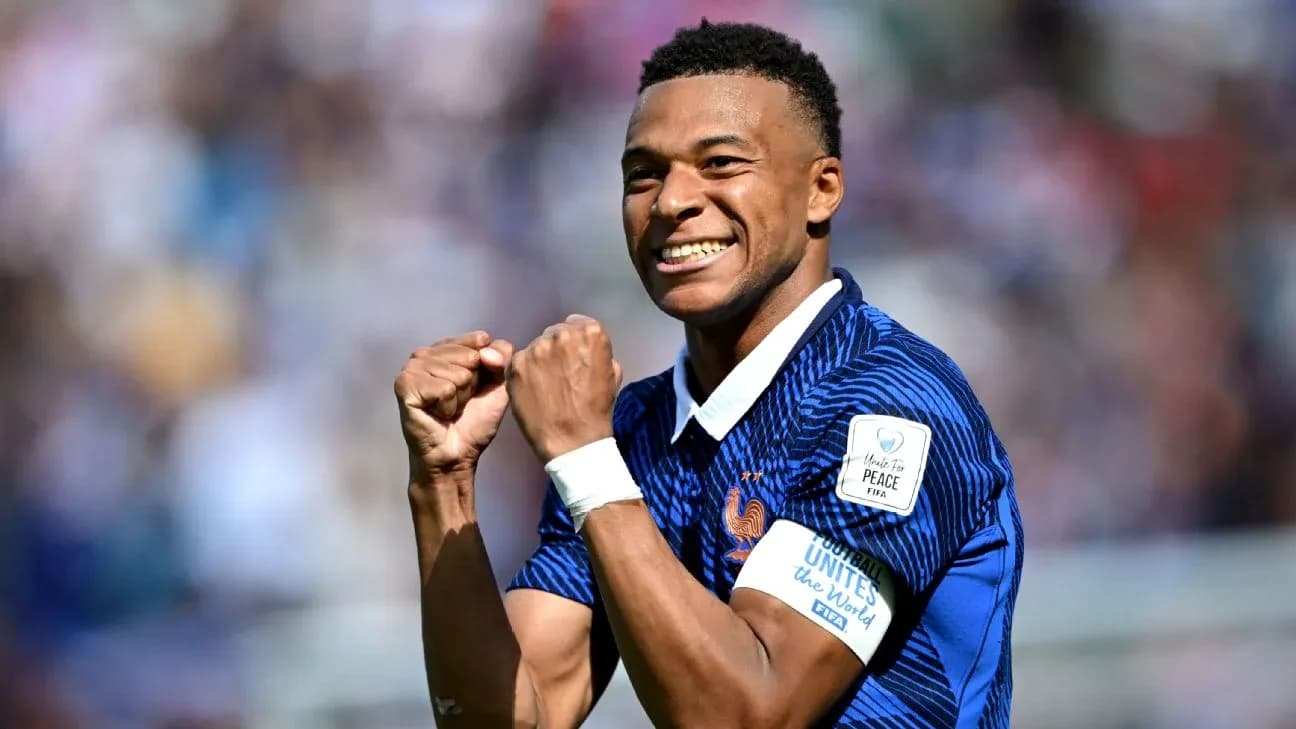
France Controls Game to Defeat Senegal 3-1
France’s 3-1 win over Senegal at MetLife Stadium was a controlled, methodical group-stage performance built on structural superiority in a mirrored 4-2-3-1 battle. With 53% possession, a 575–502 pass edge and a clear shot volume advantage (11–6, with 8–2 on target), France translated territorial and technical control into a late scoring surge, while Senegal’s plan of vertical transitions and wide counters only sporadically threatened.
Both teams lined up 4-2-3-1, but the interpretations were very different. Didier Deschamps’ France used Aurélien Tchouaméni and Adrien Rabiot as a stable double pivot, allowing a high and aggressive line from Dayot Upamecano and William Saliba. Full-backs Jules Koundé and Theo Hernández formed an asymmetrical platform: Hernández pushed higher and inside to support Michael Olise and Kylian Mbappé on the left, while Koundé stayed more conservative, securing rest defence against Sadio Mané and Ismaïla Sarr.
Senegal’s 4-2-3-1 under Bouna Thiaw Pape was more reactive. Idrissa Gana Gueye and Pape Gueye screened the back four, with Sarr and Mané tasked with springing forward once possession was won. Nicolas Jackson stayed high to stretch the French centre-backs, while Lamine Camara tried to connect midfield to the front line. However, Senegal’s block was often pinned deep, and their 502 passes at 86% accuracy came more from recycling under pressure than from controlled progression.
First Half
The first half, which finished 0-0, was defined by France’s positional dominance without scoreboard reward. France’s 7 shots inside the box over the 90 minutes reflect how their structure consistently created penetration lanes; many of those patterns were already visible before the break. Mbappé’s left-sided roaming, combined with Olise’s ability to receive between the lines, forced Kalidou Koulibaly and Moussa Niakhaté to defend large lateral spaces. Senegal coped initially through compact distances between the lines and aggressive stepping out from Koulibaly, but this came at the cost of attacking presence, as the full-backs rarely advanced.
The turning point came around the hour. At 60', a potential penalty for France involving Kylian Mbappé was cancelled by VAR, underlining how France were increasingly attacking the heart of Senegal’s box. Rather than destabilising them, that incident seemed to sharpen France’s focus. Six minutes later, the structure finally yielded: at 66', Kylian Mbappé (France) scored a normal goal, assisted by Michael Olise (France). The pattern fit the game’s tactical logic: France circulating to move Senegal’s block, then exploiting a half-space gap with Mbappé attacking the inside-left channel.
Deschamps then used substitutions to add fresh verticality rather than to protect the lead. At 80', Bradley Barcola (IN) came on for Ousmane Dembélé (OUT), injecting a direct runner against a tiring Senegal right side. Within two minutes, that decision paid off: at 82', Bradley Barcola (France) scored a normal goal, assisted by Adrien Rabiot (France). The move encapsulated France’s wide overload concept: Rabiot stepping into advanced zones from the pivot, with the substitute exploiting the blind side of full-back Krépin Diatta.
Senegal’s response was to chase more attacking threat through changes. At 75', Ibrahim Mbaye (IN) came on for Ismaïla Sarr (OUT), and at 76', Habib Diarra (IN) came on for Lamine Camara (OUT), signalling a desire for fresher legs between the lines and in wide channels. A double substitution at 83' — Ahmadou Bamba Dieng (IN) for Nicolas Jackson (OUT) and Iliman Ndiaye (IN) for Pape Gueye (OUT) — tilted the structure towards a more attacking 4-2-4 in possession, with Ndiaye operating as a creative link. At 88', Pathé Ismaël Ciss (IN) replaced Idrissa Gana Gueye (OUT), further refreshing the midfield.
These changes did improve Senegal’s punch in transition, and they eventually found reward: at 90+5', Ibrahim Mbaye (Senegal) scored a normal goal, assisted by Iliman Ndiaye (Senegal). The assist underlines Ndiaye’s impact as an advanced connector once he was introduced. However, that goal only reduced the deficit, because France had already killed the contest. In added time, Mbappé’s freedom to attack space behind a stretched Senegal back line remained decisive: at 90+6', Kylian Mbappé (France) scored a normal goal, unassisted, confirming France’s superiority in exploiting late-game disorganisation.
Between the posts, Mike Maignan (France) was largely protected by the structure in front of him. France allowed only 2 shots on goal and 6 total shots, reflecting strong control of their defensive third and effective counter-pressing from the double pivot and advanced midfield line. Maignan made 2 goalkeeper saves, matching Senegal’s modest on-target output and underlining that France’s defensive work was more about prevention than last-ditch interventions.
At the other end, Edouard Mendy (Senegal) was far busier. France produced 8 shots on goal from 11 attempts, with 7 of those inside the box, constantly testing Senegal’s last line. Mendy (Senegal) registered 5 goalkeeper saves, which, combined with France’s 3 goals, shows that Senegal’s keeper limited the damage in a game where his side were repeatedly exposed by France’s positional play and dynamic wide combinations.
The xG numbers crystallise the tactical story. France’s xG of 1.79 versus Senegal’s 0.53 reflects a clear quality gap in chance creation, fully consistent with the shot profile: more shots, more in the box, and more on target for France. Senegal’s 0.53 xG, from only 6 total shots and 2 on target, mirrors a game plan that relied heavily on low-frequency, high-difficulty transitions rather than sustained pressure.
Passing data further supports France’s control: 575 passes, 505 accurate (88%), against Senegal’s 502 passes, 430 accurate (86%). France’s slightly higher volume and accuracy, combined with superior field position, enabled them to keep Senegal pinned for long stretches and repeatedly re-load attacks after initial clearances. The corner count (6 for France, 4 for Senegal) and foul numbers (5 by France, 9 by Senegal) also align with a match in which France attacked more, while Senegal were forced into more defensive interventions.
Overall, France’s 3-1 victory was not just a function of individual brilliance from Mbappé; it was the product of a well-balanced 4-2-3-1 that controlled space, tempo and territory, gradually wearing down a reactive Senegal side whose late attacking adjustments came too late to alter the outcome.