
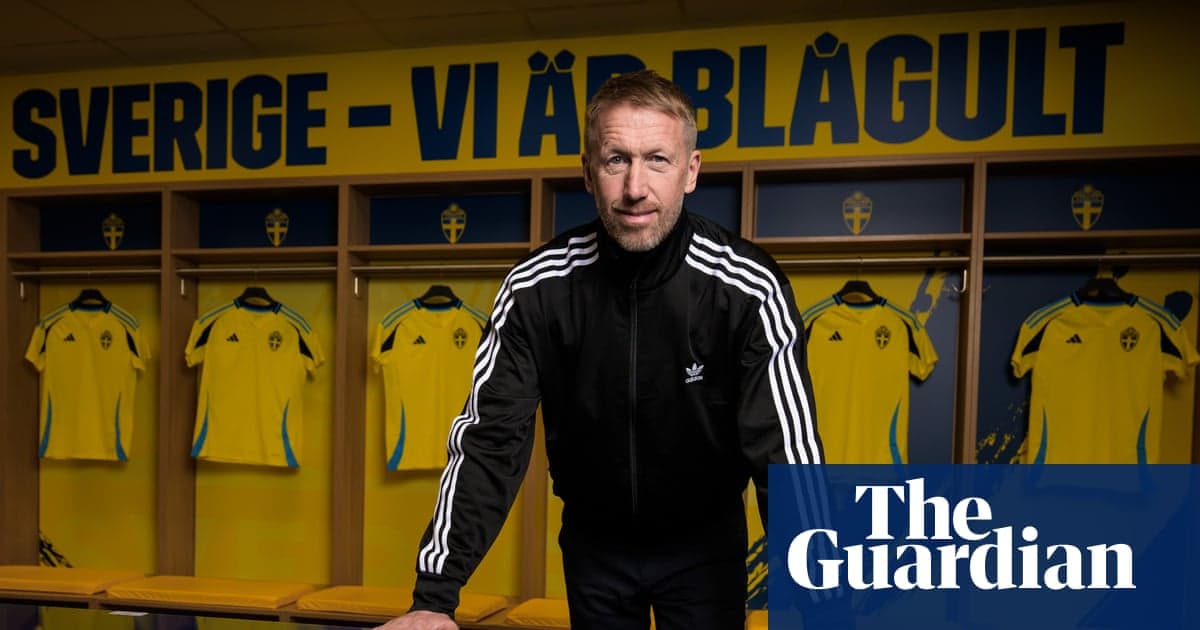
Graham Potter's Journey from Premier League Turmoil to World Cup Hope
Graham Potter leans back, thinks about Chelsea, thinks about West Ham, and does not flinch.
“You’ve got to face the bad stuff,” he says. At 51, with the scars of two bruising Premier League stints still fresh, he has stopped pretending failure is something you can outrun. “The more you face it, the more chance your life is better. Then you get these beautiful moments.”
One of those moments is coming. He is going to a World Cup with Sweden.
This is not the career arc anyone imagined when he left the stability of Brighton in September 2022 for the chaos of Chelsea, or when he took the call from West Ham after a long spell out of the game. Back then, Potter was the Premier League’s great modernist coach, the man who had turned Östersund into a European story and Brighton into a model of smart, progressive football.
Seven months at Chelsea. Twenty-five games at West Ham. Six wins, a dreadful start to his first full season, and then the sack last September. A reputation that once glowed suddenly looked like it might fade into the background noise of “promising coach, wrong moves”.
“What next?” was not a rhetorical question. It was a real, uncomfortable one.
“I have had enough life experience to be able to put all these things into perspective,” he says now. “I’m grateful for all the experiences I have had, pluses and minuses. In the end, you have to deal with what life throws at you. After West Ham, I could have done two things. I could have sat around and done media. Or you can go and work.”
He chose work. Sweden called.
From wreckage to resurrection
By the time the Swedish FA came knocking, the national team were in trouble. Their World Cup qualifying campaign had gone flat, their group hopes gone. Jon Dahl Tomasson was out, belief was draining, and the country needed something – or someone – to jolt it back to life.
Before Potter could fix Sweden, he had to fix himself.
“You have to deal with the failure,” he says. “But I think you become a better person for it. And then sometimes in football you just can’t rationalise it. You just go: ‘Maybe it wasn’t meant to be.’ Then you try to move on with your life.
“The learnings you take from these experiences, they’re painful. I won’t share my learnings with you because it’s hurt me to get them. I think it should because that’s how you improve.”
He stopped listening to the noise. “If I worry about what people think about me that’s a miserable life,” he says. The noise at Chelsea. The noise at West Ham. The noise that says you fail twice and that’s your story written.
Sweden offered a different script. Their Nations League performances had earned them a back door into the World Cup playoffs. It was not glamorous, but it was a chance. For them and, bluntly, for him. Fail again and another dent appears on the CV. Succeed and the narrative flips.
Everything changed in March.
Sweden were calm, almost cold-blooded, in the playoffs. Viktor Gyökeres tore through Ukraine with a hat-trick in a 3-1 semi-final win. Then came Poland in Stockholm, a tense, ragged decider that crackled from first whistle to last. At 2-2 in the 88th minute, Gyökeres did it again, driving in the winner and detonating a stadium.
“You go on to YouTube and go into the Swedish commentary of the game; I looked at it a couple of months afterwards and it’s the emotion in the voice,” Potter says. “Viktor scores and it’s like an out-of-body experience. All our subs are just running on the pitch. There’s 15 players on the pitch and I’m thinking: ‘That’s yellow cards, that’s problems.’ But it’s a World Cup, so all the rules are out the door.”
Those few seconds changed everything – for a team, for a country, for a manager who needed to feel joy again.
A second home, a second life
Potter’s contract now runs to 2030. This is not a short-term rescue act any more; it is a project. And in Sweden, he is not the outsider parachuted in to fix a mess. He is the coach who once took Östersund from the fourth tier to the Europa League, a man who understands the country and its footballing psyche.
“I feel very Swedish when I’m working,” he says. “I look a bit Swedish. Two of my kids were born in Sweden.”
There is something about international football that has hooked him.
“You’re aware with the national team that you’re doing something for more than you. It’s a bigger thing. You can feel the intensity. That’s what’s beautiful about it.”
The shift from club football, though, has forced him to rethink his instincts. Potter’s reputation was built on method, on layering ideas over time. International management laughs at that.
“You haven’t got the time to develop ideas,” he says. “The mistake you could make is that you could form all these ideas from the camp in November ahead of the camp in March, forming tactical plans to beat Ukraine, and the reality is that you have two days to prepare for a game. You don’t want to make it too complex.”
The glow of qualification quickly gave way to the hard part: telling players they would not be going to the World Cup. The human side of the job never goes away.
“Even if you play 11 v 11 in a training game, four players are standing on the outside,” he says. “That’s not easy. You want the group to be on the same path.”
Harmony matters now. Sweden are in camp in Stockholm before heading to their base in Texas, and the echoes of USA 94 are everywhere. That team finished third. That team still lives in Swedish football folklore. This group has been handed Japan, the Netherlands and Tunisia in Group F. The bar is high, the route unforgiving.
Heat, dead balls and thin margins
Sweden open against Tunisia in Monterrey on 14 June. The football will not be played at Premier League tempo. It cannot be.
Managing the heat will shape everything. Potter expects slower games, more pauses, more emphasis on the details that decide tournament football when the legs are heavy and the spaces are small.
“You can see the way the game has gone,” he says of set pieces. “Tournament football, you know the knife is at your throat so it’s less easy to be expansive. Games become tight. It’s a way to create chances so I think teams will focus on it a lot.”
Sweden will not rely solely on corners and free-kicks. Even without the injured Dejan Kulusevski, they have a front line that can hurt anyone. A partnership of Alexander Isak and Gyökeres carries power, movement and goals.
Gyökeres divided opinion during his first season at Arsenal, but Potter’s view is clear.
“It’s a great example of the modern world,” he says. “From our perspective, he got us to the World Cup, so his impact is incredible. From Arsenal’s perspective he’s played his role in the team, scored his goals, the team have won the Premier League and got to the Champions League final. You look at how much work he does. He’s had a brilliant season.”
Isak’s year has been far more complicated. His move from Newcastle to Liverpool last summer was supposed to be the next step. Instead, a disrupted pre-season, a broken leg and an uneven campaign left him searching for rhythm.
“It hasn’t gone as well as he would have liked,” Potter says. “We sometimes make the assumption that when you sign a player it’s going to improve everything. I’ve lived that – it’s not always the case. Alex playing for Newcastle does this but how does he adapt to what Liverpool want him to do? The player doesn’t change. His quality doesn’t change. He’s still a top player. It’s just how they interact as a team together. It can take a bit of time. He’s a great lad.”
Potter has known about Isak’s talent longer than most. He remembers the first time he saw him.
“We were quite happy before the game because the centre-forward wasn’t playing and some 16-year-old kid was playing,” he says of facing AIK with Östersund. “Then he scored, we got beat 2-0 and I learned my lesson.”
On Monday, in a 3-1 defeat by Norway, Isak offered a reminder of what he can do, crashing in a stunning goal that cut through the gloom. Potter wants him and Gyökeres on the pitch together.
“They’re different in their styles, which is good for us. We haven’t played with them together yet so that’s exciting to develop.”
A manager reborn on the biggest stage
The anticipation is building. Potter has exchanged messages with Zlatan Ibrahimovic, the totem of Sweden’s recent past, and he has been listening to those who have walked this path from club dugout to international tournaments.
“I’ve spoken to people who’ve done both and people have said the tournaments are the best feeling in football,” he says. “In the national team you feel like you’re doing something with more soul.”
Soul is not a word often attached to West Ham’s relegation or Chelsea’s churn, but it fits here. Potter looks lighter. The sack at West Ham did not save them; they went down anyway. He moved on. Now he is heading to the competition that made him fall in love with the game.
“My first football memories are ’86, 11 years old, watching Diego Maradona rip football up,” he says. “As a kid, that’s where I started. To get the chance to work in that environment, it’s just a dream.”
From the pain of London to the promise of Texas and Monterrey, Potter has stepped back into the arena. The failures are still there, still part of him. So is the World Cup.
The question now is not what went wrong at Chelsea or West Ham. It is what Graham Potter and Sweden can do when the knife is at their throat and the world is watching.




