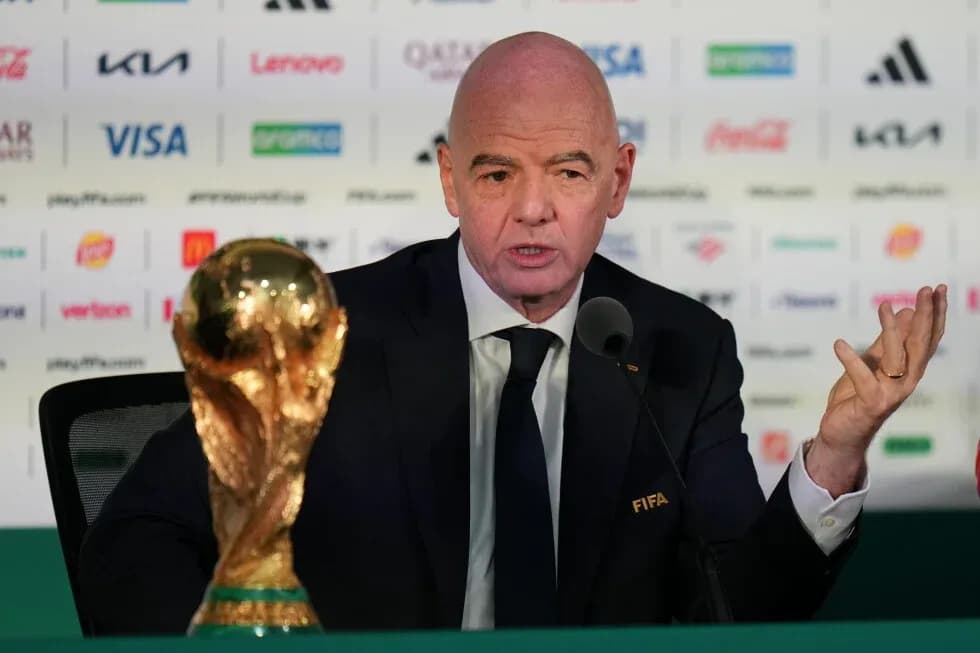
Gianni Infantino's $20 Billion FIFA Proposal Faces Global Backlash
Gianni Infantino has drawn a line in the sand.
From FIFA’s headquarters in Zurich, the president has given world football’s 211 national federations until Sept. 19 to sign up to a one-off $20 million payout each, in exchange for backing a radical plan: selling a stake in the World Cup and other flagship competitions to private investors through a new $20 billion subsidiary.
Sign the deal, and join what Infantino calls a “singular and unique funding opportunity.” Refuse, and take half the money.
The backlash has been instant, loud, and unusually united.
A $20 Billion Power Play
Infantino’s proposal centers on creating a FIFA-controlled company, the FIFA Forward Enterprise (FFE), valued at $20 billion. Private investors would own 20%, with Joshua Kushner’s Thrive Capital positioned as the anchor investor and J.P. Morgan leading the process of bringing in “a pool of diverse international investors.”
In return, the new subsidiary would effectively run FIFA’s competitions and events — including the men’s and women’s World Cups and the Club World Cups — for 12 years.
For member federations, the offer is stark. Back the plan and receive $20 million each from the commercial cycle linked to the 2030 men’s World Cup. Reject it and stick with the previously promised $10 million over the next four years.
Infantino’s own figures frame the choice bluntly: around $86 million per federation over 12 years with the private equity deal, versus roughly $36 million if they turn it down.
“It is my duty and responsibility as FIFA president to present such game-changing opportunities to you, our members,” he wrote in a letter seen by The Associated Press.
The sales pitch is clear. The politics are anything but.
UEFA Leads the Revolt
If Infantino expected quiet acquiescence, he misjudged the mood.
UEFA, already wary from previous battles with FIFA over calendars and competitions, moved quickly. The European body is preparing an emergency online meeting of its 55 member federations, likely on Thursday, and made no attempt to soften its language.
“Having held discussions with many stakeholders across the game, UEFA knows there is significant and growing opposition to FIFA’s scheme,” it said in a statement, before landing the key blow: the World Cup “is not FIFA’s to sell.”
The tension is not new. In 2021, UEFA led the resistance to Infantino’s push for a biennial World Cup, with threats of boycotts on the table. That plan collapsed under the weight of political and sporting pressure.
One option is back on the board: Europe could again threaten to walk away from FIFA competitions.
Behind that threat sits a broader fear. UEFA and other continental bodies run their own lucrative tournaments — the Champions League, European Championship, Copa America and more. A FIFA driven by private investors, hungry for revenue, could seek more World Cups, expanded Club World Cups, and swollen formats that crowd the calendar and undercut those events.
The influential European Football Clubs group, which co-manages the Champions League with UEFA, captured the frustration. It said it “learned about this proposal in the same way as most global football stakeholders — without warning and through the media.”
The message: this was not consultation. This was an ambush.
Global Resistance, Fraying Trust
The anger is not confined to Europe.
CONCACAF, representing North and Central America and the Caribbean, rarely leads public rebellions against FIFA. On Wednesday, it broke ranks.
“We are deeply concerned by the lack of due process,” it said, underlining how even traditional allies are uncomfortable with the secrecy and speed of the move.
From Asia, the Kuala Lumpur-based Asian Football Confederation voiced its own irritation, saying it was “disappointed that a matter of such significance entered the public domain before the AFC family had been afforded the opportunity to examine and discuss it.”
These are not throwaway lines. They point to a pattern that has followed Infantino’s 11-year tenure: big, commercially aggressive ideas unveiled with minimal consultation, then sold hard to a global electorate where each of the 211 members has one vote, regardless of footballing weight.
Many of those members rely heavily on FIFA money. Their national teams rarely reach World Cups. Their players seldom feature in the Champions League or Copa Libertadores. For them, an extra $10 million now and tens of millions more over a decade is not a bonus; it’s a lifeline.
That financial leverage is precisely what worries FIFA’s critics.
UEFA called the rushed deadline for the initial $20 million “everything you need to know about this plan,” adding: “FIFA cannot continue to use our sport to enrich themselves and their friends.”
Sports governance expert Antoine Duval went further, warning that private equity involvement could “incentivize FIFA to further commodify the World Cup (think more hydration breaks and dynamic pricing) in a drive to increase its revenue.”
The fear is simple: once investors are in, football’s crown jewel becomes a product to be maximized, not a tournament to be protected.
Trump, Kushner and a Political Shadow
Infantino’s latest move also deepens a political narrative that has followed him in recent years: a recurring alignment with figures close to former U.S. President Donald Trump.
He created a FIFA Peace Prize, which was awarded to Trump at the World Cup draw in December. He allowed Trump to intervene in the process that cleared United States forward Folarin Balogun to play at the World Cup. Now, he is pushing a 12-year ownership deal involving Joshua Kushner, brother of Trump’s son-in-law Jared Kushner.
These links have not gone unnoticed inside the game. Nor has the role of J.P. Morgan, a bank whose name is already burned into European football’s memory after it backed the failed European Super League.
The optics are combustible: FIFA, a not-for-profit body based in Switzerland, inviting in American private capital and political proximity to help control the future of the World Cup.
Britain Draws Its Own Red Line
In Britain, the response was swift and visceral.
Prime Minister Andy Burnham, whose government is preparing to back a joint bid from England, Scotland, Wales and Ireland to host the 2035 Women’s World Cup, came out forcefully against the plan.
“Football does not belong to investors,” Burnham said in a video message on Instagram. “Once you have sold a piece of (the World Cup), you have sold out. Football belongs to the fans. It always has, and it always will.”
British politicians have form in this arena. In 2021, the threat of legislation from then-Prime Minister Boris Johnson helped crush the European Super League, a project seen as an existential threat to UEFA’s Champions League — and one that Infantino had discreetly supported.
Now, Burnham’s intervention signals that the British government is prepared, once again, to use political muscle to protect what it views as football’s public good.
Infantino’s Endgame
Underneath the financial spreadsheets and political statements lies a more personal question: what does this mean for Gianni Infantino himself?
On paper, his path to a fourth and final term as FIFA president, running through 2031, has looked smooth. He has twice been reelected unopposed, in 2019 and 2023, after promising ever greater flows of FIFA money to member federations — a strategy that has kept him popular across Africa, Asia, and parts of the Americas.
But this week’s storm has widened the circle of discontent beyond the usual European critics. Federations now have almost four months to decide whether to back an election challenger. The deadline for candidates is Nov. 18, ahead of a vote scheduled for March 18 in Rabat, Morocco — a close Infantino ally and co-host of the 2030 World Cup.
There is also a structural twist. Some observers have long suspected that Infantino sees his future not just as a term-limited president, but as a more permanent executive figure — a CEO or commissioner of a powerful FIFA subsidiary.
A body like FFE, controlling competitions and commercial rights with private capital behind it, would offer exactly that kind of platform.
The question now is whether the federations will hand him that vehicle.
They must decide by Sept. 19 whether to take the money and accept a new era in which the World Cup becomes part-owned by private investors, or to walk away and risk a financial hit in the name of preserving control.
For a sport that insists it belongs to the fans, the next few weeks will show who really owns its future.