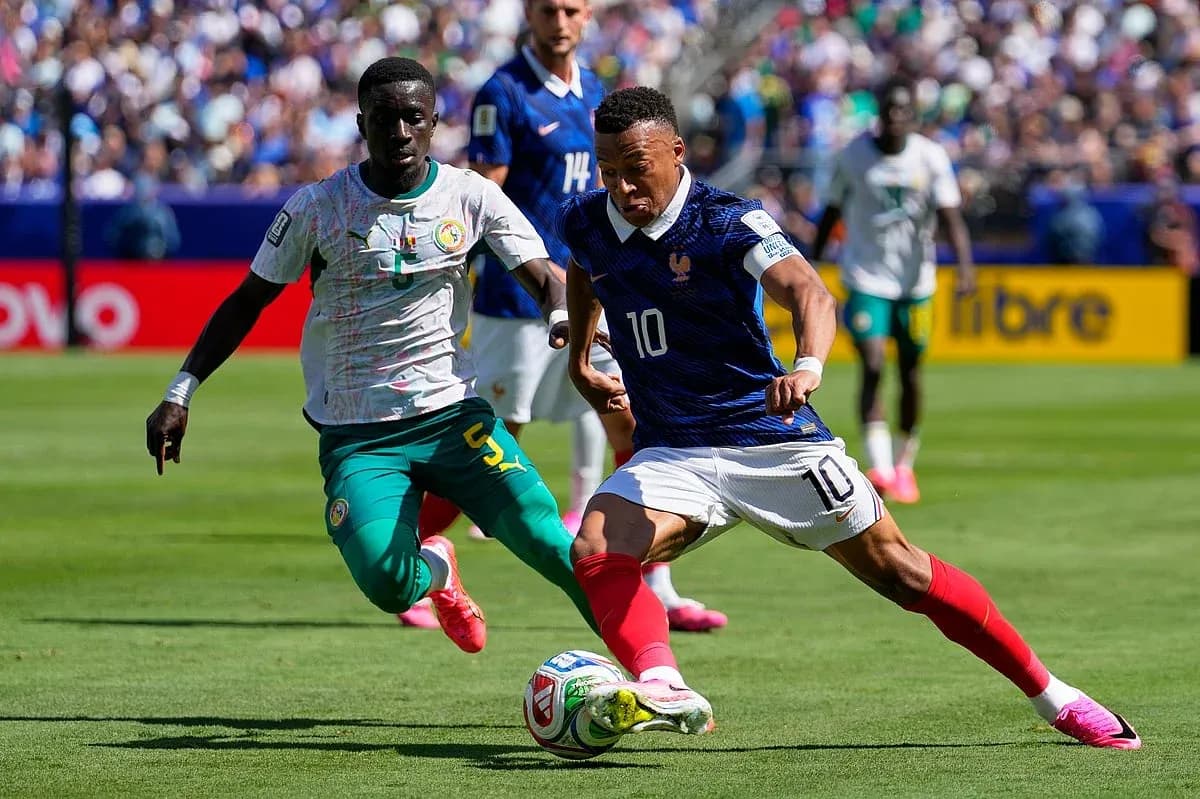
France vs Senegal: World Cup Group I Opener Analysis
MetLife Stadium, East Rutherford. A World Cup night under American lights, and a Group I opener that felt far more like a knockout rehearsal than a gentle introduction. France 3–1 Senegal in total, a scoreline that both confirmed the tournament pedigree of Didier Deschamps’ side and hinted at the disruptive potential of Bouna Thiaw Pape’s men.
I. The Big Picture – Structure and Stakes
Following this result, France sit 2nd in Group I on 3 points, their goal difference of 2 precisely reflecting 3 goals for and 1 against. In total this campaign they have played 1 match, winning it, and scoring 3.0 goals on average while conceding 1.0. Senegal, by contrast, leave the opener 3rd in the group, no points, and a goal difference of -2 from 1 goal scored and 3 conceded on their travels.
Both coaches mirrored each other on the board: a 4-2-3-1 for France and a 4-2-3-1 for Senegal. Yet the same formation numbers told very different stories in the way the sides used space, tempo, and risk.
Deschamps’ shape was built on a solid double pivot of A. Tchouameni and A. Rabiot shielding a back four of T. Hernandez, W. Saliba, D. Upamecano, and J. Kounde in front of M. Maignan. Ahead of them, the trio of D. Doue, O. Dembele, and M. Olise supported K. Mbappe as the lone forward. It was a structure designed to control the central corridor and then explode into wide spaces.
Senegal’s version of 4-2-3-1 had a different personality. E. Mendy in goal, a back line of M. Diouf, M. Niakhate, K. Koulibaly, and K. Diatta, with I. Gueye and P. Gueye as the double pivot. The attacking band of S. Mane, L. Camara, and I. Sarr floated behind N. Jackson. On paper, it was a side capable of transitioning at speed and pressing high; in practice, it spent long stretches pinned back, forced to defend deep and react.
II. Tactical Voids – What Was Missing, What Was Risked
With no official absences listed, both coaches effectively had their full squads available. The “voids” were therefore tactical rather than personnel-based.
For France, the main early gap was between the lines: with both Tchouameni and Rabiot starting cautiously, there were moments when the ball progression relied heavily on the full-backs and on M. Olise drifting infield. That occasionally left Mbappe isolated, receiving to feet with his back to goal rather than on the run.
Senegal’s void was structural. The double pivot of I. Gueye and P. Gueye had to cover enormous horizontal distances, constantly shuffling to plug half-spaces as Dembele and Olise inverted. This defensive workload blunted their ability to launch counter-attacks. When they did win the ball, the distances to N. Jackson were too great; S. Mane and I. Sarr often had to drop so deep that the front four were rarely aligned to break together.
Disciplinary data for the tournament so far shows no recorded yellow or red card timings for either side, underlining that this was more a match of tactical fouls and positional reshuffles than reckless challenges. Both teams stayed within their emotional limits; the game’s volatility came from the ball, not from the referee’s pocket.
III. Key Matchups – Hunter vs Shield, Engine Room Battles
The headline duel was always going to be K. Mbappe against K. Koulibaly and M. Niakhate. Mbappe arrives as one of the World Cup’s early leading scorers: in total this campaign he has 2 goals from 1 appearance, all in this fixture, with 4 shots, all on target, and an 8.2 rating. His 6 dribble attempts, even with only 1 success, constantly threatened to unbalance Senegal’s back line.
Koulibaly and Niakhate tried to compress his space by holding a relatively high line when Senegal had a chance to step out, but France’s wide trio repeatedly dragged them into awkward decisions. When Dembele or Olise received between the lines, Koulibaly had to choose between stepping out or holding shape; either option left a window for Mbappe’s diagonal runs. The “Hunter vs Shield” battle tilted decisively France’s way once Mbappe started attacking the channels rather than the central pocket.
On the other side, Senegal’s attacking spark came late from I. Mbaye. In total this campaign he has 1 goal from 1 appearance, scoring with his only shot on target and completing 8 passes at 87% accuracy. His introduction from the bench added directness and a willingness to run at France’s centre-backs, hinting at a different attacking identity Senegal might lean on in future group matches.
In the engine room, Tchouameni and Rabiot gradually asserted dominance over I. Gueye and P. Gueye. The French pair’s positional discipline allowed the advanced line of Doue, Dembele, and Olise to stay high, pinning Senegal back. For Senegal, the creative burden shifted late onto I. Ndiaye, who in total has 1 assist from 1 appearance, with 10 passes at 90% accuracy and 1 key pass. His cameo showed the value of a more natural link player between midfield and attack, but it came when the game state already favoured France.
IV. Statistical Prognosis – What This Tells Us Going Forward
In total this campaign, France’s offensive profile is emphatic: 3 goals from 1 match, a total average of 3.0 goals scored and 1.0 conceded, and a clean record in terms of penalties (0 taken, 0 missed). Their biggest win so far is this 3–1, and they have yet to fail to score. The 4-2-3-1 has been used in 100% of their fixtures, suggesting Deschamps has a clear structural blueprint.
Senegal’s numbers are the mirror image. On their travels they have scored 1 goal and conceded 3, with a total average of 1.0 goals for and 3.0 against. No clean sheets, but also no failures to score, which is a small but important psychological foothold. Their heaviest defeat is this 3–1 loss, and like France they have stuck to 4-2-3-1 in all matches.
Without xG data in the snapshot, the balance of play must be inferred from patterns: France’s consistent chance creation through Mbappe and the wide trio, their ability to sustain pressure, and Senegal’s reliance on late, individual moments from I. Mbaye and I. Ndiaye. The statistical and tactical evidence converge on a similar verdict: France look like a side whose attacking mechanisms are already in sync, while Senegal are still searching for the right blend between solidity and ambition.
Following this result, France project as group favourites with a high offensive ceiling and a stable defensive base, even if they have not yet kept a clean sheet. Senegal, meanwhile, emerge as dangerous but incomplete—a team with enough individual quality to trouble anyone, yet still needing to tighten their defensive block and better connect their double pivot to the front four if they are to turn flashes of promise into points.