Egypt Triumphs in Penalty Shootout Against Australia
The whistles fell like rain. Mathew Ryan paced his line. And Harry Souttar, with 70,000 voices howling from the end packed with Egypt fans, sent Australia’s first penalty soaring into the Texas night.
From that moment, the Socceroos were chasing shadows.
Tony Popovic had rolled the dice in the most dramatic way possible, throwing on his most experienced goalkeeper for the shootout in a last-gasp gamble. It was a move straight from the old-school playbook: trust the veteran, trust the aura. But in the end, it was Egypt’s composure from 12 yards – and Mohamed Salah’s cold-blooded precision – that decided a brutal, gripping World Cup knockout tie.
Five of the first six penalties were buried. Salah, largely muted during open play, stepped up and rolled his effort in with the ease of a man who has lived on this stage for a decade. Australia’s youngsters, who had run themselves into the ground for 120 minutes, suddenly carried the weight of a nation.
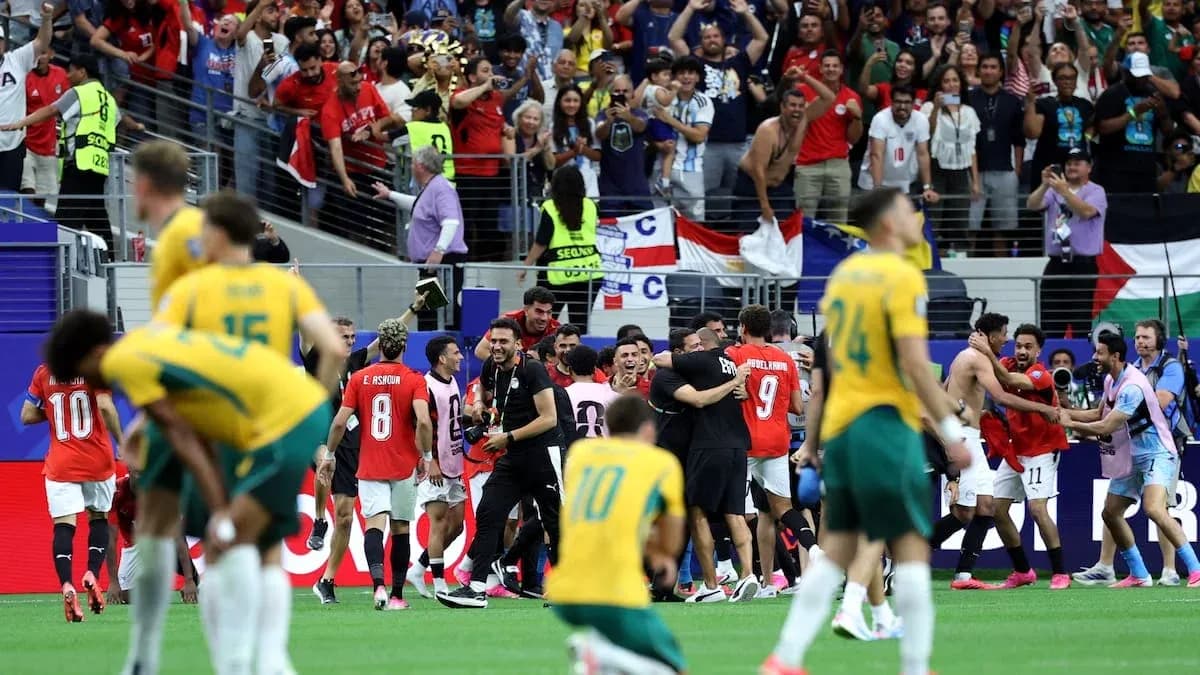
Lucas Herrington, just 18, walked forward with that burden on his shoulders. His strike crashed against the bar. Moments later, Abdelmaguid stroked home the decisive kick, sending Egypt through and sending Salah to the turf in tears of joy, while Australia’s players slumped in disbelief.
A first World Cup knockout win for Egypt. Another night of what-ifs for Australia.
Egypt strike first, against the flow
For a long spell, this game didn’t look like it would need penalties at all.
Australia started with a snarl. Inside five minutes, Cristian Volpato – the late switch from Italy to the green and gold – rattled the top of the crossbar with a vicious effort that had Mostafa Shoubir beaten. Egypt, fresh from their first-ever World Cup win in the group stage against New Zealand, looked edgy at the back, jittery in possession.
Then they scored.
Almost out of nowhere, Hossam Hassan’s side landed the first blow. Nestory Irankunda lost track of Emam Ashour at the far post, Karim Hafez whipped in a teasing cross, and Ashour met it with a firm header after 13 minutes. One chance, one ruthless finish, his second goal of the tournament, and suddenly the seven-time African champions had a platform.
For Australia, a team that had only managed two goals in the group phase, the early concession was a tactical punch to the gut. They were now forced to attack, to chase a game in a stadium more used to NFL collisions than World Cup tension, its air-conditioned bowl holding a heaving 70,000 crowd.
Yet for all their territorial pressure, the Socceroos rarely troubled Shoubir before the break. Aziz Behich finally registered a tame shot on target 10 minutes before half-time, a routine save for the goalkeeper whose father, Ahmed, had worn Egypt’s gloves at the 1990 World Cup.
A bruising contest and a cruel injury
This was never going to be a pretty game. It became a battle of inches, of duels, of collisions.
Salah, 34 and coming off a hamstring strain, drifted on the fringes of the first half. The former Liverpool star saw little of the ball, harried and crowded out by a physically committed Australian side. Every touch he took came with a yellow shirt snapping at his heels.
The half ended with a flashpoint. Jordan Bos, one of the quickest players at the tournament and a key outlet down the flank, was wiped out by a robust flying challenge from Rabia. Bos stayed down, the kind of stillness that silences a stadium, before being helped from the pitch. He did not reappear after the interval, replaced by Kai Trewin in a significant blow to Australia’s attacking threat.
Just after the restart, the game threatened to tilt decisively Egypt’s way. Omar Marmoush, the Manchester City attacker, ghosted into space and somehow slid the ball wide from close range when it seemed easier to score. It felt like a miss that might haunt them.
And it did, at least for a while.
Australia force the mistake, Egypt wobble
The pressure slowly shifted. Australia, emboldened by that escape, pushed higher and hit harder. Set pieces became their weapon of choice.
Egypt’s coach had warned about Australia’s physical edge. He was right to worry. From an in-swinging free-kick, Mohamed Hany found himself under heavy pressure and could only glance a header past his own goalkeeper. It was a brutal moment for the defender – his second own goal of the tournament – and it dragged the Socceroos level 10 minutes after half-time.
The goal changed the noise. Egyptian fans, so loud early on, grew tense. Australian supporters found their voice. Both teams suddenly sensed the enormity of what was at stake: neither had ever won a knockout match at a men’s World Cup.
The game opened up, then tightened again, like an elastic band being stretched to breaking point.
Salah remained a peripheral figure, but his fingerprints were still there in the buildup play. Deep in added time at the end of 90 minutes, he was involved as Ramy forced Patrick Beach into an outstanding save. The Australian stopper flung himself across goal to keep the tie alive and drag it into extra time.
Egypt finished normal time the stronger side. Australia, legs heavy, clung on.
Extra time, empty tanks and one last test
Extra time arrived with the feel of inevitability. So did penalties.
Before that, there was one last surge. Salah, cutting in on his weaker right foot, lashed a shot well over early in the extra period. It summed up his night from open play: half-chances, flashes, but no killer moment.
Both teams were running on fumes. Tackles lost their bite, runs lost their sharpness. Neither could find the decisive pass. The clock ticked, the tension thickened, and the penalty shootout loomed like a storm on the horizon.
Popovic made his move, summoning Mathew Ryan for the spot-kicks. A bold call. A coach’s instinct that experience would tip the balance.
Instead, it was the youngest and the coolest heads in red who settled it.
Souttar’s wild first effort handed Egypt the advantage they never relinquished. Every Egyptian taker that followed looked composed. Salah, this time from the spot, was everything he hadn’t quite been in open play: precise, ruthless, unflinching.
Herrington’s shot against the bar felt like the final twist of the knife for Australia. Abdelmaguid’s winner, rolled home with icy calm, sealed a historic night for Egypt and left the Socceroos staring at another missed opportunity on the biggest stage.
Australia walk away with bruises, regrets and a sense of how close they came. Egypt walk on, their captain in tears, their first World Cup knockout victory finally secured.
Now the question is simple: having broken that barrier, how far can they go?