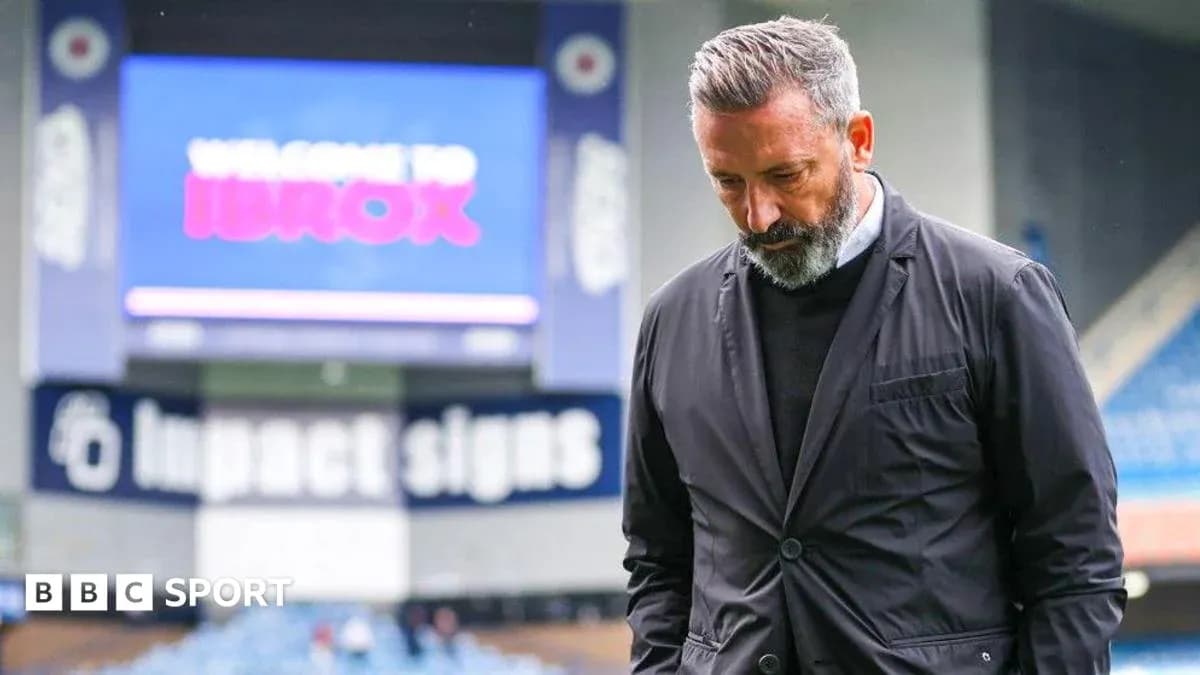
Derek McInnes Takes Charge at Rangers: A New Era Begins
When Derek McInnes walked into Tynecastle last May, he made no attempt to play it cool. This was the job he believed should have been his long ago, the role he described as “everything I wanted.” It sounded like the beginning of a long-term love story.
Thirteen months later, he’s gone. Hearts have been traded for Rangers, the supposed dream job in Edinburgh eclipsed the moment Ibrox called.
There was never much suspense. Once Rangers made their interest clear, the move felt inevitable, almost procedural. Not a question of if, only when. McInnes has always been a Rangers man, and everybody in Scottish football knew it.
Hearts’ nearly man walks
If Hearts supporters are furious, they’re keeping it relatively muted. There’s irritation, of course. A manager who came within three minutes of delivering the Scottish Premiership title has walked away at the first serious knock on the door.
But there’s also a sense of distance. McInnes was admired, even appreciated, yet never fully claimed as one of their own. Not in the way true legacy managers are. The bond was strong on the pitch, weaker everywhere else.
He almost gave Hearts the greatest day in the club’s modern history. The near-miss in the title race, the records broken week after week, the sense of something extraordinary building – all of it will live long in the memory. Still, in the background, that Rangers-shaped shadow never disappeared. With the Ibrox job surfacing so often in recent years, it felt like only a matter of time.
Hearts, in the end, were a stepping stone. The job he wanted then, not the job he wanted forever.
Control, power and the Jamestown problem
McInnes adapted quickly in Edinburgh, but he never looked entirely at ease with the club’s structure. Hearts now operate in a world where Jamestown Analytics carry serious clout. Data has a loud voice. Managers do not get absolute control.
That is not McInnes’ natural habitat. At Kilmarnock and, more notably, Aberdeen, he worked as a classic British-style manager, heavily involved in recruitment, selection and the broader football operation. At Hearts, he had to share the wheel.
He could live with it. He could not thrive on it.
At Rangers, the dynamic changes. There, he will run the football department in something much closer to his own image. He will have authority, real authority, and a budget unlike anything he has previously handled. The Rangers owners have already spent heavily in just over a year. They are ready to go again this summer, potentially in a major way.
For a manager who almost took Hearts to the title on relatively modest resources, that is a powerful lure. In the harsh logic of modern football, walking away from Hearts for that kind of opportunity is an easy decision to understand.
No more excuses at Ibrox
Rangers are now McInnes’ project. His train set, his ideas, his signings. No data department leaning over his shoulder, querying why certain players aren’t getting minutes. No algorithm quietly vetoing his preferred targets. No obligation to build around footballers whose numbers glow on a spreadsheet but don’t fit his plan.
He will get what he has craved: control.
What he will not get is patience.
At Ibrox, the title is not an ambition. It is a demand. Nothing else will satisfy. Danny Rohl tried and failed, and there was little sympathy when Rangers limped to third place last season. Philippe Clement improved that to second, and yet the appetite for change was immediate. At this club, even progress can feel like failure if Celtic are still out in front.
McInnes knows the terrain. He understands that words count for very little in Govan now. The fanbase is tired of explanations and context. There is an angry edge to their expectations, a growing fatigue at being the chasers rather than the pace-setters. If he does not win the league, no amount of rational argument will save him.
The obvious choice with unfinished business
In many respects, he was the logical appointment. He understands Rangers. He knows the league inside out. He communicates clearly and forcefully. Last season, he out-thought Rangers with his Hearts side often enough to impress the very people who now employ him.
He is no shrinking violet. McInnes is a big character, comfortable with the glare that comes with a club of this size. His tactical work has long been respected, and his self-belief has never been in short supply. At Hearts, as club records fell, his messaging was sharp, consistent and convincing. He set the tone for a group that began to believe it could topple the established order.
His record in big domestic occasions is substantial. With Aberdeen, he turned Hampden into a regular destination: League Cup finals in 2013-14, 2016-17 and 2018-19, plus a Scottish Cup final in 2016-17. Yet there is also the other side of that story – the near-misses, the disappointments.
Celtic, in their dominant years, were his immovable obstacle. Nobody could seriously criticise him for losing to them at their peak. The more uncomfortable truth lies in the cup exits to Dundee United, Hibs, St Johnstone, Dundee, Hearts, Motherwell, Hearts again, St Mirren, Motherwell again and United once more.
While he has gone without a major trophy at a Premiership club, others have seized their moments. St Johnstone, Inverness, Hibs, St Johnstone again and Aberdeen have all lifted the Scottish Cup. Ross County, St Johnstone and St Mirren have claimed the League Cup. Managers outside the Old Firm – Tommy Wright, John Hughes, Alan Stubbs, Callum Davidson (twice), Jimmy Thelin, Jim McIntyre and Stephen Robinson – have all done what McInnes has yet to do consistently: turn opportunity into silverware.
That is why the label lingers. There is still a touch of the nearly man about him.
The chance he’s waited for
Now comes the biggest examination of his career. His duels with Celtic’s manager – and his successor at Tynecastle, whoever that may be – will shape not only Rangers’ future but his own reputation.
At Hearts, he flirted with greatness and left with credit but no trophy. At Rangers, there is no room for almost. No glory in second. No solace in statistics.
This is the job that has hovered over his career for years, the one that always felt like it would arrive eventually.
It’s here now. What he does with it will define everything that comes next.