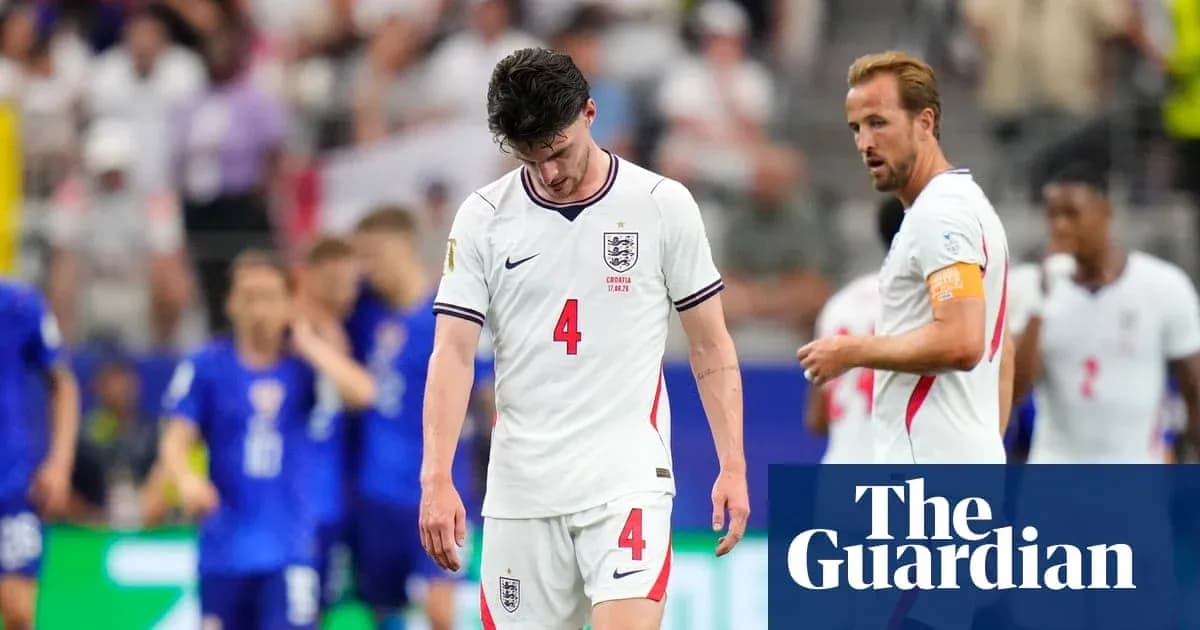
Declan Rice: England's Indispensable Midfielder Facing Injury Concerns
Aaron Cresswell calls Declan Rice “a freak of nature”. It sounds like a throwaway line from an old teammate, the kind of dressing-room compliment that gets recycled in interviews. Until you look at the numbers.
Since the start of the 2020-21 season, Rice has played 360 games. Club and country. Europe, league, cups, tournaments. No breather, no soft landings. West Ham’s European runs, England’s endless cycle of qualifiers and finals, Arsenal’s charge in the Premier League and Champions League. Every manager has leaned on him. Every team has built around him.
At some point, even freaks of nature feel it.
A tired heartbeat in a frantic opener
Game No 63 of Rice’s season arrived in Dortmund on Wednesday, England’s wild 4-2 win over Croatia to open their World Cup. It should have been familiar territory: high stakes, high tempo, Rice patrolling the middle of the pitch as England’s safety net.
Instead, he looked human.
The midfield shape was off from the start. The gap between Rice and Elliot Anderson yawned open, inviting Luka Modric to wander into it and start pulling strings. Rice dropped too deep, then got dragged out of position. England’s structure bent and creaked. For once, Rice wasn’t the one holding it together.
Thomas Tuchel will look at the tape and see tactical problems he can fix before Ghana on Tuesday. That’s the easy part. The hard part came in the 72nd minute, with England clinging to a 3-2 lead and chaos swirling around them, when the fourth official’s board went up and Rice’s number flashed red.
Rice never comes off in that situation. Not when there are tackles to be made and second balls to be won. Not when England are wobbling. Yet off he went, feeling discomfort in his lower back and upper hamstring, walking a little gingerly, and suddenly the most durable player in the squad looked worryingly fragile.
Tuchel called it precautionary. Rice insisted he will be ready for Ghana. England will want to believe both. They cannot afford not to.
England’s one irreplaceable piece
Strip this squad back and the pattern is clear. Whenever Rice has been missing over the past six years, England have rarely looked convincing. They do not have another midfielder who does his job, in his way, at his level.
Tuchel was diplomatic after Croatia. “Declan had some unusual ball losses,” he said, an understated way of acknowledging that Rice was nowhere near his usual standard. Yet even at 70%, 60%, he still felt essential. England’s midfield malfunctioned with him on the pitch; it is hard to picture what it looks like without him.
Kobbie Mainoo can glide through a press and thread passes between the lines, but he does not yet have Rice’s frame, or his defensive instincts, or his set-piece threat. Jordan Henderson brings experience and leadership, but at 36, Tuchel did not turn to him when the game against Croatia broke into a sprint.
There is no like-for-like option. No obvious Plan B.
Tuchel’s first reaction to Rice’s withdrawal was to drop Jude Bellingham deeper. On paper it made sense; in practice it nearly cost England. Bellingham’s influence faded, Croatia grew, and the experiment lasted eight anxious minutes.
Then came a glimpse of something different.
Reece James, the unexpected midfielder
Djed Spence replaced Bellingham. Reece James stepped away from right-back and into midfield, a role he has come to know well at Chelsea over the past 18 months. The switch gave England a more robust presence in the middle and a new angle in possession.
This was not a wild improvisation. James has history there. He played in midfield on loan at Wigan in 2018-19. Enzo Maresca revived the idea at Chelsea, pushing him inside from right-back. At first, there were doubts. Was this a misuse of one of the league’s best full-backs?
Maresca stuck with it. The reward came on big stages. James shone in midfield when Chelsea beat Paris Saint-Germain in last year’s Club World Cup final. He was outstanding alongside Moisés Caicedo in the 3-0 win over Barcelona last November, then dominated Rice himself when Arsenal came to Stamford Bridge five days later.
Tuchel, who once insisted James was a right-back in his England plans, has changed his tune. “Reece James can play in the 6 because he does on a high level for Chelsea,” he said when naming his World Cup squad, using that as justification for leaving out Adam Wharton and Alex Scott.
He has built a squad around versatility. If James steps into midfield, others can cover the flank. Spence, Ezri Konsa, Jarell Quansah – all are capable of playing right-back. One possible solution is to slide Konsa into a hybrid role, almost as a third centre-back alongside John Stones and Marc Guéhi, and let Nico O’Reilly explode forward from left-back.
On the tactics board, it works. On grass, it depends on one thing: whether James’s body holds.
One solution, another problem
James’s fitness record hangs over every conversation about his role. His hamstrings have betrayed him too often. The latest setback came in March, costing him almost two months of the season. Chelsea have had to ration his minutes, manage his workload, protect him from himself.
England are feeling that strain as well. Tino Livramento’s calf injury forced Tuchel to call up Trevoh Chalobah as cover. James is the first-choice right-back, but he cannot start every game. Asking him to shoulder extra responsibility in midfield, on top of that, while Rice battles his own issues, is a risk layered on a risk.
This is the reality of a squad that has been through a brutal club season and dropped straight into a World Cup. Tuchel knew it. The decision to take England early to Florida for a pre‑tournament camp in the sun was all about conditioning, trying to put something back into tired legs.
Rice arrived late, straight from Arsenal’s Champions League final. Another high-intensity match. Another week without rest. He keeps pushing the limit because every manager he plays for needs him on the pitch.
At some point, the bill arrives.
The cost of never stopping
If England go all the way and reach the World Cup final, and if Rice plays every game from here, he will finish the season on 70 appearances. Seventy. For a central midfielder who covers more ground than almost anyone, who carries the physical and mental load of being a leader for club and country.
The demands are extreme. They always have been with Rice, but the margin for error is shrinking. A tight hamstring here, a sore back there, and suddenly England’s entire structure feels vulnerable.
Tuchel has no choice now. He must trust his depth, his flexibility, his contingency plans. He must be willing to sit Rice down, even when every instinct screams to write his name on the team sheet in permanent ink.
Because if England are serious about staying in this tournament deep into July, they cannot keep treating their “freak of nature” as indestructible. The question is no longer how much Rice can give.
It is how long England dare keep asking.