Burnley vs Wolves Tactical Analysis: A 1-1 Draw Breakdown
Burnley’s 1-1 draw with Wolves at Turf Moor was a clash of contrasting game models: Mike Jackson’s side built a high-possession, territorial siege, while Rob Edwards’ Wolves leaned into vertical transitions and penalty-box efficiency. Across 90 minutes Burnley monopolised the ball (70% possession, 558 passes) and volume of attempts (16 shots, 8 on target), yet Wolves’ structure and threat profile (16 shots, 10 from inside the box, xG 2.05) underlined how dangerous their lower-possession blueprint remained.
Burnley lined up in a 4-2-3-1 with M. Weiss in goal behind a back four of K. Walker, A. Tuanzebe, B. Humphreys and Lucas Pires. The double pivot of Florentino and L. Ugochukwu (before his withdrawal) underpinned an aggressive three of L. Tchaouna, Hannibal Mejbri and J. Anthony supporting Z. Flemming as the nominal striker. The structure was clearly designed to lock Wolves into their half: full-backs pushed high, the pivots stepped onto second balls, and the three attacking midfielders constantly rotated between half-spaces and wide channels.
Wolves countered with a 3-4-2-1: J. Sa in goal behind a trio of Y. Mosquera, S. Bueno and L. Krejci. Wing-backs R. Gomes and D. M. Wolfe gave width either side of the central pairing Andre and A. Gomes, with M. Mane and Hwang Hee-Chan tucked in behind A. Armstrong. The early VAR intervention at 4' for a “Penalty confirmed” on Ladislav Krejčí encapsulated the plan: soak pressure, then spring quickly into the spaces behind Burnley’s advanced full-backs. Armstrong’s penalty at 5' gave Wolves a 0-1 platform ideally suited to their counter-punching setup.
With the lead, Wolves compressed their 3-4-2-1 into a compact 5-4-1 without the ball. The wing-backs dropped to the line of three, while Mane and Hwang Hee-Chan slid wide to block Burnley’s full-backs, leaving Armstrong to screen passes into Florentino and Ugochukwu. Burnley responded by having Hannibal and Tchaouna drop between the lines to overload Andre and A. Gomes. The result was territorial dominance but a crowded central lane, forcing Burnley into a mix of switches and half-space crosses rather than clean through-balls.
In this context, individual duels became central. Walker and Lucas Pires were effectively auxiliary wingers, pinning Wolves’ wide men back and contributing to Burnley’s 7 corners. However, Wolves’ back three, anchored by Mosquera and S. Bueno, dealt well with first balls into the box, as evidenced by Burnley’s 6 blocked shots. Many of Burnley’s 8 efforts on target came from second phases and edge-of-box situations rather than unopposed finishes.
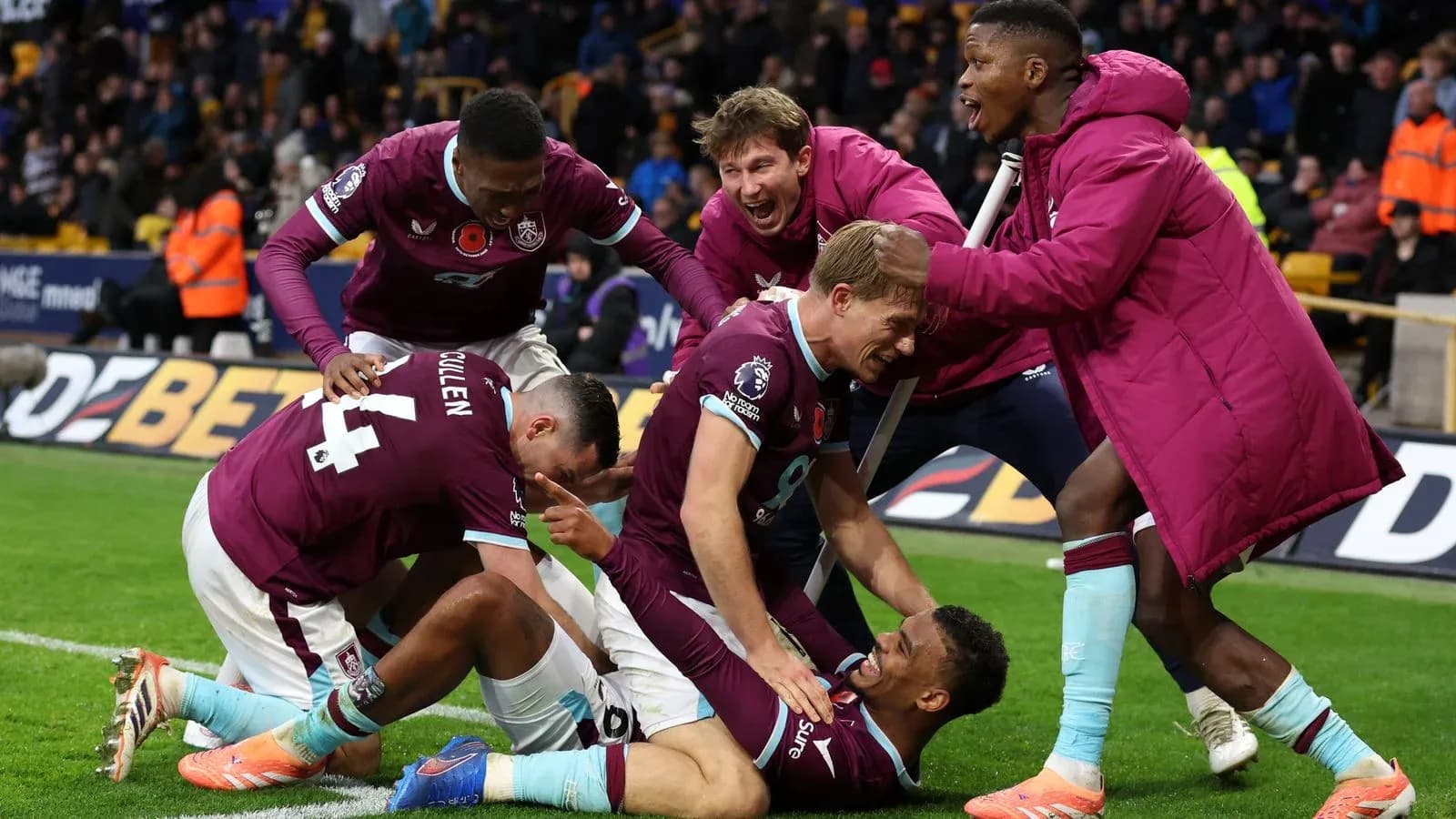
The key tactical pivot arrived after the interval. Trailing 0-1 at half-time, Burnley accelerated their tempo early in the second half, and the equaliser at 47' reflected a more incisive use of their attacking midfielders. Z. Flemming’s “Normal Goal”, assisted by L. Tchaouna, came from Burnley finally managing to break Wolves’ last line with a well-timed movement and combination, rather than relying solely on volume. Tchaouna’s role between the lines was crucial; his positioning forced Wolves’ midfield to turn, creating the angle that Flemming exploited.
Once level at 1-1, both benches moved to recalibrate the contest. At 66', H. Mejbri (who had been booked for “Argument” at 45+9') went off, with Z. Amdouni (IN) coming on to add a more penalty-box oriented threat from midfield. Simultaneously, Wolves reshaped their spine: A. Gomes (OUT) made way for T. Arokodare (IN), and L. Krejci (OUT) was replaced by Toti (IN). The double change nudged Wolves towards a slightly more direct, physically robust front line, with extra height and running power to attack transitions and set plays.
Further Wolves substitutions at 74' – D. M. Wolfe (OUT) for H. Bueno (IN) and A. Armstrong (OUT) for J. Abbey (IN) – subtly altered their pressing triggers. Abbey’s fresh legs helped contest Burnley’s first pass out of pressure, while H. Bueno brought defensive energy to shore up the flanks as Burnley’s full-backs continued to push on. At 82', R. Gomes (OUT) for Pedro Lima (IN) kept Wolves’ wing-back intensity high into the closing stages.
Burnley’s response, particularly at 75' and 84', showed Jackson’s intent to turn dominance into a winner. L. Ugochukwu (OUT) for J. Ward-Prowse (IN) at 75' traded ball-winning for distribution, giving Burnley a deeper playmaker to exploit Wolves’ retreating block. In the same minute, L. Tchaouna (OUT) for M. Edwards (IN) injected fresh 1v1 threat on the flank. Later, at 84', Z. Flemming (OUT) for Ashley Barnes (IN) and J. Anthony (OUT) for J. Bruun Larsen (IN) completed the shift towards a more traditional target-man setup: Barnes as a focal point, surrounded by crossers and second-ball runners.
In goal, M. Weiss (Burnley) made 3 saves, with goals prevented of 0.29, mirroring Wolves’ xG superiority and underlining that Burnley’s territorial control did not translate into defensive comfort. J. Sa (Wolves), by contrast, made 7 saves and also registered 0.29 goals prevented, a testament to his importance as the final layer of Wolves’ low-block strategy. His shot-stopping under sustained pressure was a key factor in preserving the point.
Discipline added an undercurrent of tension that reflected the game’s physical and emotional stakes. Hwang Hee-chan (Wolves) was cautioned at 41' — “Off the ball foul” — a by-product of Wolves’ attempts to disrupt Burnley’s rhythm without the ball. Hannibal Mejbri’s yellow at 45+9' — “Argument” — highlighted Burnley’s frustration as the first half ended 0-1. In the closing stages, with Burnley throwing numbers forward and Wolves defending deep, tempers flared again at 90+4': Ashley Barnes (Burnley) — “Argument” — and Yerson Mosquera (Wolves) — “Argument” — were both booked, emblematic of a contest that had become increasingly combative around the Wolves penalty area.
Statistically, the draw sits on a knife-edge between process and payoff. Burnley’s 70% possession, 558 passes (488 accurate, 87%), and 16 shots with 8 on target paint the picture of a side structurally dominant and territorially entrenched. Yet their xG of 1.06 suggests that, despite volume, the quality of chances created was moderate. Wolves, with just 223 passes (164 accurate, 74%) and 30% of the ball, matched Burnley’s shot count (16) but generated a far higher xG of 2.05 and took 10 of those efforts from inside the box.
Tactically, that divergence reveals the core story: Burnley’s 4-2-3-1 successfully controlled field position and tempo but often struggled to disorganise Wolves’ back five sufficiently to carve out premium opportunities. Wolves’ 3-4-2-1, morphing into 5-4-1, conceded territory but excelled at compressing central spaces and springing into the gaps Burnley left in behind. The substitutions on both sides reinforced these identities rather than transforming them: Burnley added more creativity and aerial threat to a possession-heavy platform; Wolves added legs and physicality to a counter-attacking shell.
In the end, a 1-1 scoreline at Turf Moor felt like a tactical compromise. Burnley could point to control, pressing structure and shot volume as evidence of a strong home performance; Wolves could counter with superior chance quality, a resilient defensive block, and the knowledge that their low-possession model still produced the clearer openings.