Burnley and Wolves: A Season of Struggles in the Premier League Finale
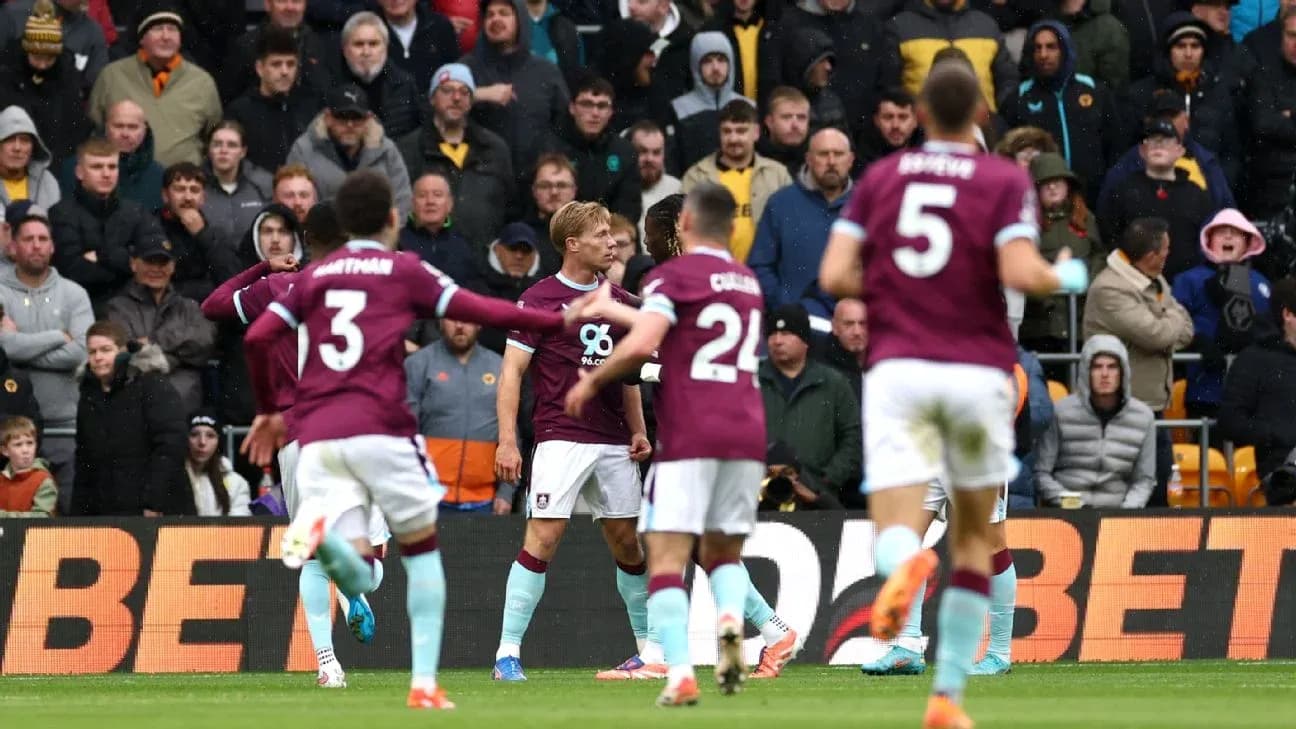
On a grey afternoon at Turf Moor, the Premier League season closed with a match that felt less like a finale and more like an inquest into two broken campaigns. Burnley and Wolves, locked in 19th and 20th place respectively, shared a 1-1 draw that encapsulated why both are heading for the Championship.
I. The Big Picture – Two Relegated Identities Collide
Following this result, the table tells a stark story. Burnley finish 19th with 22 points and a goal difference of -37, built from 38 goals for and 75 against. At home this campaign they played 19 times, winning 2, drawing 7 and losing 10, scoring 18 and conceding 29. Their overall attacking profile – 1.0 goals per game in total, with 0.9 at home – has never been enough to offset an overall 2.0 goals conceded per match.
Wolves, bottom with 20 points and a goal difference of -41 (27 scored, 68 conceded), have been even more anaemic in front of goal. On their travels they failed to win a single league game: 19 away fixtures, 0 wins, 6 draws, 13 defeats, with just 8 away goals and 34 conceded. Overall they averaged 0.7 goals per game in total and 0.4 away, numbers that weigh heavily on any tactical plan.
This match, the 38th and final round of the Premier League season, pitted Burnley’s more expansive 4-2-3-1 against a Wolves side that leaned again into a 3-4-2-1, a shape that promised control but has too often delivered sterile possession.
II. Tactical Voids – Absences and the Disciplinary Shadow
Both managers entered the day knowing they were working with incomplete toolkits. Burnley were again without J. Beyer (hamstring) and J. Cullen (knee), two absences that have quietly shaped their defensive and midfield fragility all season. Beyer’s injury has left Mike Jackson leaning on A. Tuanzebe and B. Humphreys as the central pairing, with Kyle Walker’s experience and Lucas Pires’ energy trying to hold the line together.
For Wolves, Rob Edwards had to cope without L. Chiwome, M. Doherty, E. Gonzalez and S. Johnstone. The loss of Doherty’s two-way presence on the flank particularly influences how Wolves build from wide areas; in his absence, the wing responsibility fell to R. Gomes and D. M. Wolfe in the line of four, supported by the back three of Y. Mosquera, S. Bueno and L. Krejci.
Across the season, both sides have been shaped by their disciplinary edges. Burnley’s yellow-card timings show a team that often loses composure late: 19.70% of their yellows came between 16-30 minutes, 18.18% between 76-90, and another 19.70% in the 91-105 window. Their red-card profile is equally telling, with dismissals spread across 31-45, 76-90 and 91-105 – the kind of volatility that regularly undermines game plans.
Wolves, by contrast, are most combustible just after the break: 27.50% of their yellows arrive between 46-60 minutes, with further spikes at 61-75 (20.00%) and 76-90 (18.75%). Their reds have been clustered in the heart of contests – one each in 31-45, 46-60 and 61-75 – suggesting a team that struggles to recalibrate under pressure.
III. Key Matchups – Hunter vs Shield, and the Engine Room
The headline duel was always going to be Z. Flemming against the league’s most goal-shy attack and a brittle Wolves defence. Flemming, Burnley’s standout with 11 league goals in total, started as the nominal forward in the 4-2-3-1 but carried the profile of a roaming attacker: 38 shots, 21 on target, and a willingness to work both ways with 17 tackles and 5 blocked shots. His duel numbers – 274 contested, 114 won – underline a player who thrives in chaos rather than in a pure penalty-box role.
Opposite him stood a Wolves defensive unit that has conceded 68 goals overall, 34 at home and 34 away, with an overall average of 1.8 goals against per game in total and 1.8 away. Y. Mosquera, one of the league’s most carded defenders with 12 yellows, brings aggression and aerial presence: 62 tackles, 17 blocked shots and 29 interceptions. His tendency to step out and engage early was always going to collide with Flemming’s instinct to drift into pockets between the lines.
Behind Flemming, Burnley’s creative axis was built around H. Mejbri and the wide threat of J. Anthony and L. Tchaouna. Mejbri’s season – 1 goal, 4 assists, 21 key passes and 34 dribble attempts with 20 successes – marks him as the side’s primary conduit between midfield and attack. He also embodies Burnley’s edge: 10 yellow cards and a penalty conceded this season, a reminder that his intensity can cut both ways.
For Wolves, the “Engine Room” belonged to Andre and A. Gomes. Andre, with 1306 passes at 91% accuracy and 18 key passes, is the metronome, but he also walks a disciplinary tightrope with 12 yellow cards and 47 fouls committed. A. Gomes adds bite and coverage: 108 tackles, 36 interceptions, and 69 fouls committed alongside 10 yellows. Together they form a double pivot capable of suffocating space, but their aggression risks giving away dangerous set-pieces – a key factor when Burnley can call on the delivery of players like J. Ward-Prowse from the bench.
IV. Statistical Prognosis – xG Logic and Defensive Fragility
Even without explicit xG numbers, the season-long data points to the underlying story this 1-1 draw likely followed. Burnley, averaging 1.0 goals for and 2.0 against in total, and Wolves, at 0.7 for and 1.8 against in total, almost script a low-scoring, error-prone contest. Burnley’s four clean sheets at home versus Wolves’ single clean sheet away underline why both sides were more likely to trade blows than shut each other out.
Burnley’s preferred 4-2-3-1, used 13 times this season, aims to maximise the creative influence of Flemming and Mejbri while protecting a vulnerable back line with the double pivot of Florentino and L. Ugochukwu. Yet the numbers – 75 goals conceded overall, 29 at home – show that the shield has been too thin.
Wolves’ 3-4-2-1, their most-used shape with 12 appearances, tries to compensate for a lack of attacking punch with structural solidity. But with 68 goals conceded and 19 failed-to-score matches in total (12 of those away), their expected goals profile has almost certainly been one of narrow margins squandered and long spells without incision.
Following this result, nothing fundamental changes: Burnley remain a side whose attacking sparks, led by Flemming and Mejbri, cannot fully mask their defensive openness, while Wolves leave the Premier League as a team whose midfield warriors – Andre and A. Gomes – fought hard but could not overcome chronic attacking insufficiency and a porous back line. The numbers, as much as the narrative, explain why both will be rebuilding in the Championship.