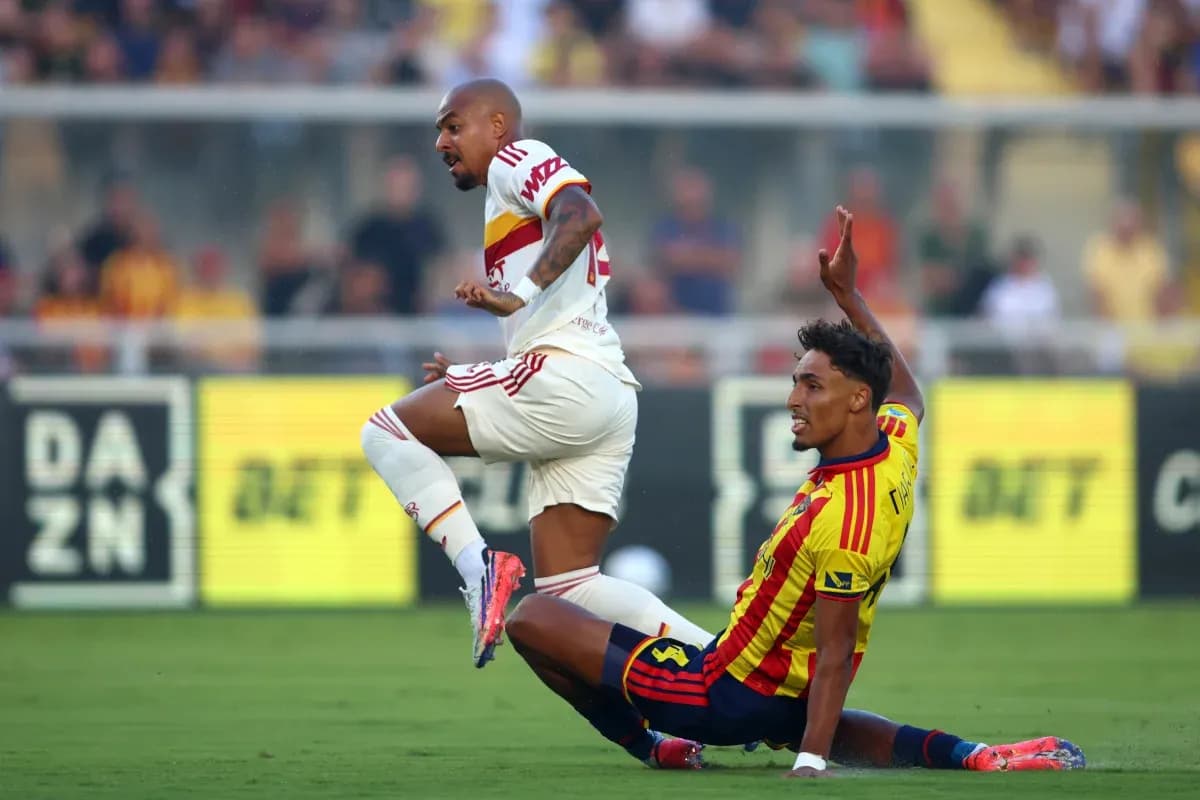
AS Roma Dominates Lecce in Tactical Masterclass
The Stadio Via del Mare closed on a harsh lesson for Lecce. Under the late-summer light in Lecce, AS Roma arrived as early-season pacesetters and left having underlined exactly why they sit top of Serie A. A 4–0 away win, built on a ruthless first half, turned this “Regular Season - 2” fixture into a tactical demonstration of what a fully formed system looks like against one still finding its shape.
Heading into this game, the table already hinted at the gap. Lecce, 13th with 3 points from 2 matches, had a total goal difference of -2, built on 2 goals for and 4 against overall. At home they had played 1, lost 1, scored 0 and conceded 4; on their travels they had been far more solid, winning their only away match 2–0. Roma arrived as leaders with 6 points from 2 games, 8 goals for and none conceded overall – a total goal difference of +8 – perfectly split between home and away: 4–0 at home, 4–0 away.
I. The Big Picture – Systems Colliding
Eusebio Di Francesco doubled down on structural boldness, rolling out a 3-5-2 for Lecce. Wladimiro Falcone sat behind a back three of Jannik Siebert, Kiko Gaspar and Tiago Gabriel. The midfield band of five – D. Veiga, L. Coulibaly, O. Ngom, O. Gorter and C. Ndaba – was asked to do everything at once: protect the central lanes, press Roma’s build-up, and provide service to the front two of S. Pierotti and W. Geubbels.
Across from them, Piero Gasperini Gian’s Roma were fully committed to their 3-4-2-1, a shape that has already become their early-season identity. Mile Svilar anchored a back three of D. Ghilardi, Gianluca Mancini and Mario Hermoso. The wing-and-engine quartet of E. Lulli, M. Koné, Bryan Cristante and Wesley Franca formed the platform, with Paulo Dybala and Matías Soulé floating behind Donyell Malen as the lone striker.
Roma’s seasonal DNA is clear from the numbers. Overall they average 4.0 goals for per game both at home and on their travels, with 0.0 goals against in either dimension. Two matches, two clean sheets, and both a home 4–0 and an away 4–0 already in the books. Lecce’s profile is the mirror opposite: overall they average 1.0 goal for per game and 2.0 against; at home they average 0.0 scored and 4.0 conceded, while away they average 2.0 scored and 0.0 conceded. This is a side that has been brave but brutally exposed in front of its own supporters.
II. Tactical Voids – Absences and Discipline
Roma’s dominance is even more striking considering who was missing. L. Pellegrini, M. Bah and D. Rensch were all ruled out of this fixture with thigh, knee and muscle injuries respectively. On paper, that strips Roma of creativity, depth and defensive rotation. In practice, it merely accelerated the responsibility placed on Cristante, Koné and Dybala to run the game’s tempo.
From a disciplinary standpoint, both teams arrived with clear patterns. Lecce’s yellow cards this season have been evenly spread: 25.00% in each of the 0–15, 46–60, 61–75 and 76–90 minute ranges. That distribution suggests a side that struggles to manage transitions and game states, picking up cautions in every phase rather than in one specific storm. Roma, by contrast, have concentrated their yellows in the first hour: 33.33% in 0–15, another 33.33% in 31–45, and 33.33% in 46–60. This is an aggressive, front-foot team that sets its physical tone early, then manages the game thereafter.
No red cards or penalties – scored or missed – have defined either side’s campaign so far, leaving this match to be decided purely in open play and structural superiority.
III. Key Matchups – Hunter vs Shield, Engine Room Battles
The headline duel was always going to be Donyell Malen against Lecce’s back three. Malen came into the round as Serie A’s top scorer, with 5 goals from 2 appearances, 9 shots in total and 6 on target, supported by an 8.75 average rating. His movement in the channels between Gaspar and Tiago Gabriel was the primary “Hunter vs Shield” storyline. Tiago Gabriel himself has been one of Lecce’s early bright spots, with 1 league goal and a 6.9 rating as a defender, winning 4 of 5 duels and making 2 tackles and 2 interceptions. Yet the structural demand on him here – stepping out to track Malen while still holding the line in a back three – was always going to be extreme.
Behind Malen, Dybala and Soulé formed the creative storm. Dybala leads Serie A in assists with 3 in just 2 appearances, backed by 7 key passes and 115 total passes at 84% accuracy. Wesley Franca adds another creative conduit from deeper zones, with 1 assist, 4 key passes and 6 tackles, embodying the dual role of ball-winner and progressive carrier. Together they targeted the spaces around Lecce’s central trio of Coulibaly, Ngom and Gorter.
This is where the “Engine Room” battle tilted decisively. Cristante and Koné are not just passers – Koné has 110 passes at 92% accuracy with 4 key passes, while Cristante’s positional discipline glues Roma’s structure together. Lecce’s midfield, stretched across five lanes, struggled to compress Roma’s central square of Cristante, Koné, Dybala and Soulé. Once that square controlled the ball, the wide midfielders Ndaba and Veiga were constantly being pulled into full-back roles, leaving Pierotti and Geubbels isolated.
On the flanks, Wesley and Lulli repeatedly overloaded Lecce’s wing-backs. With Roma’s back three comfortable in build-up, those wing-backs could push high, pinning Lecce’s wide midfielders and preventing any consistent counter-attacking outlet.
IV. Statistical Prognosis – Roma’s Ruthless Edge
Even without explicit xG values, the pattern is unmistakable. Roma’s overall attacking average of 4.0 goals per game, combined with a defensive record of 0.0 goals conceded both home and away, paints the picture of a side whose xG and xGA profiles will be heavily tilted in their favour. Their clean sheet in Lecce extends a run of 2 clean sheets in 2 matches overall, underpinned by a compact 3-4-2-1 that has yet to be meaningfully disrupted.
Lecce, by contrast, have now failed to score in both of their home halves of the season so far, with 1 home match played, 0 goals for and 4 against. The contrast with their away form – 1 match, 2 goals scored, none conceded – suggests that Di Francesco’s 3-5-2 may be better suited to reactive, counter-attacking setups on their travels than to proactive home control.
Following this result, the trajectories feel stark. Roma look every inch a “Champions League league stage” contender, already comfortable in their structure even with key absentees, and powered by an in-form Malen and a creative Dybala. Lecce, still experimenting between a 4-3-3 and a 3-5-2 across their 2 league lineups, must quickly decide what they want their home identity to be.
For now, this 4–0 in Lecce will be remembered as a tactical masterclass: a well-drilled 3-4-2-1 suffocating a brave but fragile 3-5-2, with Roma’s numbers and patterns suggesting that this is less a hot streak and more the early chapters of a sustained title challenge.