Anfield's Long Goodbye: A Season of Failure and Uncertainty
They sang Bob Marley as the rain came down and the season finally, mercifully, ended. “Every little thing is gonna be alright…” floated out from The Kop, less a declaration of faith than an attempt at self-soothing after a campaign that has stripped Liverpool of its illusions.
This was not a blip. This was a failure.
A flat 1-1 draw with Brentford wrapped up a miserable year that still, somehow, ended with Champions League qualification. It should have felt like a salvage job. It didn’t. The mood was of a club staring into an uncertain future, watching the last pillars of an era walk away.
Mo Salah and Andy Robertson, two of the defining figures of Liverpool’s modern renaissance, are gone. Half of the squad Arne Slot inherited just two years ago has already departed. Several more could follow. The churn is relentless. The sense of continuity that underpinned nine years of major honours has evaporated almost overnight.
For Liverpool supporters of a certain age, the parallels are hard to ignore. They remember Graeme Souness dismantling Kenny Dalglish’s ageing but title-winning squad at speed, then paying with his job as the club slid into a decade of mediocrity. The fear is not just about who has left, but what this all feels like: the end of something, without a convincing beginning in sight.
Salah has felt it too. As his extraordinary nine-year stay closed, he chose not to hide his concerns. He spoke plainly about standards, about expectations, about what Liverpool are supposed to be.
The table tells its own story. Fifth place. Sixty points. Four wins in the last 14 games in all competitions. No trophy. No title challenge. No real moment where Liverpool looked like Liverpool.
Strip away the mitigating factors and the numbers are brutal. Sixty points, in most seasons, doesn’t get you near the Champions League. Last year it would have put Liverpool ninth. The year before, seventh. Three years ago, ninth again. This is the lowest points total to secure Champions League football since 2003/04, the season Gerard Houllier’s time ended with a carefully choreographed farewell on the Anfield pitch.
There was no such warmth around Slot as this season drew to a close.
A Coach Apart
This was his moment to step forward. To acknowledge the fans who had watched the club post its lowest league win total in a decade – just 17 victories. To show he understood the bond between team and terrace that defines Liverpool more than any tactical blueprint.
Instead, he stayed seated.
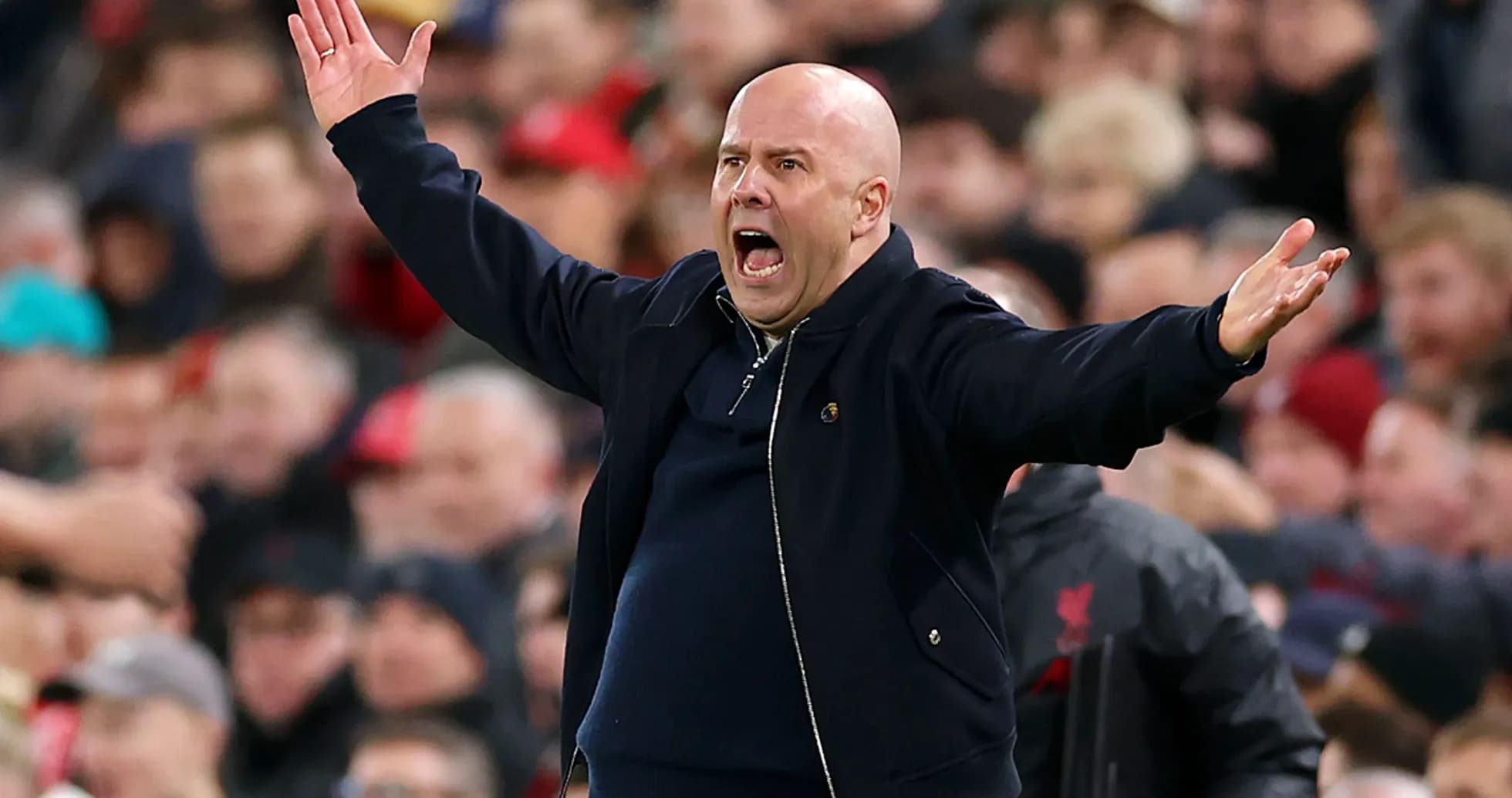
While the players walked the pitch in the traditional lap of appreciation, Slot remained on the bench, looking distant, almost detached. Perhaps it was nothing more than a man deep in thought. Perhaps he wanted to give the departing players their stage. But for a fanbase already unsure about him, the optics were awful.
This club lives on connection. Jurgen Klopp understood that instinctively. Salah showed he still does, telling Sky Sports: “They [the fans] don’t care that much about the result as long as you sweat and give your blood here, they’ll love you forever.”
It was a pointed reminder. Liverpool supporters will tolerate bad days. They will not tolerate feeling taken for granted.
His message was clear: show up, give everything, walk through the storm together. The storm this season has been real and raw, shaped in part by the tragedy of Diogo Jota’s death in pre-season. The emotional weight of that loss hung over everything. But even within that context, Liverpool’s football fell well short of what this club demands.
Injuries, Choices and a Shrinking Squad
Slot’s own assessment of the season came down to a single word.
“Injury,” he said, when asked to sum it up.
On the surface, it is a fair frustration. Liverpool did suffer. Key players missed chunks of the campaign. The squad looked stretched, especially when the games piled up midweek and weekend.
But the manager’s own words from October hang over that argument.
“This is a decision we have made together,” Slot said then, when asked about squad size. “I completely believe in this, because if you have 25 [players] it’s very hard to manage your squad.”
He wanted a smaller group. He got it. And then he spent much of the season pointing to its limitations.
You cannot, with any credibility, argue for a lean squad and then lament that you lack options when injuries hit, when players can’t handle the load of midweek and weekend football, when you repeatedly concede late goals because legs and minds are gone.
The expanded Champions League, the intensity of the Premier League, the physical demands of modern football – they all scream for depth. Liverpool went the other way. Worse, they barely used some of the depth they did have.
- Trey Nyoni, an 18-year-old midfielder who made his debut under Klopp at 16 and is widely regarded as one of the club’s brightest prospects, played just 21 league minutes.
- Federico Chiesa, sidelined again, managed only 318 league minutes.
- Wataru Endo, signed as an experienced option, featured for just 170 league minutes.
- Kieran Morrison, captain and standout of the Under-21s, made the bench 13 times. He played five minutes of first-team football, in an FA Cup tie at Wolves.
On paper, Liverpool had more bodies than the manager trusted. In reality, the squad was even smaller than it looked. That was Slot’s choice as much as it was his misfortune.
Then there was the Harvey Elliott situation. No agreement was reached to bring him back to Anfield in January, even as the second half of the season unfolded with Liverpool crying out for quality from the bench. It bordered on farce.
When Slot says “injury” defined the year, many will nod. But many will also ask why Liverpool went into a brutal schedule with a squad deliberately kept thin, and then used even less of it than they could.
Heavy Defeats, Heavier Standards
Slot has tried to frame the manner of Liverpool’s exits from the cups as understandable. Lose 4-0 to Manchester City in the FA Cup? They went on to win it. Go out 4-0 on aggregate to PSG in the Champions League? No one has beaten them over two legs in Europe for two seasons.
Those are facts. They are not comfort.
This is a club that measures itself by different standards. Liverpool do not look kindly on heavy defeats, no matter the opponent, no matter the stage. Not Salah. Not Virgil van Dijk. Not Robertson. Not Curtis Jones. All have spoken, in their own way, about a season that fell below what is required.
“Being in Liverpool, winning something for Liverpool and winning games is the best thing that could happen to you all,” Salah told his teammates on his final day at the AXA Training Centre. It was both a farewell and a warning. This is not a place where simply turning up and qualifying for the Champions League is enough.
Slot tried to position this as “our lowest base,” noting that Chelsea and Tottenham, “big clubs,” have missed out on Europe altogether this season. For some supporters, that line landed badly. It sounded like a softening of ambition, a recalibration of what counts as acceptable.
Liverpool should be hunting trophies, not hiding behind the failures of others. Exiting competitions 4-0, in the middle of a run of four defeats in five, will never be dressed up as progress here.
Even the season’s longest unbeaten run – 13 games after the 4-1 humiliation at home to PSV, arguably the nadir of the campaign – felt like a mirage. The sequence included draws with Leeds (twice), Burnley and Fulham. Seven wins came, but two were against Barnsley in the FA Cup and a West Ham side that would later be relegated. The numbers looked tidy. The performances did not.
A Summer of Transition – and Turmoil
The word “transition” has become a constant at Anfield. Slot has already warned of another summer of change, though he insists it will not be as “drastic” as last year.
On paper, that sounds reassuring. In reality, it looks anything but.
The uncertainty runs from the dugout to the boardroom. Slot himself has only one year left on his contract. So do Richard Hughes and Michael Edwards, the key decision-makers tasked with reshaping the squad. There is no clear long-term picture, no obvious guarantee that the people making this summer’s calls will be around to live with them.
Then there is the dressing room. Up to nine first-team players could depart if the right offers arrive.
Salah and Robertson are already out the door. Ibrahima Konaté is out of contract. Chiesa and Endo are expected to move on. Curtis Jones, wanted by Inter Milan and with only a year left on his deal, is widely tipped to leave. Alisson has admirers at Juventus. Joe Gomez, another with a year remaining, could be sold. Alexis Mac Allister, one of the few bright spots this season, may also be sacrificed if a huge bid lands.
Strip that list back and the picture is stark. Liverpool are heading into next season with Cody Gakpo as their leading current goalscorer for the club. Van Dijk, a centre-back, is next.
That is not the profile of a side gearing up to challenge for the title. It is the profile of a squad in need of major surgery.
Slot insists the rebuild will be manageable, not radical. The outgoing names suggest otherwise. The departures of Salah and Robertson alone tear out two of the dressing room’s loudest voices and most reliable performers. Add the potential exits of Alisson, Gomez, Jones, Konaté, Mac Allister and others, and you are not just changing a team. You are changing the club’s core.
What Now for Liverpool?
The Kop tried to sing away the anxiety. They always do. “Don’t worry about a thing,” they roared, even as the league table and the team sheet told them exactly the opposite.
They have watched one golden cycle end. They have seen a season in which 60 points and fifth place were dressed up as a base rather than a warning. They have heard their manager lean on injuries and context while the standards they cling to feel like they are slipping out of reach.
Liverpool will be back in the Champions League next season. On paper, that is a platform. In reality, it is a test.
A test of Slot’s ability to reconnect with a restless fanbase. A test of whether the club’s hierarchy can navigate another summer of upheaval without plunging Liverpool into another Souness-style spiral. A test of whether “transition” is a step towards something, or an excuse for drifting away from what this club is supposed to be.
The songs will return in August. The flags will rise. The stadium will believe, because that is what Anfield does.
The question is simple, and unforgiving: will the team – and the manager – be worthy of that faith?