World Cup Last 16: England Faces Mexico in Altitude Challenge
Six days, 16 matches, and half the World Cup field has gone. The tournament has snapped into sharper focus: 32 down to 16, chaos giving way to calculation. But not before Germany were dumped out on penalties by Paraguay, the first true jolt of the knockouts.
Germany went into that tie with roughly a 63% chance of progressing. They are already on a plane home. Paraguay, stubborn and organised, have ripped open one side of the bracket and handed a gift to the teams lurking behind them.
Senegal almost produced a shock of similar scale. They led Belgium and came close to turning a 37% chance into a famous win, only to let it slip. On another night, we would be talking about African resilience reshaping the tournament tree. Instead, Belgium survive, bruised but alive.
Morocco did not need such drama. Their win over the Netherlands might have felt like an upset, but the numbers never truly saw it that way. With the Dutch only around 55% favourites, this was a match on a knife edge from the outset – one of the most finely balanced ties of the round, and it played like it.
At the other end of the spectrum, the so‑called mismatches delivered some of the loudest shocks to the system.
Cape Verde, given just a 10% chance of going through, dragged holders Argentina into extra time and had them sweating. Congo, rated at 17% to progress, led England with a quarter of an hour to go. The favourites survived, but only after being shoved uncomfortably close to the brink.
Familiar faces, unfamiliar outsiders
The last 16 looks, in many ways, like a World Cup we have seen before. Asia is gone. Africa has been cut back to just two representatives. Europe and South America dominate the bracket, as they so often do.
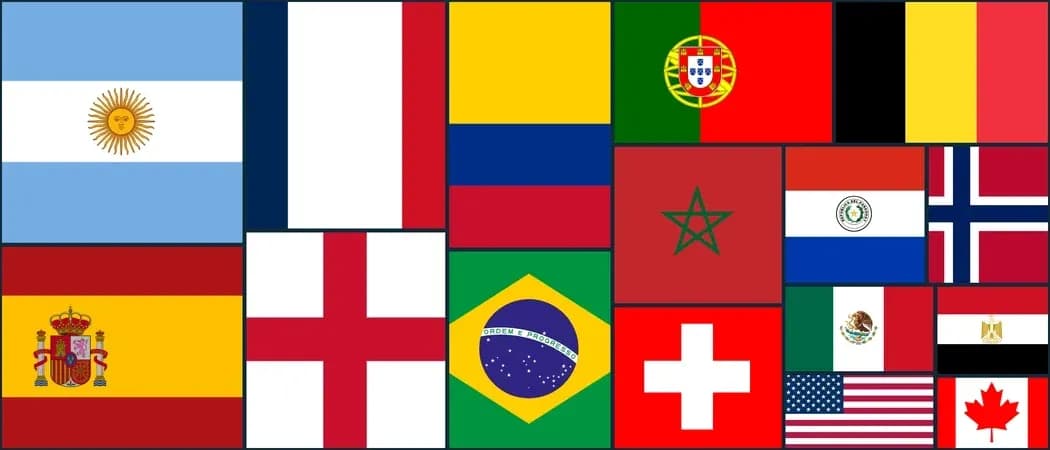
Five nations stand as the outliers: Canada, Egypt, Mexico, Morocco and the United States. All are outside the traditional power base, all are long shots. Put together, their combined chance of lifting the trophy is only about 3.5%. One of them may yet bloody a nose or two, but the numbers say the winner is still most likely to come from the old guard.
Argentina remain at the head of that pack. They survived Cape Verde in extra time, but that scare has taken a small bite out of their overall prospects. Their probability of winning the tournament has dipped to 28%. Not a collapse, but a reminder that even the favourites can be dragged into the mud.
France are the big beneficiaries of Germany’s collapse. Their path has cleared a little, and their title chances have jumped to 14%. Spain’s have climbed to 16%. Both cruised through their last‑16 openers: Spain brushed aside Austria, France did the same to Sweden. One more step taken, one more obstacle cleared.
England sit just behind them on 12%. That rise says as much about the shrinking field as it does about Gareth Southgate’s side. The road ahead is brutal: Brazil and Argentina loom in their half of the draw if they get that far. First, though, comes Mexico – and the altitude.
England, Mexico and the myth of Mexico City
Mexico City. Estadio Azteca. Thin air, thick noise, and a storyline that never dies: altitude.
England face Mexico with the numbers firmly in their favour. Even after accounting for home advantage, the expected goals model gives England 1.6 and Mexico 0.6 – a full goal’s worth of superiority. That translates into a 62% chance of England winning in normal time, 13% for Mexico, and a 25% chance of the match going to penalties.
The debate, of course, is whether altitude tilts that balance.
We are not short of evidence. Thousands of international matches have been played at different heights above sea level. Grouped in 500‑metre bands, the data tell an awkward story for those who insist altitude is a decisive weapon.
At sea level, home teams win about 55% of the time. Roughly a third of all internationals are played within 250 metres of sea level, above or below, so the sample is enormous.
Between 250 and 750 metres, the share of matches is smaller – around 6%, close to 4000 games – but the pattern does not explode in favour of the home side. Even at 2000 to 2250 metres, the band in which Mexico City sits, the home win rate is only 52%. That is actually lower than at sea level.
Raw win percentages, though, do not tell the whole story. You need to strip out team quality.
Here, the Economic Observatory Elo ratings step in. They correlate closely with FIFA’s rankings and track international performance well. Crucially, they give a pre‑match probability of a home win between 0 and 1.
Turn the home result into a 1‑or‑0 outcome, subtract the Elo prediction, and take the average. The result is a simple measure: how often do home teams outperform expectations?
Below about 1750 metres, they do not. Home sides win about as often as their Elo suggests they should. Above that threshold, something changes. Teams at higher altitude – Bolivia above 3000 metres; Ecuador, Ethiopia and Mexico above 2000 – start to overperform.
The gap, even then, is modest. At the very highest altitudes, home teams are winning roughly 20 percentage points more often than the model expects. That sounds significant, but it sits inside the margin of error. It hints at an advantage without proving an overwhelming one.
So what does that mean for England?
It does not point to Mexico enjoying a massive edge. It does not eliminate the possibility of a subtle one either. England have little time to acclimatise. Mexico are used to this air.
If you nudge the model to reflect a plausible altitude effect – knock England’s expected goals down by 0.25, add 0.25 to Mexico – the picture tightens. England’s win probability drops from 62% to 48%, Mexico’s rises to 24%, with the rest again swallowed up by the draw and the lottery of penalties.
Even then, England remain the better side on every available measure, from results‑based models to squad valuation metrics such as Transfermarkt. Altitude drags the gap closer, but it does not flip the tie into a coin toss. England still walk out as favourites. Just not overwhelming ones.
The rest of the bracket: who should go through?
Strip away the noise, feed the team strengths into the simulations, and a clear set of expectations emerges for the remaining last‑16 ties.
- Argentina are projected to beat Egypt 77% of the time.
- England, even with the Mexico City factor, are rated 74% likely to progress past Mexico.
- Morocco, impressive and disciplined, are 70% favourites against Canada.
- Spain, with that smooth, suffocating control, are given a 72% chance of knocking out Portugal.
- Colombia are 70% likely to beat Switzerland.
- Brazil, always lurking in the shadows of any World Cup conversation, are at 69% to eliminate Norway.
- Belgium are 64% favourites against the United States.
Then there is France against Paraguay, the one that makes you pause.
On paper, it looks straightforward: a free‑scoring European heavyweight against a South American side built on defence. The numbers tell a more nuanced story. France’s chance of progressing sits at just 62% – the lowest of any favourite in this round.
Paraguay’s reputation from the group stage holds up under scrutiny. Aside from their opener against the United States, they have been exactly what many expected: compact, disciplined, hard to break down.
The expected goals model underlines the danger. France are projected at only 1.1 expected goals in this match, Paraguay at 0.6. That is not a mismatch; it is a knife fight. For all the attacking flair in Didier Deschamps’ squad, this could be their sternest test so far, and not the formality many assumed when the bracket was drawn.
So the World Cup moves into its next phase with a familiar cast and a few stubborn outsiders. The giants know the route. The numbers sketch the likely path. But as Germany have already discovered, and as England may yet find in the thin air of Mexico City, probability is only ever a guide – never a guarantee.