Egypt's Tactical Supremacy Over Australia in Round of 32
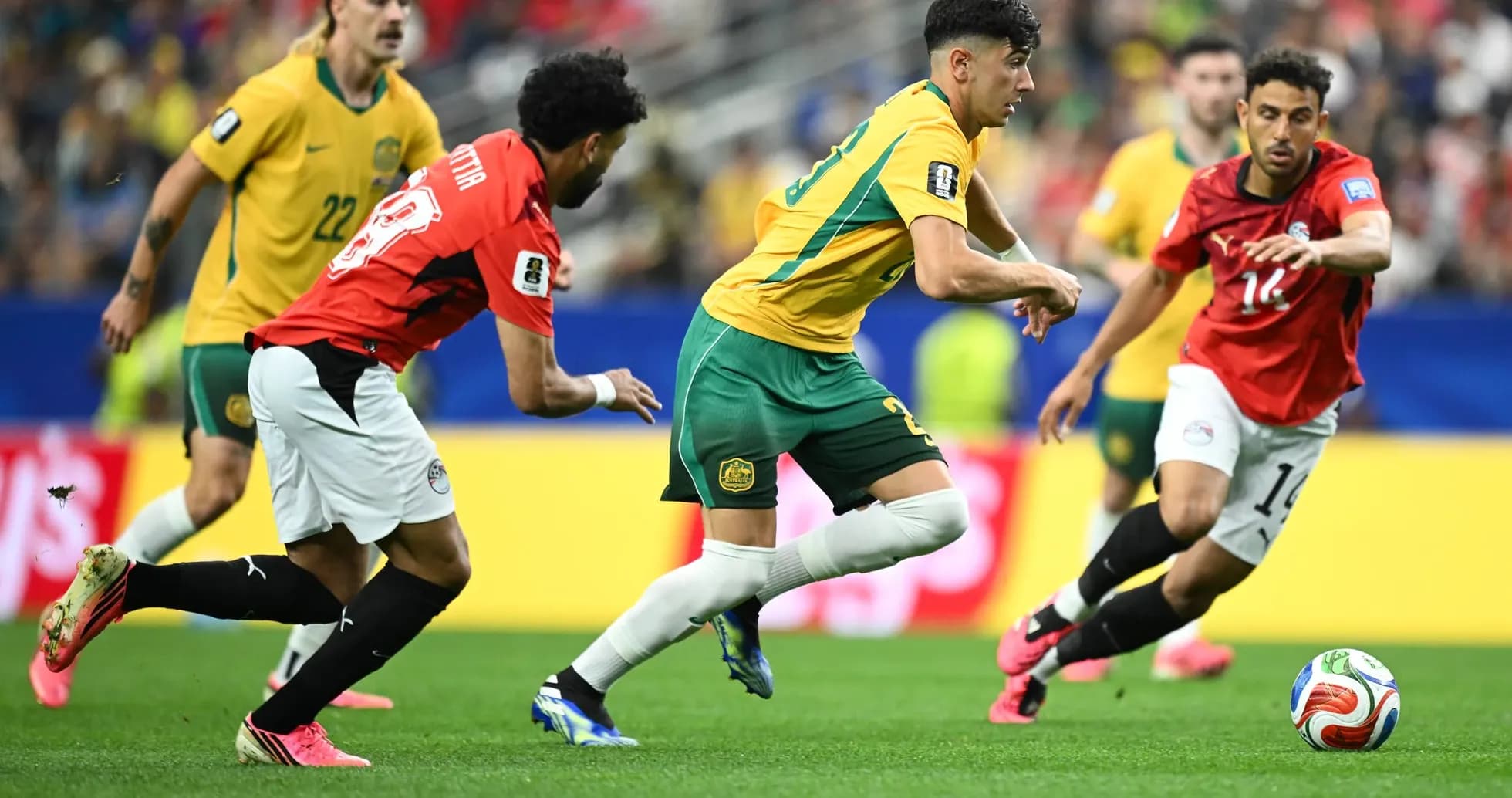
Australia’s Round of 32 exit to Egypt at AT&T Stadium was defined by a clash of structures and game models: Australia’s 3-4-2-1 trying to compress and counter, against Egypt’s 4-4-2 that controlled territory and tempo. Over 120 minutes, Egypt’s superior possession and shot quality (58% of the ball, 14 shots, xG 1.36) gradually bent the match in their favour, even if a 1-1 draw and a 4-2 penalty shootout were required to finish the job.
Egypt’s Structure
Egypt’s 4-4-2 was built on a clear spine. Yasser Ibrahim and Rami Rabia anchored a back four that held a relatively high line, supported by full-backs Mohamed Hany and Karim Hafez stepping aggressively into midfield. In front, Hamdy Fathy and Marwan Attia (later introduced) were tasked with controlling central zones, while Emam Ashour and Omar Marmoush operated from the line of four with license to break lines. Mohamed Salah and Mostafa Ziko led the front pair, offering a vertical threat that Australia’s back three had to constantly track.
Australia’s Approach
In contrast, Tony Popovic’s 3-4-2-1 for Australia was structurally conservative but vertically ambitious. Harry Souttar, Alessandro Circati and Lucas Herrington formed the back three, with Jordan Bos and Aziz Behich as wing-backs. Aiden O’Neill and Jackson Irvine tried to screen and spring the front trio of Cristian Volpato, Connor Metcalfe and Nestory Irankunda. On paper, the system offered a 3v2 advantage against Egypt’s forwards, but in practice Egypt’s wide midfielders turned it into a problem: the Socceroos’ wing-backs were repeatedly pinned deep, and the back three were forced to defend large horizontal spaces.
Statistical Profile
The statistical profile underlines that territorial imbalance. Egypt completed 723 passes to Australia’s 507, with a higher accuracy (614 accurate, 85% versus Australia’s 404 accurate, 80%). That passing dominance allowed Egypt to progress methodically through the thirds, especially down the left where Hafez combined with Marmoush and Ashour. Australia’s 42% possession was largely spent in deeper zones, and while they did create volume (16 total shots to Egypt’s 14), the quality gap is reflected in the xG: 0.87 for Australia against Egypt’s 1.36.
Defensive Strategies
Defensively, Australia’s plan revolved around compactness in a mid-block and heavy commitment to shot suppression. The Socceroos registered 9 blocked shots, a very high figure that speaks to the work of Souttar, Circati and Herrington in protecting the central channel. Egypt, by comparison, had 6 blocks. That Australian back three repeatedly stepped out to confront Salah and Ziko between the lines, forcing Egypt to shoot from imperfect angles or through traffic. The trade-off was clear: Australia ceded territory and possession but tried to keep Egypt’s chances as low-value as possible.
Goalkeeping Performance
In goal, Patrick Beach (Australia) started and later made way for Mathew Ryan in the 119th minute as Popovic prepared specifically for penalties. Across the match, Australia’s goalkeepers combined for 3 saves according to the statistics, which, against 4 Egyptian shots on target, indicates that Egypt’s one regulation-time goal was broadly in line with their on-target output. The goals prevented metric at -0.9 for Australia suggests that, relative to the xG of the efforts on target they faced, their goalkeeping underperformed slightly expectations.
At the other end, Mostafa Shobeir (Egypt) faced far less truly dangerous work. Australia managed just 1 shot on goal from their 16 attempts; Shobeir is credited with 1 save. The rest of Australia’s threat was either off target (6 shots) or smothered by Egypt’s defensive block (9 blocked). Egypt’s goals prevented figure is also -0.9, implying that on the rare occasions Australia generated real danger, the goalkeeper’s contribution was marginally below the statistical expectation, though the defensive line’s ability to block and divert shots meant those moments were infrequent.
Tactical Superiority
Tactically, Egypt’s superiority with the ball was most evident in the distribution of their shots. They produced 8 attempts from inside the box, matching Australia’s 10 but with more control over when and how those situations arose. Egypt’s 7 corners to Australia’s 4 further underline their territorial pressure, with set plays adding a repeatable threat against a back three that already had to manage open-play overloads.
Disciplinary Profile
The disciplinary profile also hints at the tactical tone. Egypt committed 14 fouls to Australia’s 12 and collected both yellow cards of the match, to Haissem Hassan and Yasser Ibrahim, both for “Foul”. This reflects an Egypt side willing to break up transitions and accept tactical fouls to prevent Australia’s counters from turning into clear chances. Australia, despite playing in a more reactive posture, stayed card-free, suggesting that their defensive work was more about structure and interceptions than emergency challenges.
Substitutions
Substitutions were used to adjust the tactical picture rather than transform it. Australia’s changes — including the introductions of Kai Trewin for Jordan Bos, Mohamed Touré for Nestory Irankunda, Ajdin Hrustić for Cristian Volpato, Awer Mabil for Connor Metcalfe, Paul Okon-Engstler for Aiden O’Neill, and finally Mathew Ryan for Patrick Beach — were aimed at refreshing legs in wide and attacking zones and, late on, tailoring for penalties. Egypt’s use of Hossam Abdelmaguid, Haissem Hassan, Mahmoud Trézéguet, Omar Marmoush and Mahmoud Saber, plus the late involvement of Marwan Attia, maintained their 4-4-2 shape while adding fresh pressing energy and dribbling threat on the flanks.
Conclusion
Ultimately, the statistical verdict supports the visual narrative of a match where Egypt’s structure and ball dominance gave them the more coherent attacking platform, while Australia relied on volume, blocks and defensive organisation. Egypt’s higher xG, greater possession, and superior passing metrics framed a performance that, even if forced to penalties, was tactically in control for long stretches. Australia’s resilience and shot blocking kept them alive to the shootout, but the underlying numbers and patterns tilted decisively towards Egypt’s 4-4-2 and its control of the key zones at AT&T Stadium.